In summary:
- Gradual ascent is the single most important, non-negotiable factor in preventing altitude illness.
- Proactive hydration with electrolytes is critical to counter the severe fluid loss in dry, high-altitude air.
- A high-carbohydrate diet is not about comfort; it biochemically improves your body’s oxygen efficiency.
- Pre-trip fitness, particularly high-intensity interval training (HIIT), can pre-condition your body for hypoxic stress.
The vision is clear: sweeping mountain vistas, the crisp alpine air, a sense of profound accomplishment. But for many who live at sea level, this dream is shattered by a throbbing headache, nausea, and debilitating fatigue. This is Acute Mountain Sickness (AMS), and it can turn a long-awaited adventure into a miserable and even dangerous ordeal. The common advice—”go slow,” “drink water”—is a starting point, but it’s often too generic to be truly effective. It treats the symptoms, not the cause.
The true key to a successful high-altitude trek lies not in simply following a vague checklist, but in understanding the specific physiological stresses that altitude places on your body. This is a medical challenge, and it requires a proactive, evidence-based approach. The primary enemy is hypoxia, a lack of sufficient oxygen. Every strategy, from your ascent profile to your diet, must be geared towards helping your body manage this fundamental stressor. It’s about managing your hypoxic load, maintaining metabolic efficiency, and supporting your body’s natural acclimatization process.
This guide moves beyond platitudes. We will dissect the science of acclimatization from a medical standpoint, offering a clear framework for prevention. By understanding the ‘why’ behind each recommendation, you can make informed decisions that will empower you to not just survive, but thrive above 3,000 meters. This is about transforming your approach from reactive fear to proactive management, ensuring your focus remains on the breathtaking scenery, not a splitting headache.
To navigate this complex topic, we will break down the essential components of high-altitude safety. This structured approach will provide a clear, step-by-step understanding of how to prepare for and execute your trek safely.
Summary: A Medical Specialist’s Guide to Preventing Altitude Sickness
- Why Partial Pressure of Oxygen Drops and How Your Body Compensates?
- Climb High, Sleep Low: How to Structure Your Ascent Profile?
- Diamox vs. Natural Pace: Is It Better to Medicate or Go Slow?
- The Dry Air Factor: Why You Lose More Water at Altitude?
- Carbohydrates at Height: Why You Need More Sugar Up High?
- Why Intensity Triggers Adaptations Faster Than Duration?
- Hydration in the Cold: Why You Dehydrate Faster When You Don’t Feel Thirsty?
- Wilderness Risk Management: How to Plan Adventures in Uncontrolled Environments?
Why Partial Pressure of Oxygen Drops and How Your Body Compensates?
The percentage of oxygen in the air—roughly 21%—remains constant regardless of altitude. The problem is not the percentage, but the pressure. As you ascend, barometric pressure decreases, meaning the air molecules, including oxygen, are spread further apart. This reduces the “partial pressure” of inspired oxygen (PiO2). The result is that with every breath you take, you are inhaling fewer oxygen molecules. In fact, at 3,050m (10,000 ft), inspired oxygen is only 69% of what you would get at sea level. This state of reduced oxygen availability is known as hypoxia, the central physiological stressor at altitude.
Your body, an incredible adaptation machine, immediately begins to compensate for this hypoxic load. This is not a single event but a multi-phase process known as acclimatization. Understanding these phases is key to respecting your body’s limits:
- Immediate Response (Minutes to Hours): Your body’s first line of defense is to increase your breathing rate (hyperventilation) and heart rate. This is an attempt to pull more air into the lungs and circulate the available oxygen more quickly. This is a normal and necessary response.
- Short-Term Acclimatization (Days to Weeks): If the hypoxic stress continues, your kidneys are stimulated to produce a hormone called erythropoietin (EPO). EPO signals your bone marrow to manufacture more red blood cells, which are the primary transporters of oxygen in your blood. This process increases your blood’s oxygen-carrying capacity, but it takes several days to a week to become effective.
- Long-Term Adaptations (Months to Years): For those living at high altitude, deeper changes occur, including increased capillary density in muscles and more efficient mitochondria. While not relevant for a short trek, it illustrates the profound extent of the body’s adaptive potential.
Failure to allow adequate time for these short-term adaptations to occur before ascending further is what leads directly to altitude sickness. Your ascent plan must be built around this biological timeline, not your travel itinerary.
Climb High, Sleep Low: How to Structure Your Ascent Profile?
The single most effective and proven strategy for preventing AMS is gradual ascent. This principle is embodied in the mountaineering maxim: “climb high, sleep low.” This practice involves hiking to a new, higher altitude during the day to stimulate acclimatization, and then descending to a lower elevation to sleep. Sleeping at a lower altitude reduces the overall hypoxic load on your body during its critical recovery period, allowing for more effective adaptation and better quality rest. It allows your body to ‘catch up’ with the physiological demands placed on it during the day’s climb.
A properly structured ascent profile is your primary medical plan. While individual responses vary, established guidelines provide a safe starting point. Once you are above 3,000 meters (approx. 10,000 feet), you should not increase your sleeping altitude by more than 300-500 meters (1,000-1,600 feet) per day. Furthermore, it’s crucial to schedule a full rest day—with no additional ascent—for every 1,000 meters gained. This allows your body to consolidate its acclimatization gains. Monitoring your symptoms with a pulse oximeter can provide valuable data, but should never replace listening to your body.

As you can see, tools can help, but the ascent plan itself is paramount. There are different models for structuring this ascent, depending on experience and trip duration. The key is choosing a conservative profile that builds in contingency days.
This table outlines two common ascent strategies. For anyone new to altitude, the Graded Ascent model is the medically recommended approach.
| Ascent Model | Daily Gain | Rest Pattern | Best For |
|---|---|---|---|
| Graded Ascent | 300-400m daily | Rest day every 3-4 days | First-time trekkers, longer expeditions |
| Pulsed Ascent | 500-700m gains | Full rest day after each gain | Experienced trekkers, time-limited trips |
Diamox vs. Natural Pace: Is It Better to Medicate or Go Slow?
Acetazolamide, commonly known as Diamox, is a medication frequently used for the prevention and treatment of AMS. However, it should never be seen as a substitute for gradual ascent. It is a tool for augmenting acclimatization, not for bypassing it. The decision to use Diamox is a medical one that depends on your ascent profile, medical history, and past experiences at altitude. It is not a “magic bullet” and comes with its own set of side effects that must be considered.
The primary mechanism of Diamox is to act as a diuretic and to inhibit the enzyme carbonic anhydrase. This action induces a mild metabolic acidosis (a slight decrease in blood pH). As the Wilderness Medicine Society explains, this has a very specific benefit for acclimatization. Their clinical guidelines note that Diamox works by stimulating breathing, especially at night. This increased respiratory drive helps to counteract the periodic breathing patterns that often disrupt sleep at altitude, leading to better rest and improved oxygenation during the crucial recovery period.
Diamox works primarily by inducing metabolic acidosis, which stimulates breathing, especially at night, thereby improving sleep quality and reducing periodic breathing.
– Wilderness Medicine Society, Clinical Practice Guidelines for Prevention and Treatment of Acute Altitude Illness
The fundamental choice is not between medication and a slow pace; a slow pace is always mandatory. The choice is whether to supplement a slow pace with medication. This decision requires a careful risk-benefit analysis. A natural, unmedicated pace is always preferable if the itinerary allows for it. Diamox is most appropriate for situations where a rapid ascent is unavoidable (e.g., flying directly to a high-altitude city like Cusco or Leh) or for individuals with a known history of severe AMS despite a slow ascent.
Your Decision Framework for Using Diamox
- History Check: Have you experienced moderate to severe AMS on previous high-altitude trips, even with a conservative ascent?
- Ascent Profile Assessment: Is your itinerary forced or rapid, such as flying directly to an altitude above 3,000m with limited time for acclimatization?
- Medical History Review: Do you have any contraindications, most notably a sulfa allergy, or severe kidney or liver disease? Consult your physician.
- Side Effect Tolerance: Are you prepared to manage potential side effects, such as tingling in fingers/toes (paresthesia), frequent urination, and altered taste?
- Alternative Considerations: Have you discussed alternatives like ibuprofen with your doctor? It can be effective for preventing the headache associated with AMS but does not aid acclimatization in the same way.
The Dry Air Factor: Why You Lose More Water at Altitude?
Dehydration is a significant and often underestimated risk at high altitude, and it can both mimic and exacerbate the symptoms of AMS. The environment itself actively conspires to dehydrate you. The air at altitude is extremely dry, meaning the humidity is very low. This creates a steep moisture gradient between the saturated air in your lungs and the dry ambient air. With every breath you exhale, you lose a significant amount of water vapor—a process known as insensible respiratory water loss. This is compounded by the increased breathing rate (hyperventilation) your body uses to compensate for hypoxia. You are breathing more often and losing more water with each breath.
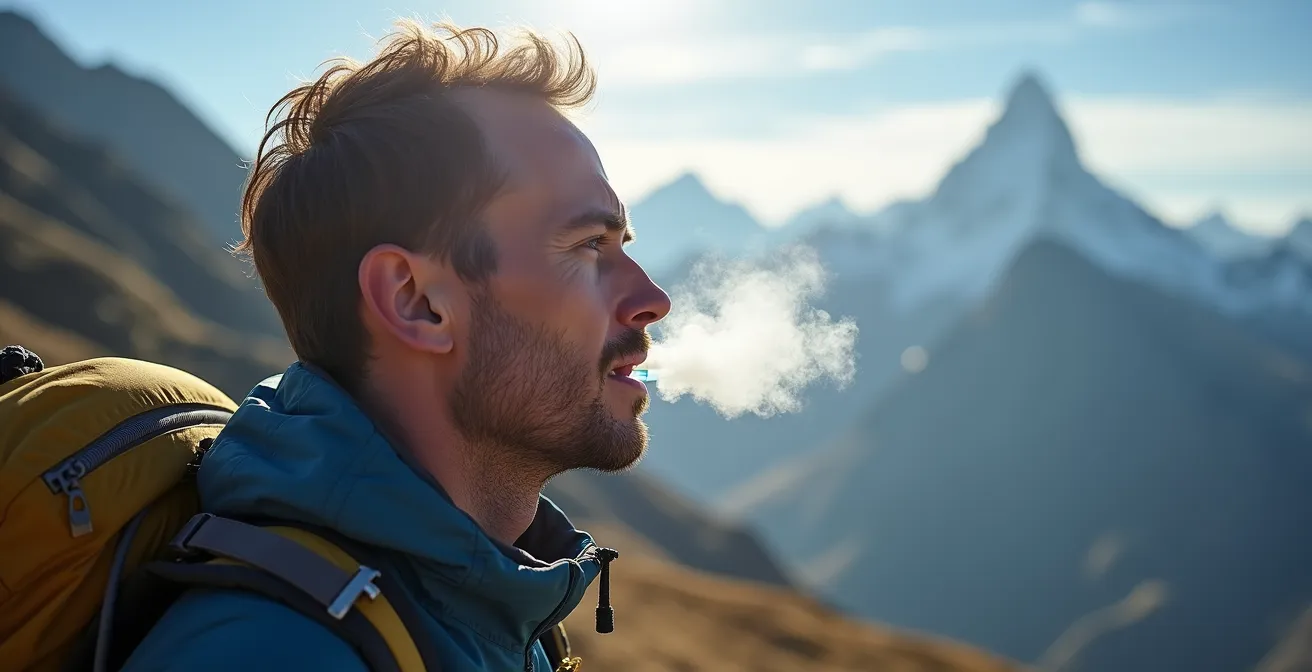
The physical exertion of trekking also contributes through sweat, even if it evaporates so quickly in the dry air that you don’t feel “sweaty.” The combination of these factors means your daily fluid requirements skyrocket. While sea-level recommendations are around 2-3 liters per day, at high altitude, health experts recommend drinking up to 7 liters per day depending on exertion and altitude. The goal is to maintain a copious output of pale, clear urine.
However, the advice to simply “drink more water” is dangerously incomplete. Aggressive hydration without adequate electrolyte replacement can lead to a serious condition called exercise-associated hyponatremia (low sodium in the blood), whose symptoms—headache, nausea, fatigue—can be mistaken for AMS.
The Hyponatremia Risk: A Cautionary Tale
Trekkers who diligently follow advice to “drink a ton of water” but fail to replace lost salts can dilute their blood sodium to dangerously low levels. As detailed in case reports from trekking clinics, individuals consuming over 5-6 liters of plain water daily are at high risk. The medically sound recommendation is to use electrolyte supplements or oral rehydration salts in your water. A simple rule of thumb is to monitor your urine: it should be pale yellow, not completely clear like water. This indicates a healthy balance of hydration and electrolyte concentration, preventing the double-threat of dehydration and hyponatremia.
Carbohydrates at Height: Why You Need More Sugar Up High?
A common complaint among high-altitude trekkers is a loss of appetite. Yet, maintaining adequate caloric intake, specifically from carbohydrates, is a cornerstone of successful acclimatization. This is not simply about energy; it’s about metabolic efficiency in a hypoxic environment. Your body can metabolize carbohydrates for energy with less oxygen than it needs to metabolize fats or proteins. This is a crucial biochemical advantage when oxygen is the limiting factor.
The science is clear on this point. While fats are a more calorie-dense fuel source, their metabolism is more oxygen-intensive. In contrast, metabolic research shows that carbohydrates yield more ATP (the body’s energy currency) per molecule of oxygen consumed. By shifting your diet to be approximately 70% carbohydrates, you are effectively making your body’s engine run more efficiently on the limited oxygen available. This spares protein from being used as an energy source, preserving muscle mass, and provides readily available fuel for your brain, which can help mitigate some of the cognitive effects of altitude.
The challenge, of course, is consuming enough calories when you feel nauseous and have no appetite. This requires a strategic approach to eating, prioritizing palatable, easy-to-digest, carbohydrate-rich foods. This is not the time for a low-carb diet; it is the time for pasta, rice, potatoes, bread, and sugary snacks.
Here are some effective strategies for managing appetite and ensuring adequate carbohydrate intake at altitude:
- Focus on Liquid Calories: Soups, broths, hot chocolate, and electrolyte/energy drinks can be easier to stomach than solid food and contribute to hydration.
- Eat Small, Frequent Meals: Instead of three large meals, graze on smaller portions every 2-3 hours to avoid overwhelming your digestive system.
- Pack Familiar Comfort Foods: Bringing some favorite snacks from home can be a powerful psychological tool to encourage eating when unfamiliar local food seems unappetizing.
- Choose High-Calorie Dense Foods: Supplement meals with nuts, dried fruits, chocolate, and energy bars to maximize caloric intake per bite.
- Time Simple Carbs: Use easily digestible simple sugars like energy gels, gummies, or hard candy for immediate energy during steep, demanding sections of the trail.
Why Intensity Triggers Adaptations Faster Than Duration?
Your preparation for a high-altitude trek begins long before you set foot on the trail. A solid fitness base is essential, but not all training is created equal when it comes to pre-acclimatization. While long, slow endurance training builds a great aerobic base, incorporating high-intensity interval training (HIIT) can provide a unique advantage. HIIT involves short bursts of near-maximal effort followed by brief recovery periods. This type of training effectively simulates the hypoxic stress your body will face at altitude.
During a high-intensity interval, your muscles’ demand for oxygen outstrips your cardiovascular system’s ability to supply it, creating a temporary state of localized hypoxia and oxygen debt. Your body is forced to adapt to function in this low-oxygen state. Repeatedly exposing your system to this stress in a controlled training environment can pre-condition your physiological responses. It trains your body to become more efficient at utilizing the oxygen it has, improving your lactate threshold and enhancing mitochondrial function. In essence, you are giving your body a ‘preview’ of the challenges to come.
HIIT Training as a Pre-Acclimatization Tool
Observational studies on athletes preparing for expeditions have shown a correlation between pre-trip HIIT and better acclimatization outcomes. Athletes who incorporated 1-2 HIIT sessions per week in the 4-6 weeks leading up to their trip reported fewer AMS symptoms and demonstrated better performance at altitude. These sessions, which might include hill sprints, cycling intervals, or circuit training, appear to improve the body’s ability to handle the physiological stress of hypoxia, boosting VO2 max and making the entire acclimatization process smoother and faster upon arrival at altitude.
This does not replace the need for gradual ascent on-site, but it does mean you arrive better prepared for the initial shock to your system. A well-rounded training program should include a strong endurance base (long hikes, running) complemented by strategic, high-intensity workouts. This dual approach builds both the physical stamina for long trekking days and the physiological resilience to handle the low-oxygen environment.
Hydration in the Cold: Why You Dehydrate Faster When You Don’t Feel Thirsty?
A dangerous paradox exists at high altitude: the cold, harsh environment actively dehydrates you while simultaneously suppressing your body’s thirst mechanism. This creates a perfect storm for significant, unnoticed fluid loss. We’ve already discussed the major role of respiratory water loss into the dry air, but the cold itself adds another layer of physiological complexity that every high-altitude trekker must understand and manage proactively.
One key mechanism is cold-induced diuresis. When exposed to cold, your body initiates peripheral vasoconstriction, shunting blood away from your extremities (hands, feet) to protect your core temperature. This increase in central blood volume is interpreted by your body as a state of fluid overload. In response, your kidneys reduce the production of anti-diuretic hormone (ADH), signaling them to excrete more fluid. The result is an increased need to urinate, actively depleting your body of water even when you are not drinking excessively.
Compounding this problem is the fact that your thirst response is blunted in cold weather. In a warm environment, thirst is a reliable indicator of dehydration. In the cold, you simply may not feel thirsty even when your body is in a significant state of fluid deficit. Relying on thirst as your cue to drink is a flawed strategy at altitude. You must adopt a disciplined, proactive hydration schedule, drinking consistently throughout the day regardless of whether you feel thirsty or not. Using a hydration bladder with an insulated tube can help by making water easily accessible and preventing it from freezing.
This suppressed thirst, combined with increased fluid loss from breathing and cold-induced diuresis, means you must be vigilant. The risk of dehydration is just as high, if not higher, on a cold mountain pass as it is in a hot desert, but it is far more insidious.
Key Takeaways
- Acclimatization is a biological process, not an itinerary. Your ascent must be slow enough to allow your body to produce more red blood cells.
- Hydration is a science. You must replace fluids lost to dry air and exertion while also supplementing with electrolytes to prevent hyponatremia.
- Carbohydrates are high-octane fuel. They provide the most energy for the least amount of oxygen, making them the most efficient fuel source for a hypoxic body.
Wilderness Risk Management: How to Plan Adventures in Uncontrolled Environments?
Successfully navigating high altitude is the ultimate exercise in wilderness risk management. It requires moving beyond a simple checklist and adopting a holistic, systems-based approach to your personal safety. Your plan is not a single document, but a dynamic strategy that integrates everything we have discussed: your physical conditioning, your ascent profile, your nutrition and hydration plan, and your medical contingencies. The “uncontrolled environment” of the high mountains demands that you control every variable that you possibly can.
Your personal risk management plan begins with an honest self-assessment. What is your prior altitude experience? What is your current level of fitness? How conservative does your ascent profile truly need to be? This assessment informs every subsequent decision. Your plan must be built with redundancy. What happens if you or a team member starts showing symptoms of AMS? Have you built in buffer days in your itinerary to rest or descend? Is your guide trained in recognizing and treating altitude illness? Do you have a clear communication plan and knowledge of evacuation procedures?
This framework forces you to think in terms of “if-then” scenarios. If a headache develops, then we stop, rest, hydrate, and consider a painkiller like ibuprofen. If symptoms worsen or signs of HACE (High-Altitude Cerebral Edema) or HAPE (High-Altitude Pulmonary Edema) appear, then immediate descent is the only acceptable action. Proactive risk management means you have already considered these possibilities and have a clear, pre-determined plan of action.
Ultimately, preventing altitude sickness is about respecting the mountain and your own physiology. It’s about meticulous planning, disciplined execution, and the humility to turn back when your body tells you to. The principles of gradual ascent, proactive hydration, and proper nutrition are not just tips; they are the pillars of a comprehensive safety system that empowers you to adventure responsibly.
Before embarking on any high-altitude expedition, it is imperative to consult with a physician, preferably one with experience in travel or wilderness medicine, to create a personalized medical and acclimatization plan.