Contrary to popular belief, the key to learning snow sports as an adult isn’t being fearless—it’s learning how to fall smart.
- Understanding the physics of relaxation when you fall is the single most effective way to prevent injury.
- Strategic protective gear, like impact shorts and MIPS helmets, acts as a psychological safety net that dramatically accelerates your learning curve.
Recommendation: Your goal should be total control and mastery on gentle green runs before even considering a steeper blue slope.
The thought of strapping your feet to a plank (or two) and sliding down a frozen mountain can be exhilarating. But for many adults, that excitement is quickly overshadowed by a single, paralyzing fear: the fear of a serious injury. You have a job, responsibilities, maybe a family. A broken bone isn’t just a painful inconvenience; it’s a major life disruption. You see kids flying down the slopes without a care in the world and think, “My body just doesn’t bounce back like that anymore.” This is the number one barrier I see with my adult students, and it’s a completely valid concern.
Most advice you’ll find is well-meaning but generic: “take a lesson,” “start slow,” “wear a helmet.” While true, this advice fails to address the core psychological hurdle. It doesn’t explain *how* to manage the very real fear of losing control and getting hurt. The secret isn’t to be brave or to ignore the fear. The secret is to systematically dismantle it by understanding what actually causes injuries and how to build a fortress of confidence around yourself, both mentally and physically.
This guide is designed to do exactly that. We’re going to move beyond the platitudes and dive into the practical mechanics and psychology of learning snow sports safely as an adult. We’ll explore why relaxing is a superpower, how gear can be a mental tool, and why the most common progression path is actually a trap. By the end, you won’t be fearless—you’ll be smart, prepared, and ready to enjoy the mountain with confidence instead of anxiety.
For those who prefer a visual introduction to the basics, the following video from the Professional Ski Instructors of America (PSIA-AASI) is an excellent primer on the fundamental body positions and movements that build a strong foundation for skiing.
In this article, we will build upon these visual basics by exploring the strategies and mindset required to overcome the specific challenges adult beginners face. Let’s break down how to turn fear into a tool for success.
Summary: A Practical Guide to Conquering the Slopes as an Adult
- Why Tensing Up Makes Falls More Dangerous on Ice?
- How to Use Impact Shorts and Wrist Guards to Boost Confidence?
- Skiing vs. Snowboarding: Which Is Harder to Learn but Easier to Master?
- The Blue Run Trap: Why Progressing to Steep Slopes Too Soon Ruins Technique?
- Group Lessons vs. Private Instructor: Which Offers Better ROI for Beginners?
- Why Your Heart Rate Increases Faster When Exercising in Freezing Temps?
- MIPS vs. Standard Helmets: Is the Extra Cost Worth the Brain Protection?
- Carving vs. Skidding: How to Stop Braking and Start Gliding Efficiently?
Why Tensing Up Makes Falls More Dangerous on Ice?
The first instinct when you lose balance is to become rigid. Your arms shoot out, your muscles clench, and you essentially turn your body into a solid, unforgiving plank. This is the single most dangerous thing you can do. Think of it like dropping a glass rod versus a rubber ball; one shatters, the other bounces. When you’re tense, you concentrate all the impact force onto one small point—usually a wrist, shoulder, or hip. When you’re relaxed, your body can absorb and distribute that same force across a larger area, turning a potential fracture into a minor bruise.
This isn’t just theory; it’s a cornerstone of safe snow sports. In fact, an overwhelming 86% of injuries result from self-inflicted falls rather than collisions with other people or objects. This statistic is incredibly empowering because it means your safety is largely within your own control. Learning to fall correctly is more important than learning to turn perfectly in the beginning. Professional organizations like the Professional Ski Instructors of America (PSIA) dedicate significant training time to teaching beginners how to consciously relax into a fall, tuck their chin, and roll with the momentum.
The key is to retrain your brain’s panic response. Instead of fighting the fall, accept it. As you feel yourself starting to go down, take a deep exhale. This simple action forces your muscles to relax. Try to make your body as “small” and “round” as possible, tucking your arms and chin towards your chest. The goal is to land on the fleshy parts of your body—your backside or the side of your thigh—and roll to dissipate the energy. Practicing this on a soft carpet at home can build the muscle memory you need, so when it happens on the snow, your body knows how to react without thinking.
How to Use Impact Shorts and Wrist Guards to Boost Confidence?
While learning to fall correctly is your primary defense, having a physical backup is a game-changer for your mental state. This is where “confidence engineering” comes in. Protective gear like impact shorts and wrist guards isn’t just about physical protection; it’s about psychological armor. They give you permission to fail. When you know a fall will be cushioned rather than jarring, you’re more willing to experiment, lean into your turns, and progress faster. The fear of that one hard, day-ending fall on your tailbone—a common occurrence, as research shows 12% of all snowboarding injuries are tailbone injuries—is massively reduced.
Think of it as an investment in your learning curve. A hesitant skier or snowboarder who spends three days defensively skidding in fear makes far less progress than a confident beginner who falls a dozen times but learns from each one. The cost of a pair of impact shorts is often less than a single day’s lift ticket, yet it can make every day on the mountain more productive and enjoyable.
I fell a couple of times, one of the falls would have ended my day early if I had not been using these shorts. It’s super freeing and really boosts your confidence especially as a beginner if you know that you can fall without it hurting so much.
– Rippl Impact Gear User Review
The return on investment becomes clear when you analyze the cost of hesitation versus the cost of equipment. Hesitation costs you valuable practice time and enjoyment, while the right gear unlocks your ability to learn effectively.
| Investment | Cost | Benefit | Value Return |
|---|---|---|---|
| Impact Shorts | $65-$130 | Reduces fear, accelerates learning curve | Saves 2-3 days of hesitant practice |
| Daily Lift Pass | $150-$250 | One day of skiing | Limited by fear if unprotected |
| Private Lesson | $200-$400 | 2-hour instruction | More effective with confidence boost |
For snowboarders, wrist guards are equally crucial, as the natural tendency is to break a fall with an outstretched hand. For skiers, while less common, they can still provide peace of mind. The goal is to remove as many sources of “what if” anxiety as possible, freeing your mind to focus on the task at hand: learning to glide.
Skiing vs. Snowboarding: Which Is Harder to Learn but Easier to Master?
One of the first big decisions an adult beginner makes is “skis or snowboard?” There’s a common saying in the instructor community that holds true: skiing is easier to learn but harder to master, while snowboarding is harder to learn but easier to master. Understanding this difference is crucial for setting your expectations and managing frustration.
Skiing has a more intuitive starting point. You’re facing forward, your legs are separate, and the basic “pizza” or “wedge” position for controlling speed is relatively easy to grasp on the first day. You’ll likely be linking some basic turns on the bunny hill within a few hours. However, progressing from that skidded wedge turn to elegant, parallel carved turns is a significant technical leap that can take years to perfect.
Snowboarding, on the other hand, presents a steeper initial challenge. Your feet are locked to one board, you stand sideways, and the fundamental skills of balancing on your heel and toe edges can be incredibly frustrating. The first day often involves a lot of falling and getting up. But once you conquer those initial “falling leaf” and C-turn drills—usually within two to three days—the path to becoming a competent intermediate rider is surprisingly fast. Linking smooth S-turns on a snowboard feels more fluid and natural once the basics click.
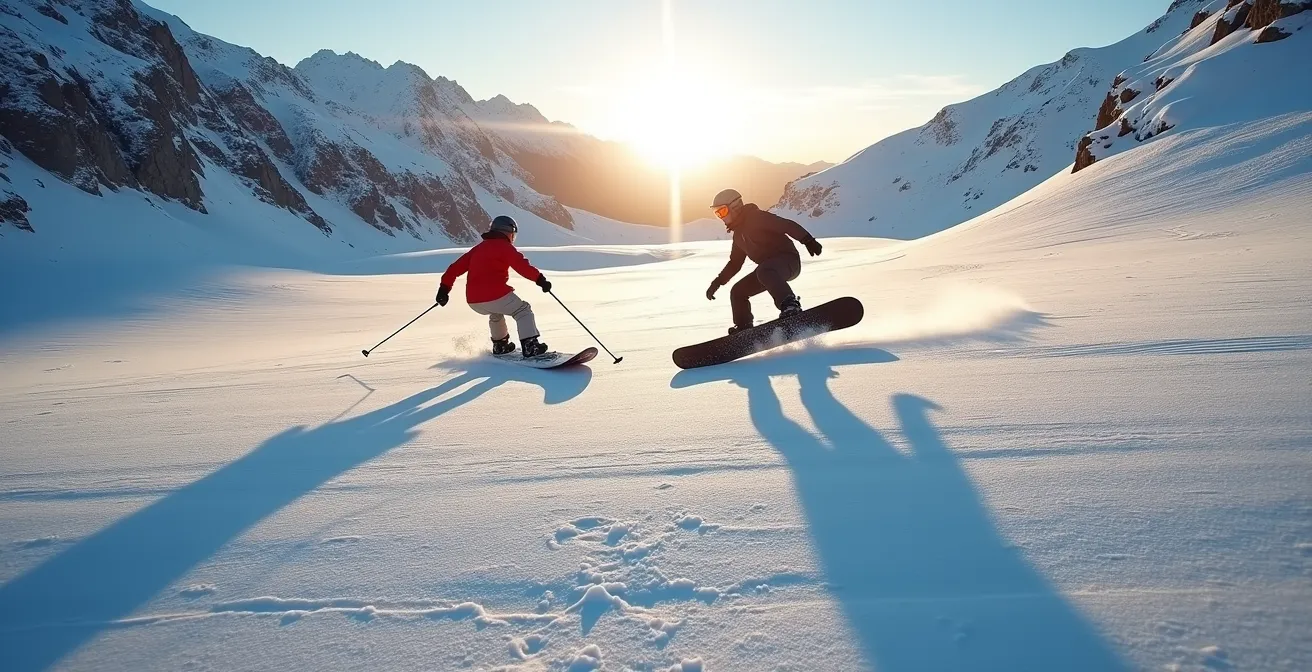
For adults concerned about injury, this choice has implications. The frequent, low-speed falls in the first days of snowboarding can lead to bruised tailbones and wrists (hence the importance of the gear we just discussed). Skiing’s initial falls might be less frequent but can sometimes involve more awkward leg twisting if you’re not careful. There’s no single “safer” option; it comes down to personal preference and which learning curve best suits your personality. Are you willing to endure a tough initial learning period for a quicker path to proficiency (snowboarding), or do you prefer an easier start with a longer road to mastery (skiing)?
The Blue Run Trap: Why Progressing to Steep Slopes Too Soon Ruins Technique?
Once you’ve gained a little confidence on the green “bunny” hills, the temptation is immense. You look up at the mountain, see the blue signs for “intermediate” terrain, and think, “I’m ready for the next step.” This is the single biggest mistake I see adult learners make, and it’s a dangerous one. It’s called the Blue Run Trap. The moment you venture onto a slope that is steeper than your current skill level can handle, you stop learning and start surviving. Your focus shifts from practicing good technique to simply not crashing. You revert to defensive, skidded turns, lean back on your heels, and reinforce bad habits that are incredibly difficult to unlearn later.
Worse, this is where many serious injuries happen. You might feel like you’ve moved beyond the “beginner” zone, but your skills haven’t caught up. You pick up more speed than you’re comfortable with, and a small mistake has much bigger consequences. In a sobering report, National Ski Areas Association data shows the majority of fatal accidents occur on intermediate (blue square) terrain, not on the expert black diamonds. This is because intermediate terrain gives a false sense of security to those whose skills are not yet truly consolidated.
The antidote to the Blue Run Trap is “Intentional Progression.” This means you don’t graduate to a blue run until you have truly mastered the greens. Mastery isn’t just about getting down without falling; it’s about being in complete control. Can you make smooth, rounded turns of different sizes? Can you stop on a dime anywhere, anytime? Can you control your speed using the shape of your turn, not by constantly braking? Before you even think about that blue run, you should be able to confidently check off these skills:
- Complete 10 consecutive, controlled S-turns without defensive skidding.
- Execute a quick, emergency stop from a moderate speed.
- Maintain a consistent, comfortable speed through an entire green run.
- Traverse the slope on both your uphill and downhill edges with balance.
- Link your turns smoothly without your upper body twisting against your legs.
Own the greens. Make them feel easy. Only then are you truly ready for the next challenge. Resisting the lure of the blue run is a mark of a smart, patient learner who prioritizes safety and proper technique over ego.
Group Lessons vs. Private Instructor: Which Offers Better ROI for Beginners?
The advice to “take a lesson” is a given, but the choice between a group setting and a one-on-one private instructor can significantly impact your return on investment (ROI), especially as a fearful adult. A group lesson is budget-friendly and offers a sense of camaraderie; you see others struggling with the same things you are. However, the instructor’s attention is divided among several students, often of varying abilities and fitness levels. The pace is dictated by the slowest learner, and there’s little time to address your specific fears or technical flaws.
A private instructor, while more expensive upfront, offers unparalleled value for the anxious adult. A good private instructor becomes your personal coach and psychologist on the snow. They can tailor the entire lesson to your pace, focus 100% on your body mechanics, and provide immediate, personalized feedback. Most importantly, they can help you “connect the dots” between a feeling (fear, tension) and a technical adjustment (shifting your weight, pressing on your shins). This targeted approach can achieve in two hours what might take two days to accomplish in a group setting.
For the absolute best ROI, I often recommend a hybrid strategy to my students. This approach gives you the best of both worlds and manages the cost effectively.
This table illustrates how a combined approach can optimize your learning journey, providing targeted fear management upfront and cost-effective practice later.
| Lesson Type | Cost | Duration | Confidence ROI | Best For |
|---|---|---|---|---|
| Initial Private | $400-600 | 2 hours | High – personalized fear management | Breaking initial fear barrier |
| Follow-up Group | $150-200 | 3 hours | Medium – peer support | Practice and mileage |
| Total Hybrid | $550-800 | 5+ hours | Optimal | Complete beginner journey |
Start with a half-day private lesson to build that crucial foundation and conquer the initial fear barrier. Your instructor can give you specific drills and a solid technical base. Then, join a group lesson the next day. With your newfound confidence and better fundamentals, you’ll be one of the stronger students in the group, able to get more value from the supervised practice time without feeling left behind or rushed.
Why Your Heart Rate Increases Faster When Exercising in Freezing Temps?
Have you ever noticed that even on a gentle slope, your heart feels like it’s pounding out of your chest? It’s a common experience for beginners, and it’s not just nerves. Your body is working much harder than you think, thanks to a process called vasoconstriction. In cold temperatures, your body’s survival instinct kicks in. To protect your vital organs, it narrows the blood vessels in your extremities—your hands, feet, arms, and legs. This restricts blood flow to keep your core warm.
While this is a brilliant survival mechanism, it means your heart has to pump much harder to push blood through these narrowed vessels to your working muscles. This, combined with the physical exertion of skiing or snowboarding and often the reduced oxygen at higher altitudes, can cause your heart rate to spike surprisingly quickly. Understanding this physiological response is a form of “biomechanical empathy”—it helps you be kinder to yourself. You’re not “out of shape”; your body is simply responding intelligently to the cold.

This elevated heart rate can sometimes be mistaken for panic or anxiety, creating a feedback loop of fear. Recognizing it as a normal physical response allows you to manage it calmly. The key is proactive management. Start by hyper-hydrating before you even hit the slopes; well-hydrated blood flows more easily. A proper warm-up indoors for 5-10 minutes is also essential, as it gradually prepares your cardiovascular system for the shock of the cold.
On the chairlift, practice slow, deep breathing to bring your heart rate down. Don’t push yourself too hard on your first few runs. Give your body time to acclimate. By understanding and respecting this physiological process, you can avoid misinterpreting physical stress as fear, keeping your mind calm and focused on learning.
MIPS vs. Standard Helmets: Is the Extra Cost Worth the Brain Protection?
Wearing a helmet is non-negotiable. Period. The data is clear: helmet use reduces the risk of head injuries by 22-60%. However, not all helmets are created equal. When you’re shopping, you’ll see a significant price difference between standard helmets and those equipped with MIPS (Multi-directional Impact Protection System). For an anxious adult, understanding what that extra cost buys you is critical for peace of mind.
Most falls in snow sports are not straight, direct impacts. They are angled, causing your head to decelerate and rotate rapidly. This rotational force is a primary cause of concussions and more severe brain injuries. A standard helmet is designed and tested for direct, linear impacts, like dropping it straight onto a flat surface. MIPS is a low-friction layer inside the helmet that allows the helmet’s outer shell to rotate 10-15mm relative to your head during an angled impact. This tiny slip redirects and absorbs some of that damaging rotational energy that would otherwise be transferred to your brain.
Case Study: The Limits of Standard Helmets
The National Ski Areas Association (NSAA) reported that in a recent season with 87% helmet usage among skiers and snowboarders, the majority of fatalities still involved individuals who were wearing a helmet. This highlights a crucial point: while standard helmets are effective at preventing skull fractures from direct impacts, the complex, rotational nature of many severe falls requires a more advanced solution. MIPS technology was specifically developed to address this rotational force, which is a key factor in many concussions and traumatic brain injuries that standard helmets may not fully mitigate.
For an adult learner, the extra $40-$80 for a MIPS helmet is one of the wisest investments you can make. It’s an added layer of “what if” protection that directly targets the most dangerous forces in a typical fall. However, the most advanced helmet is useless if it doesn’t fit correctly. An ill-fitting helmet can shift during a fall, rendering its protective features useless. Performing a simple fit test is essential.
Your Essential Helmet Fit “Shake Test”
- Strap It On: Put the helmet on and fasten the chin strap. It should be snug enough that you can only fit one or two fingers between the strap and your chin.
- Side-to-Side Shake: Shake your head vigorously from side to side. The helmet should move with your head, not shift independently by more than an inch.
- Up-and-Down Nod: Nod your head up and down. The front rim of the helmet should not drop down over your eyebrows or slide back to expose your forehead.
- The Yawn Test: Open your mouth wide as if you are yawning. The helmet should pull down slightly on your head. This confirms the chin strap tension is correct.
- Pressure Point Check: Wear the helmet for 5-10 minutes. If you feel any specific pressure points or discomfort, it’s likely the wrong shape or size for your head.
Key Takeaways
- The most critical safety skill is learning to relax and roll into a fall, not bracing for impact.
- Protective gear like impact shorts and MIPS helmets are tools for building psychological confidence, not just physical armor.
- True mastery on gentle green slopes is the prerequisite for safely progressing to steeper blue runs. Avoid the “Blue Run Trap.”
Carving vs. Skidding: How to Stop Braking and Start Gliding Efficiently?
For a beginner, every turn feels like a controlled brake. You push your skis or board sideways, scraping against the snow to scrub off speed. This is skidding. It’s a necessary first step, but it’s fundamentally rooted in a defensive, fear-based mindset. It’s noisy, inefficient, and keeps you in a constant battle with the mountain. The true joy of snow sports, and the point where you trade fear for exhilaration, is when you learn to carve.
Carving is about trust. It’s trusting the design of your equipment. Skis and snowboards have a “sidecut”—they are wider at the tip and tail than in the middle. When you tilt your equipment on its edge and apply pressure, this sidecut naturally wants to bend into an arc and turn for you. A carved turn doesn’t scrape against the snow; it slices cleanly through it, like a knife. It’s quiet, smooth, and incredibly efficient. Instead of fighting gravity, you’re using it to create a graceful, pendulum-like motion across the slope.
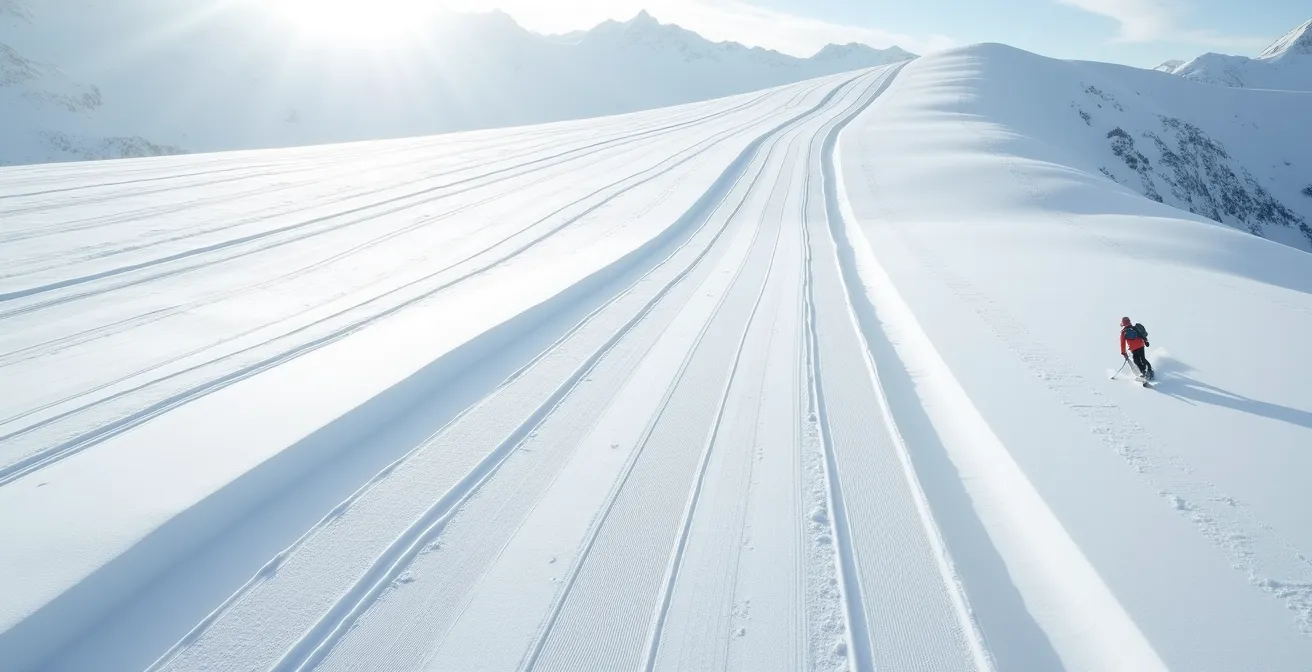
The transition from skidding to carving is the biggest technical and mental leap you’ll make. It requires you to do something that feels counter-intuitive at first: you must lean down the mountain and commit your weight to your downhill edge. For a beginner, this feels like letting go of the brakes. But once you feel the edge “lock in” and guide you through a smooth, stable arc, a lightbulb goes on. You realize that control comes from the edge, not from braking. You discover that you can manage your speed purely by changing the shape and size of your carved turn—a long, wide turn preserves speed, while a short, tight turn naturally slows you down.
This is the ultimate goal for the fearful adult learner. When you are carving, you are no longer a passenger just trying to survive the ride. You are the pilot, fully in command of your line, your speed, and your experience. It’s the moment the fear of “breaking bones” is replaced by the pure, fluid joy of gliding.
Frequently Asked Questions About Learning Snow Sports as an Adult
What is your specific methodology for teaching anxious first-timers?
When vetting an instructor, look for those who emphasize a specific process for fearful adults. They should mention progressive terrain usage (mastering one area before moving on), a strong focus on relaxation techniques and safe-falling drills, and individualized pacing that respects your comfort zone rather than rushing you to steeper slopes to keep up with a group.
How do you balance pushing students with maintaining their comfort zone?
An experienced instructor should be able to describe how they read a student’s body language and verbal cues. They will use frequent check-ins (“How did that feel on a scale of 1-10?”) and focus on building confidence through a series of small, achievable victories. They should never force you to do something that feels terrifying, but rather build a ladder of skills that gets you there confidently.
What percentage of your students are adult beginners with fear issues?
Don’t be afraid to ask this directly. An instructor who regularly works with fearful adults (e.g., 30% or more of their clients) will have developed a specialized patience and a toolbox of specific strategies for this demographic. They’ll understand your concerns on a deeper level than an instructor who primarily teaches fearless children or advanced skiers.