A standard travel insurance policy is a contract designed to limit the insurer’s liability; it is not a blanket safety net for adventurous activities.
- Most policies contain ambiguous “high-risk” activity exclusions and insufficient medical evacuation caps that do not cover point-of-injury rescue.
- Undeclared or improperly managed pre-existing medical conditions, even minor ones, can be used to void an entire claim through causality clauses.
Recommendation: Conduct a formal review of any policy for specific exclusionary language and verify that coverage limits align with the realistic costs of emergency services in your destination. Assume nothing is covered until confirmed in writing.
The assumption that a travel insurance policy purchased alongside a flight or through a credit card provides comprehensive protection is a critical, and often costly, miscalculation. For the adventurous traveler, this assumption represents a significant, unmitigated financial exposure. The belief that “being insured” equates to “being covered” for any eventuality, particularly a catastrophic one like a remote helicopter evacuation, stems from a fundamental misunderstanding of the product. An insurance policy is not a promise of aid; it is a legally binding contract with precisely defined terms, conditions, and, most importantly, exclusions.
While marketing materials may evoke images of carefree exploration, the policy document itself operates on a starkly different principle: risk limitation for the underwriter. The fine print is not an inconvenience; it is the core of the agreement. It delineates the precise circumstances under which the insurer is obligated to act. Standard policies are priced and structured for common travel mishaps—lost luggage, flight cancellations, or medical treatment in an urban hospital. They are fundamentally ill-equipped to handle the logistical complexity and extreme costs associated with emergencies in uncontrolled environments.
This analysis will dissect the contractual framework of travel insurance from a risk assessment perspective. It will move beyond the platitude of “read your policy” and instead provide a methodology for deconstructing it. The objective is to expose the specific clauses, caps, and conditions that render standard policies inadequate for adventure travel. We will examine why the definition of “high-risk” is deliberately vague, how evacuation coverage is often a semantic trap, and why a forgotten knee injury from five years ago can lead to a contractual void, leaving you solely liable for a five-figure rescue bill.
This guide provides a structured examination of the critical contractual elements you must verify before undertaking any remote expedition. The following sections will detail the specific legal and financial traps embedded within standard policies and outline the necessary steps to ensure your insurance is a viable asset, not a worthless liability.
Summary: A Contractual Analysis of Adventure Travel Insurance
- Why ‘High Risk’ Activities Are Often Hidden in Fine Print?
- How to Verify Evacuation Caps for Remote Jungle or Mountain Areas?
- General Travel Insurance vs. Specialist Adventure Policies: Is the Premium Worth It?
- The Medical History Trap: Why Old Knee Injuries Can Void Claims?
- The Communication Protocol: Who to Call First When an Accident Happens?
- Mountain Trekking vs. Coastal Kayaking: Which Trip Suits Beginners Best?
- PLB vs. Satellite Messenger: When to Push the SOS Button?
- Wilderness Risk Management: How to Plan Adventures in Uncontrolled Environments?
Why ‘High Risk’ Activities Are Often Hidden in Fine Print?
The term “high-risk activity” is a cornerstone of an insurer’s strategy to limit liability. It is intentionally left ambiguous in many standard policy documents, allowing the underwriter maximum discretion in claim adjudication. An activity you consider a recreational hobby, such as trekking or kayaking, may be contractually classified as a high-risk exclusion. The insurer is not obligated to provide an exhaustive list of every excluded activity. Instead, they rely on broad, exclusionary language that can be applied retroactively to a wide range of situations. This shifts the burden of proof entirely onto the policyholder to demonstrate that their activity was not, in fact, “high-risk” as defined by the insurer’s internal, and often undisclosed, criteria.
The financial incentive is clear. By maintaining ambiguity, insurers can sell policies to a broad market while retaining the legal mechanism to deny high-cost claims. Shocking as it may seem to the average traveler, recent industry data reveals that 33% of travel insurance claims are denied, with disputes over policy terms and exclusions being a primary cause. The “fine print” is not a secondary component of the contract; it is the primary instrument of risk management for the insurer.
To counter this, a traveler must act as their own underwriter, proactively searching the policy document for specific keywords that signal an exclusion. These terms often relate to equipment, altitude, or the nature of the participation. For example, the mere mention of using “ropes” or a “harness” can automatically trigger an exclusion for rock climbing or mountaineering, even at a beginner level. Similarly, many policies set a surprisingly low altitude limit, often around 2,500 meters, rendering coverage void for many popular mountain treks. Failure to identify and clarify these terms before departure is tantamount to traveling without insurance.
How to Verify Evacuation Caps for Remote Jungle or Mountain Areas?
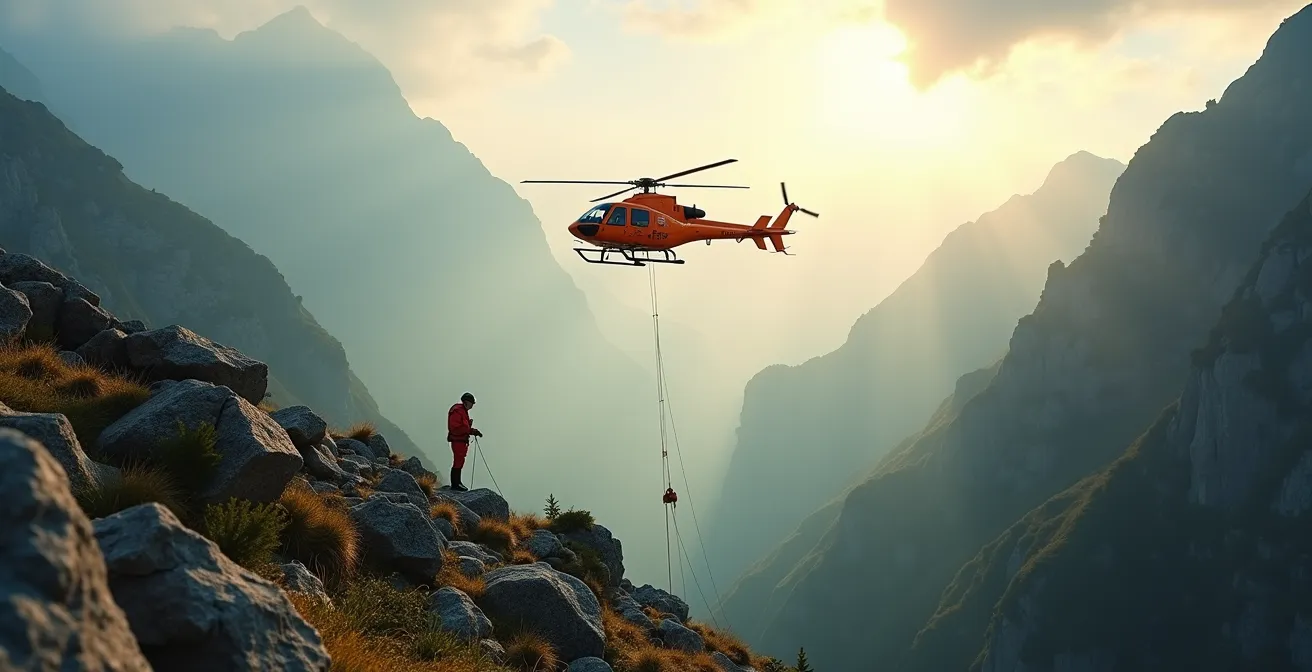
A significant point of failure in standard travel insurance is the misunderstanding between “medical evacuation” and “search and rescue” (SAR). A standard policy typically covers evacuation from one recognized hospital to another, more suitable one (“hospital-to-hospital”). It does not, in most cases, cover the cost of locating you on a remote mountainside and transporting you to the first point of medical care. This initial extraction is classified as SAR, a service often provided by government or private entities and one that is almost universally excluded from basic policies. Your policy might state a $1,000,000 medical evacuation limit, which is contractually irrelevant if the policy does not cover the initial $50,000 helicopter rescue from the “point of injury.”

This distinction is crucial. As the visualization above differentiates, the search phase in an uncontrolled environment and the subsequent transport to a facility are operationally and financially distinct from inter-hospital transfers. In regions like the Himalayas, this gap is exploited. Organized fraud schemes have been documented in Nepal, where rescue missions costing between $4,000 and $12,000 are initiated for minor ailments, with commissions distributed among guides, helicopter companies, and hospitals. An insurer will rightfully deny a claim if it is deemed medically unnecessary or fraudulent, leaving the traveler liable.
Verifying your coverage requires a direct and uncompromising line of questioning with the provider. You must obtain written confirmation answering the following: Does the policy cover evacuation from the point of injury or illness? Is this coverage defined as “search and rescue,” and what is the specific monetary cap for that service, separate from the general medical evacuation limit? Who authorizes the rescue—the insurance company’s assistance line or a local third party? Without clear, documented answers to these questions, any stated evacuation benefit should be considered inapplicable to a wilderness emergency.
General Travel Insurance vs. Specialist Adventure Policies: Is the Premium Worth It?
The distinction between a general travel insurance policy and a specialist adventure policy is not a matter of branding, but of fundamental contractual design. A general policy is built on a foundation of exclusions, designed to indemnify against common, low-cost travel disruptions. A specialist policy, conversely, is built on a foundation of specified inclusions. It is designed to cover the unique and high-cost risks inherent in adventure activities, justifying its higher premium through a drastically different risk model.
The primary value proposition of a specialist policy is the explicit coverage for activities that would otherwise be excluded. These policies replace ambiguous wording with clear schedules of covered activities, often categorized by risk level. More importantly, they address the critical gap in evacuation services. As demonstrated by providers like Redpoint, specialist policies often include “rescue from the point of emergency” as a standard component, not an add-on. This single clause shifts the financial liability for the initial, most expensive part of an emergency—the extraction—from the traveler to the insurer.
While many may balk at the higher cost, the premium must be evaluated against the potential financial exposure. A standard policy that costs $100 but fails to cover a $50,000 helicopter rescue is a 100% loss. A specialist policy that costs $500 and covers that same rescue provides immense value. As Allianz Global Assistance notes, the perception of risk can be skewed. While they state that “some 90 percent of adventure travel is considered soft travel,” the insurance contract does not operate on perceptions. A simple kayaking trip can become a high-cost emergency if it falls under an “unguided watercraft” exclusion in a standard policy. The specialist premium is, in effect, the cost of closing these contractual loopholes.
The Medical History Trap: Why Old Knee Injuries Can Void Claims?
One of the most insidious clauses in any insurance contract is the one pertaining to pre-existing medical conditions. A traveler might assume this only applies to serious, chronic illnesses. This is a dangerous misinterpretation. From a legal standpoint, a pre-existing condition is any ailment for which you have received advice, diagnosis, care, or treatment within a specified “look-back” period before your policy’s start date. This period is a critical detail, as insurance companies typically review a 60-180 day look-back period to establish a medical baseline.
The trap lies in the causality chain. If you suffer an injury during your trip—for instance, a fractured leg while trekking—the claims adjuster will investigate the cause. If they discover you consulted a physiotherapist for knee pain three months prior (within the look-back period) and you did not declare it, they can argue that the knee weakness contributed to the fall. This establishes a causal link, however tenuous, between the undeclared pre-existing condition and the new injury. On this basis, they can legally deny the entire claim, not just the portion related to the knee. The policy is effectively rendered a contractual void.

The onus is on the policyholder to be meticulously transparent. Any condition, no matter how minor or seemingly resolved, that has been treated or has shown symptoms within the look-back period must be declared. This includes conditions managed by stable medication, old injuries that have flared up, or even a consultation for a minor sprain. While some insurers offer a “pre-existing condition waiver” if the policy is purchased within a certain timeframe after the initial trip deposit, this waiver comes with its own strict conditions that must be met. The default legal position is that non-disclosure of a relevant medical fact constitutes a breach of contract, giving the insurer the right to refuse indemnification.
The Communication Protocol: Who to Call First When an Accident Happens?
In the event of a wilderness emergency, instinct may dictate calling local emergency services or a guide for immediate help. From a contractual perspective, this can be a catastrophic error. Your insurance policy is not just a financial instrument; it is a managed service. It includes a non-negotiable protocol for initiating and authorizing any major expense, especially an evacuation. Virtually all policies require that the first or earliest possible call must be to the insurer’s 24/7 emergency assistance line. Failure to do so can be grounds for claim denial.
The rationale is control. The assistance company, which acts on behalf of the insurer, must authorize the service provider (e.g., the helicopter company) and guarantee payment. If you, or a well-meaning guide, authorize a helicopter rescue independently, the insurer can argue that they were not given the opportunity to manage the response, verify the medical necessity, or control the cost. They are within their contractual rights to refuse to reimburse expenses they did not pre-authorize. This places you in the perilous position of having to pay for the rescue upfront and then attempting to reclaim the funds, an often-fruitless endeavor.
The correct procedure must be ingrained as a critical safety step. The emergency assistance number should be saved in multiple accessible locations, including on a physical card, in your phone, and with your emergency contact back home. When the call is made, you must be prepared to provide your policy number, exact location (GPS coordinates if possible), the nature of the emergency, and any local contact information. This call initiates the formal claims process and, more importantly, transfers the logistical and financial coordination of the response to the entity contractually obligated to handle it.
Action Plan: Emergency Communication Pyramid Protocol
- Initiate Local Response: Contact local emergency services or your guide for immediate first aid and to assess the situation, but do NOT authorize evacuation.
- Contact Insurance Assistance: Make the mandatory call to your insurance provider’s 24/7 assistance line to report the incident and request authorization for any further action.
- Liaise with Embassy/Consulate: For severe incidents, inform your country’s consulate for logistical support, communication relays, and legal guidance.
- Inform Your Home Contact: Your designated emergency contact should be notified to act as a secondary coordinator and liaison with the insurance company from a stable location.
- Document Everything: Record all times, names of individuals spoken to, reference numbers provided by the insurer, and details of the incident. This documentation is critical for the formal claim.
Mountain Trekking vs. Coastal Kayaking: Which Trip Suits Beginners Best?
From a risk assessor’s perspective, choosing a beginner-friendly adventure is not about which is “easier,” but about which has a more manageable risk profile and fewer insurance complications. Mountain trekking and coastal kayaking present fundamentally different types of risk, which in turn affect insurance premiums and the feasibility of rescue. A beginner must assess these variables with the same diligence as they would their physical fitness.
Mountain trekking at altitude introduces objective hazards like altitude sickness, severe weather exposure, and falls on steep terrain. The primary insurance complication is the high cost and logistical complexity of evacuation. Rescue is often entirely helicopter-dependent, making it extremely expensive and sensitive to weather conditions. Furthermore, the “bailout options” are limited; once committed to a remote valley, self-evacuation is often impossible. Coastal kayaking, while not without risk, presents a different profile. The primary dangers are drowning, hypothermia, and being overcome by currents. However, rescue is typically managed by a coast guard or marine service, which can be faster and less costly than a high-altitude helicopter. Critically, coastal routes usually offer multiple shore access points, providing more options for self-rescue or bailout if conditions deteriorate.
This comparative analysis is essential for aligning your insurance coverage with your chosen activity. The following table breaks down the key variables from an insurance and risk standpoint.
| Factor | Mountain Trekking | Coastal Kayaking |
|---|---|---|
| Primary Risks | Altitude sickness, falls, weather exposure | Drowning, currents, hypothermia |
| Insurance Cost Impact | Higher premiums above 4,000m | Standard rates for coastal, higher for open water |
| Evacuation Complexity | Helicopter dependent, weather sensitive | Coast guard/boat rescue, generally faster |
| Bailout Options | Limited once committed to route | Multiple shore access points typically available |
| Gear Failure Risk | Lower critical failure impact | High – hull breach or lost paddle creates immediate emergency |
As this comparative risk analysis shows, while a gear failure in kayaking can create an immediate emergency, the overall evacuation framework is often less complex than in mountain environments. For a beginner, an activity with more straightforward rescue logistics and lower insurance premium hurdles, such as coastal kayaking in a well-trafficked area, presents a more manageable entry into adventure travel.
PLB vs. Satellite Messenger: When to Push the SOS Button?
Personal Locator Beacons (PLBs) and satellite messengers are powerful risk management tools, but they are also financial triggers. Activating the SOS function is not a simple call for help; it is the initiation of a potentially large-scale and expensive rescue operation for which you may be held financially liable. The decision to press the button must be based on a strict assessment of “grave and imminent danger,” not discomfort or inconvenience. A wrongful activation can result in a claim denial from your insurer and a direct bill from the rescue service.
The case of a hiker in Bears Ears National Monument is a stark illustration. After breaking his leg, he activated his PLB, leading to a helicopter airlift. The resulting bill was $51,000. While his insurance likely covered a portion, it highlights the immense financial consequence of an SOS activation. The key difference between devices is communication capability. A PLB is a one-way communication device; pressing the button sends a distress signal to a global rescue coordination center via the Cospas-Sarsat satellite system. You cannot provide context or de-escalate the response. A satellite messenger (like a Garmin inReach) allows for two-way texting, enabling you to communicate the nature of your emergency, confirm your need for extraction, or even self-rescue with remote guidance.
The decision framework for activation must be clear. The SOS function is reserved for situations involving a clear risk to life, limb, or eyesight that cannot be mitigated by self-evacuation. A sprained ankle that is painful but allows for slow, assisted walking is not a valid reason. A compound fracture or a rapidly deteriorating medical condition, however, is. For non-critical situations, such as being lost but otherwise safe or having a manageable injury, the two-way communication of a satellite messenger should be used to request assistance or information without triggering a full-scale rescue. Misuse of these devices not only creates personal financial liability but also diverts critical resources from genuine emergencies.
Key takeaways
- A standard insurance policy is a risk-limitation contract for the insurer, not a comprehensive safety net for the traveler.
- Critical coverage gaps exist in standard policies regarding “point-of-injury” rescue, ambiguous activity definitions, and pre-existing condition clauses.
- Verifying coverage requires direct, written confirmation from the provider on specific terms like SAR caps, altitude limits, and the emergency communication protocol.
Wilderness Risk Management: How to Plan Adventures in Uncontrolled Environments?
Effective wilderness risk management is a systematic process that begins long before setting foot on the trail. It is an exercise in foresight that extends beyond packing the right gear; it involves a legal and financial pre-assessment of your trip. From an insurer’s perspective, a well-documented plan is evidence of due diligence, which can be a critical factor in the adjudication of a claim. It demonstrates that an incident was an unforeseen accident, not the result of negligence.
The foundation of this process is a comprehensive trip plan left with a reliable contact who is not on the trip with you. This document should go far beyond a simple itinerary. It must include detailed route information with GPS waypoints, expected timelines, bail-out points, a full list of participants with their medical information and insurance details, and a copy of your gear list. As noted by the experts at Global Rescue, this planning serves a dual purpose. In their “Wilderness Emergency Response Guidelines,” they emphasize that a proper trip plan is not just a safety tool, but evidence of foresight that can support a claim.
A proper trip plan left with a trusted contact is not just a safety tool, but evidence of foresight that can support a claim.
– Global Rescue, Wilderness Emergency Response Guidelines
This proactive approach constitutes the first layer of your personal risk management system. The subsequent layers involve a realistic assessment of your own skills and physical limits, choosing objectives that are well within your capabilities, and establishing clear decision-making criteria for when to turn back. Ultimately, the safest approach to adventure is to possess the skills and judgment to avoid needing a rescue in the first place. The insurance policy should be treated as the final, last-resort safety net, not the primary one. True risk mitigation is achieved through meticulous planning, conservative decision-making, and a profound respect for the uncontrolled nature of the wilderness environment.
To ensure you are adequately protected, the next logical step is to conduct a formal audit of your existing or potential insurance policy against the specific risks of your intended destination and activities. Do not assume coverage; verify it.
Frequently Asked Questions on Adventure Travel Insurance
What if I activate my PLB/InReach SOS but haven’t contacted insurance?
SOS activation triggers a response from international coordination centers, but this does not automatically involve your insurance provider. You or your designated emergency contact must still inform your insurance company simultaneously. Their role is to coordinate payment and logistics, and failure to notify them in a timely manner can lead to claim complications or denial, as they were not involved in authorizing the expense.
Can the helicopter company demand cash upfront?
Yes, this is a common practice in certain regions, particularly Nepal. Helicopter services often operate on a “cash-first” basis and may require a substantial cash deposit or a direct payment guarantee from the insurance company before initiating a flight. This is precisely why pre-authorizing the rescue through your insurer’s assistance line is a non-negotiable step.
What information must I provide to the insurance assistance line?
When you make the emergency call, you must be prepared to provide a minimum set of critical information. This includes your full name and policy number, your precise location (GPS coordinates are ideal), a clear description of the nature of the emergency, contact information for local personnel (like a guide), and the name of any medical facility you are being taken to. Being prepared with this information streamlines the authorization process.