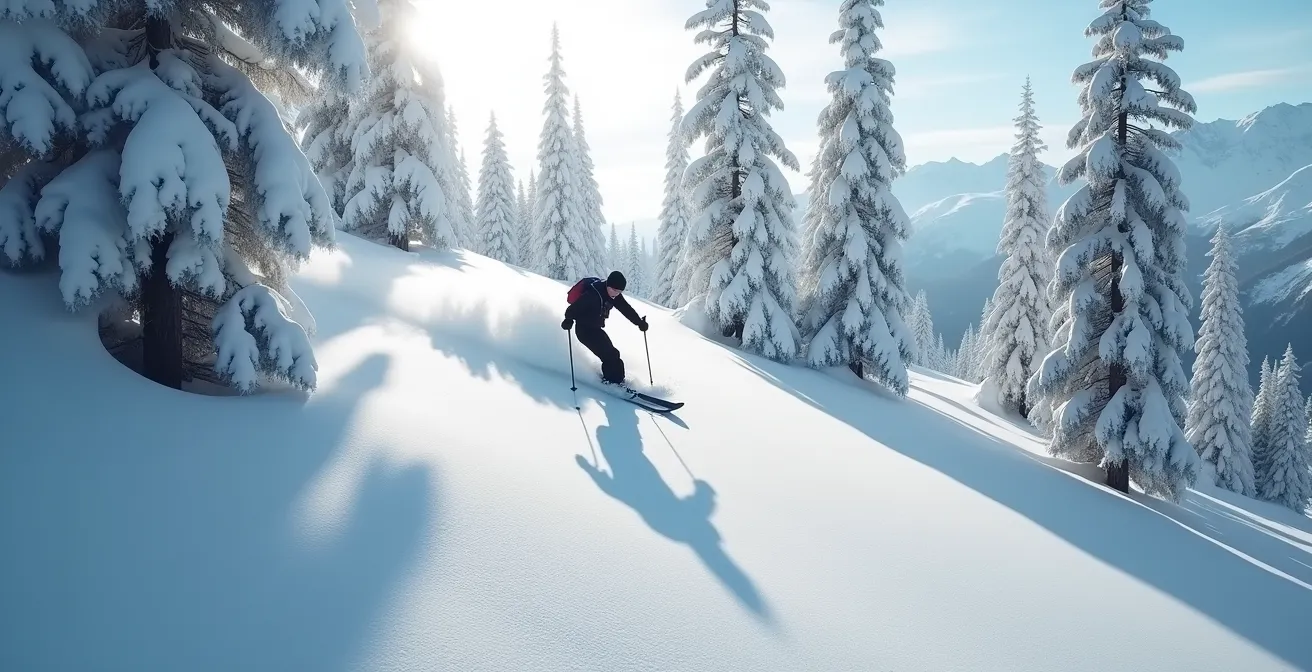
The reason you sink in powder has nothing to do with not leaning back enough—in fact, that common advice is precisely what’s holding you back.
- Flotation comes from a centered stance and using both skis as a single, wide platform, not from desperately trying to lift your tips.
- The engine of powder skiing is a vertical “bounce” (compression and rebound) that creates weightlessness, allowing you to steer effortlessly.
Recommendation: Instead of fighting the snow, start thinking of it as a fluid. Your first goal is to master the rhythmic bounce on a gentle slope; speed and turns will follow naturally.
The feeling is all too familiar for a skier raised on corduroy groomers. The perfect storm delivers a foot of fresh, untracked snow. You push off the lift, heart pounding with anticipation, and immediately plunge your tips, cartwheeling into a soft, cold, and deeply frustrating cloud. You fight to get up, exhaust yourself, and watch as freeriders dance past, seemingly floating on a different substance altogether. You’ve been told to lean back, keep your skis together, and just point them, but every instinct from your hard-pack training screams that this is wrong. And it is.
The transition from skiing on a hard surface to skiing in a fluid medium is the single greatest challenge in a skier’s development. The techniques that give you power and precision on ice—aggressive edging, powerful weight transfer to the outside ski, a forward-driving stance—are the very things that cause you to sink and fail in powder. The problem isn’t your strength or courage; it’s your technique. You are trying to carve a liquid.
This guide dismantles those old habits. We will ignore the flawed “lean back” mantra and focus instead on the real physics of flotation and the biomechanics of control in deep snow. This is about reprogramming your movements to work with the mountain, not against it. We’ll explore the science of why you float, how to generate lift through a rhythmic bounce, why a centered stance is your anchor, and how to manage the unique risks that come with leaving the groomed path behind.
This article provides a structured progression, from understanding the core physics of flotation to mastering the risk management essential for any wilderness adventure. Follow these steps to transform your powder days from a struggle for survival into an expression of freedom.
Summary: Unlocking the Secrets of Deep Powder Skiing
- Why Powder Requires a Larger Surface Area for Flotation?
- How to Use the ‘Bounce’ to Unweight Skis in Heavy Snow?
- Centered Stance vs. Leaning Back: What Really Works in Powder?
- The Tree Well Hazard: Why You Should Never Ski Close to Conifers Alone?
- Getting Up in Deep Snow: How to Use Poles as Anchors?
- How to Commit Weight to the Outside Ski to Initiate Turns?
- Objective Hazards: How to Read Weather Signs Before the Storm Hits?
- Wilderness Risk Management: How to Plan Adventures in Uncontrolled Environments?
Why Powder Requires a Larger Surface Area for Flotation?
The first step to stop sinking is to understand why you float. In deep snow, your skis function less like blades cutting a surface and more like the hull of a boat in water. The primary force keeping you on top is displacement, supplemented by hydrodynamic lift once you gain momentum. Think of it this way: a narrow object sinks in water, while a wide, flat one (like a surfboard) floats. Your skis are the same. By keeping them close together, you effectively create a single, wider platform, maximizing your surface area and, therefore, your ability to displace snow.
But surface area is only half the equation. Speed is the other critical component. The principle of hydrodynamic lift means your flotation capability is directly related to your velocity. In fact, as some skiing physics discussions suggest, float increases with the square of speed, meaning doubling your speed quadruples your lift. This is why expert skiers advise maintaining momentum. They aren’t just being reckless; they are actively using physics to stay afloat. Slowing down or stopping in deep powder is the equivalent of a boat cutting its engine; you lose lift and begin to sink.
The goal is to find the minimum speed required to maintain this lift, a speed that feels comfortable and in control. This “planing speed” allows your skis to rise up through the snow and surf on top of it. Resisting the urge to defensively brake and instead trusting in momentum is a fundamental mental shift from groomer skiing. You must let the skis run to let them work.
How to Use the ‘Bounce’ to Unweight Skis in Heavy Snow?
If speed provides lift, the “bounce” is the engine that provides control and rhythm. In powder, you cannot simply roll your ankles and knees to set an edge. You need to unweight your skis completely to change direction. This is achieved through a rhythmic cycle of compression and rebound. It’s a vertical movement, a dance with gravity and the snowpack itself. You press down into the snow, feel its resistance, and then use that energy to spring back up, becoming momentarily weightless at the peak of the bounce.
This is the magic moment. At the apex of your rebound, when your skis are lightest and almost out of the snow, you can effortlessly pivot them into a new direction. The turn is initiated from your hips and feet while you are unweighted, not by carving. This continuous, porpoise-like motion is the heartbeat of modern powder skiing. It’s proactive, not reactive, and it generates both a feeling of weightlessness and a constant state of readiness to turn.
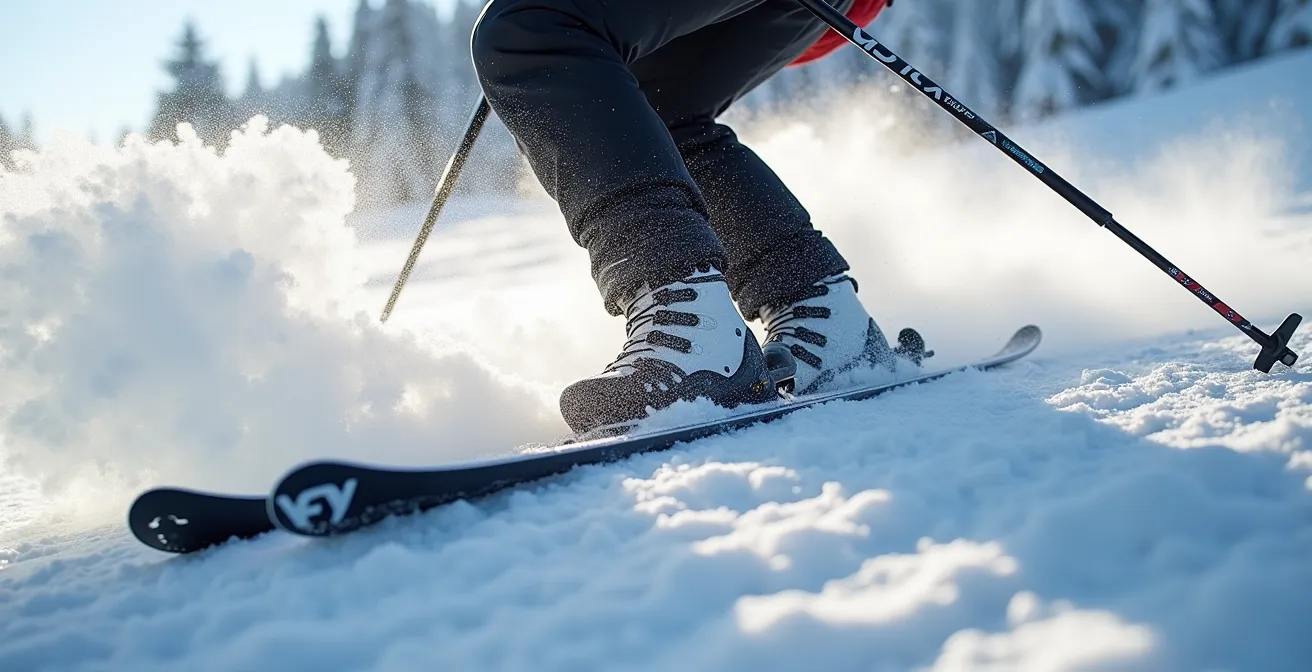
Mastering this movement takes practice. It feels unnatural at first, but it is the key to unlocking effortless turns. Start on a low-angle slope and focus solely on the vertical motion without trying to turn. To develop this essential skill, follow a clear progression:
- Find a gentle pitch with fresh snow and begin straight running to build momentum.
- Actively push your skis deep into the snow with a powerful leg extension until you feel the snow compressing and pushing back.
- When you feel that push-back, immediately pull your knees toward your chest, allowing the compressed snow to rebound you upwards.
- Time your directional change for the exact moment your skis are at their highest and lightest point.
- Add a pole plant at the peak of the bounce to help establish rhythm, timing, and balance for your next turn.
Centered Stance vs. Leaning Back: What Really Works in Powder?
Here we dismantle the most pervasive and damaging myth in powder skiing: the idea that you must lean back. While it seems intuitive to unweight your tips by shifting your weight to your heels, this “backseat” stance destroys your balance, kills your quad muscles, and critically, takes your feet out from under you, robbing you of the ability to steer. Leaning back is a defensive, reactive posture. Powder skiing requires a confident, proactive, and centered stance.
Your goal is to keep your center of mass balanced squarely between your bindings. This allows you to apply pressure through the whole length of the ski, maximizing its planing surface. A centered stance also enables the powerful compression and rebound motions described earlier. You simply cannot “bounce” effectively if you are sitting on the tails of your skis. As Stephen Helfenbein of the PSIA National Demo Team explains in an interview with Ski.com, the focus must shift:
One of the biggest challenges for new powder skiers is overcoming the habit of twisting skis sharply across the hill. Powder skiing is all about control through resistance (flexing and extending), rather than turning.
– Stephen Helfenbein, PSIA National Demo Team
This shift from turning to flexing is impossible from the backseat. Your stance in powder is fundamentally different from that on a groomer. The following table highlights the key adjustments you need to make to your body position.
| Aspect | Groomed Run Stance | Powder Stance |
|---|---|---|
| Weight Distribution | 80% outside ski, 20% inside | 60% outside, 40% inside |
| Stance Width | Hip width or wider | Narrower than hip width |
| Ankle Flex | Moderate forward pressure | Flexed but balanced |
| Center of Mass | Forward over boots | Centered between bindings |
| Edge Angle | High angle for carving | Minimal edge angle |
Embracing a narrower, more balanced stance with two active feet transforms your skis from two independent blades into one unified platform. It’s a subtle but profound change that puts you back in the driver’s seat.
How to Commit Weight to the Outside Ski to Initiate Turns?
On a groomer, you turn by pressuring the outside ski and rolling it onto its edge. In powder, this concept needs a radical reinterpretation. Because you are in a “fluid medium,” aggressive weighting of the outside ski will cause that ski to dive while the inside ski lifts, leading to instability and a fall. Instead, you must think of steering a unified platform. Both skis work together, staying relatively flat and weighted more evenly (a 60/40 or even 55/45 split) to maintain that crucial single planing surface.
Turning, therefore, is not an act of edging but an act of steering. With your skis acting as one board, you use your hips and feet to pivot the entire platform in the new direction. This pivot happens at that weightless moment at the peak of your bounce. The “commitment” is not to the outside ski, but to the direction of the turn itself, using your whole lower body to guide the platform. It’s a smoother, more subtle movement, like steering a rudder in water rather than carving a trench in ice.
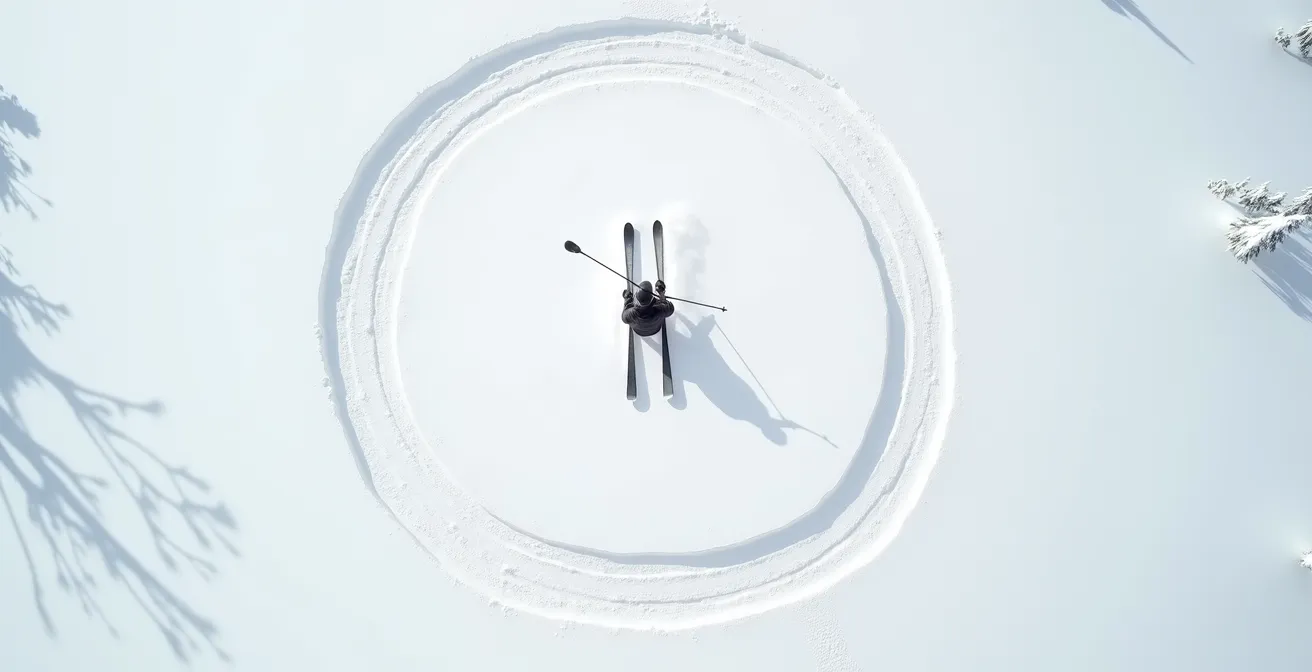
This two-footed steering can feel strange, but you can practice the motion with a series of drills that isolate hip rotation from edging:
- Braquage Drill: On a gentle slope, stand with skis across the fall line. Release your edges and allow the skis to flatten, then use a swift rotation of your hips and feet to pivot 180 degrees so you face the other way.
- Falling Leaf Pattern: Traverse a powder slope, but instead of making full turns, gently steer your unified platform up the hill and then back down toward the fall line, like a leaf falling from a tree. This teaches subtle pressure control.
- Pump and Steer: Combine the vertical bouncing motion with the gentle steering from your hips. At the top of each bounce, initiate a small directional change. Link these together to create a fluid, flowing descent.
This technique is about finesse over force. You are guiding, not commanding. You let the skis float and simply direct them where you want to go at the moment of least resistance.
Getting Up in Deep Snow: How to Use Poles as Anchors?
Even the best skiers fall in powder. The difference is that experts don’t waste energy fighting the snow; they have a methodical system for getting up. Frantically flailing your arms and legs is the worst thing you can do—it just digs you deeper and drains your precious energy. The key is to relax, create a stable platform, and use your equipment intelligently.
The experience of falling in powder is often more embarrassing than painful. A professional instructor on a forum shared this valuable perspective:
I learned to ski powder as an adult, and the best advice I got was to relax and treat powder skiing as playtime. When you fall, don’t panic – it’s more goofy and embarrassing than painful compared to hard surfaces. Make loud whooping noises, laugh a bit, and remember that struggling frantically just makes you sink deeper. Take your time, compact the snow methodically, and you’ll pop right back up.
– Professional Instructor’s Recovery Experience, SkiTalk Forum
This mindset is crucial. Once you’ve taken a breath and had a laugh, follow a structured technique to get back on your feet with minimal effort. It’s a three-phase process that turns a struggle into a simple procedure.
- Phase 1 – Create Your Platform: Before you even think about standing, use your hands and arms to pack down the snow around your hips and torso. You need to create a firm, stable base that won’t collapse when you put weight on it. This is the most important step.
- Phase 2 – H-Pattern Pole Setup: Take your poles and place them together, parallel to each other, on your downhill side. Grip them together in the middle with your downhill hand, creating a wide, stable “H” shape. This bridge provides a large surface area to push against. Do not cross your poles; this creates a pivot point and is unstable.
- Phase 3 – Controlled Rise: Push down on your pole platform with your downhill hand while simultaneously using your uphill hand on your snow platform. The goal is to rotate your hips and bring your skis underneath you, perpendicular to the fall line. Push through your core and rise in a smooth, controlled motion.
Patience is your best friend here. Rushing the process will only lead to a second, more tiring fall. Methodical, calm execution is the fastest way back to skiing.
The Tree Well Hazard: Why You Should Never Ski Close to Conifers Alone?
As you gain confidence in powder and venture into the trees, you graduate to a new level of risk management. The most insidious and often misunderstood danger in treed terrain is not hitting the tree itself, but falling into a tree well. A tree well is a hidden void of deep, unconsolidated snow that forms around the base of a conifer. The tree’s low-hanging branches prevent snow from compacting, creating a dangerous trap that can be many feet deep.
If you fall headfirst into a tree well, the loose snow can quickly collapse around you, making it impossible to breathe or move. This is known as Snow Immersion Suffocation (SIS), and it is a leading cause of fatalities inbounds and in the backcountry. According to data from the Northwest Avalanche Institute, the danger is significant, as tree wells and SIS events account for a staggering portion of skiing fatalities. The cardinal rule of tree skiing is to always ski with a partner and keep them in sight. If your partner disappears, assume they are in a tree well and begin your search immediately.
Your best defense is avoidance, which requires actively looking for the tell-tale signs of these hidden dangers. Being able to recognize a potential tree well from a distance is a critical wilderness skill.
Action Plan: Recognizing Tree Well Hazards
- Observe the Base: Look for the distinct, funnel-shaped depressions of loose snow around the trunks of evergreen trees.
- Check Lower Branches: Identify a lack of snow accumulation on the lower branches, which indicates a void space or “moat” beneath them.
- Spot False Floors: Be wary of areas where snow-laden branches create a fragile “roof” that hides the deep, loose snow underneath.
- Scan for ‘Moats’: Watch for clear circular gaps or trenches that can form between the solid snowpack and the loose snow around the tree trunk.
- Assess Small Trees: Recognize that even small trees with only their tops visible can have deep, hidden wells around their buried trunks.
Treat every conifer on a deep powder day as a potential hazard. Give them a wide berth and always, without exception, rely on the buddy system.
Objective Hazards: How to Read Weather Signs Before the Storm Hits?
Expert freeriders don’t just ski the snow; they ski the conditions. Not all powder is created equal, and your technique must adapt based on temperature, wind, and how long the snow has been on the ground. Understanding these variables before you even click into your bindings is a hallmark of advanced risk management. The “quality” of the powder dictates the speed and force required to ski it effectively.
Case Study: How Temperature Dictates Technique
An analysis by New Generation Ski School highlights how dramatically technique must change with snow temperature. Their instructors found that light, fluffy ‘cold smoke’ powder, typically found at -15°C, requires minimal speed (around 10-15 mph) and a gentle, high-frequency bouncing motion to maintain float. In contrast, heavy, wet ‘Sierra cement’ at -2°C demands aggressive speed (over 20 mph) and deep, powerful compressions to push back against the dense snow and prevent bogging down. Critically, they reported that skiers who failed to adapt their technique to the temperature experienced 80% higher fatigue rates and a much greater frequency of falls.
This shows that reading the weather is not just about deciding what to wear; it’s about anticipating the physical demands of the day. A storm’s evolution also provides crucial clues. The snow you ski in the first hour of a storm is very different from the snow you ski two days later, even on the same slope. An expert skier adapts their approach based on the storm’s timeline.
- Hour 1-6 (During the Storm): The snow is light, unbonded, and offers little resistance. Use a light touch, minimal pressure, and a quick, frequent bounce to stay afloat.
- Hour 6-24 (Settling Period): The snowpack begins to compact under its own weight. It becomes more supportive but also heavier. You’ll need to increase your speed and the power of your compressions to generate rebound.
- Day 2 (Sun-Affected): The sun begins to work on the snow, especially on south-facing slopes. A crust can form, creating highly variable and unpredictable conditions. Seek out sheltered, north-facing aspects and be prepared for sudden changes from soft to hard.
- Day 3+ (Consolidated): The snow is now much denser and heavier. Maximum speed and powerful, rhythmic turns are required to ski it well. This is often called “hero snow” because it’s very supportive, but it demands energy.
By checking the forecast for temperature and timing your runs based on the storm cycle, you move from being a passenger to being a strategist.
Key takeaways
- Your on-piste habits (edging, aggressive weighting) are the primary cause of sinking in deep snow.
- Powder skiing is governed by fluid dynamics; flotation requires a centered stance, speed, and using both skis as a unified platform.
- The “bounce” (compression and rebound) is the engine for turning, providing a moment of weightlessness to pivot your skis.
Wilderness Risk Management: How to Plan Adventures in Uncontrolled Environments?
Mastering powder technique opens the door to the backcountry and uncontrolled environments, where risk management becomes the most important skill you possess. Here, the hazards are objective and unforgiving. Your safety depends not just on how well you ski, but on how well you think. It’s about making smart decisions based on the conditions, the terrain, and a brutally honest assessment of your own energy levels.
One of the most dangerous cognitive traps is complacency on days with “moderate” avalanche risk. Many skiers let their guard down, assuming the danger is low. However, avalanche safety data shows a chilling reality. According to statistics, roughly 80% of backcountry avalanche fatalities occur when the risk level is rated as Level 2 (Moderate) or Level 3 (Considerable). This is because more people venture out on these days, and they often underestimate the potential for isolated but deadly slides. A “moderate” rating doesn’t mean “safe.”
Beyond avalanche awareness, the most overlooked factor in wilderness risk is personal fatigue. As your energy wanes, your technique deteriorates, your reaction time slows, and your decision-making becomes flawed. An expert skier knows when to back off. They proactively match the terrain to their energy level throughout the day, following a mental risk matrix.
| Time of Day | Energy Level | Appropriate Terrain | Risk Factors |
|---|---|---|---|
| 9 AM – First Runs | 100% Fresh | Steeper pitches, trees OK | Overconfidence |
| 12 PM – Midday | 70% Moderate fatigue | Open bowls, moderate pitch | Decreasing reaction time |
| 2 PM – Afternoon | 40% Significant fatigue | Groomed runs only | Decision fatigue, poor form |
| 3 PM+ – Late Day | 20% Exhausted | Download recommended | High accident probability |
True mastery isn’t about charging until you collapse; it’s about knowing when to stop. It’s about ending the day with energy left in the tank, ready for the next adventure. This self-awareness, combined with a deep respect for the mountain’s objective hazards, is the essence of wilderness risk management.
By integrating this layered approach—from physical technique to mental strategy—you are no longer just a skier; you are a true freerider. The next step is to take this knowledge to the snow. Start on a gentle slope, practice the bounce, find your center, and begin the conversation with the mountain. Your journey into the world of powder has just begun.