
The key to longevity in sport isn’t avoiding pain, but learning to accurately interpret its language so you can train with confidence.
- Productive pain (DOMS) is diffuse, symmetrical, and resolves, while injury pain is often sharp, localized, and persists or worsens.
- Systematic self-tests for range of motion and pain symmetry are more reliable than just “listening to your body.”
Recommendation: Instead of guessing, use the diagnostic framework in this guide to make an informed decision on whether to push, modify, or rest.
For any dedicated athlete, there’s a constant internal negotiation. A nagging ache in the shoulder, a persistent twinge in the knee—is this the “good pain” of progress, the microscopic tearing and rebuilding of muscle? Or is it the “bad pain,” a genuine injury signal that, if ignored, could lead to a serious setback? The fear isn’t the discomfort itself; it’s the ambiguity. Stopping training feels like a failure, but pushing through could be a catastrophe. You’ve been told to “listen to your body,” but your body seems to be speaking a language you don’t quite understand.
The common advice often falls short. We categorize pain into simplistic boxes: “soreness is a dull ache,” “injury is a sharp pain.” While a useful starting point, this doesn’t account for the grey areas where most athletic anxiety lives. What about the ache that’s more than sore but not quite sharp? What about fatigue that feels deeper than just muscular? The truth is, distinguishing productive discomfort from a harmful signal requires more than just passive listening; it requires an active, diagnostic approach.
But what if the solution wasn’t to simply stop when you feel pain, but to learn how to methodically test and interpret it? This guide moves beyond the platitudes. It’s designed to give you a sports physiotherapist’s framework for decision-making. We will explore the science of muscle soreness, teach you how to perform basic diagnostic tests on yourself, clarify the non-negotiable red flags, and provide strategies for both systemic recovery and a safe return to training after a minor issue. It’s time to turn that signal-to-noise ratio in your favor and train with intelligence and confidence.
This article provides a clear, structured approach to help you understand what your body is telling you. The following sections will walk you through a complete diagnostic framework, from the science of soreness to practical recovery strategies.
Summary: A Physiotherapist’s Framework for Interpreting Your Body’s Pain Signals
- Why Delayed Onset Muscle Soreness Peaks 48 Hours After Exercise?
- How to Test Range of Motion to Detect Structural Issues?
- Stabbing Pain vs. Aching Burn: Which Requires Immediate Cessation?
- The One-Sided Ache: Why Asymmetrical Pain Is Always a Warning?
- The Pain-Free Rule: How to Grade Exposure After a Minor Tweak?
- Why Central Nervous System Fatigue Hits Harder Than Muscle Soreness?
- The Motivation Trap: Why ‘No Pain No Gain’ Leads to Quitting Within 3 Months
- Recovery Strategies for Amateur Athletes Who Sleep Less Than 7 Hours
Why Delayed Onset Muscle Soreness Peaks 48 Hours After Exercise?
That familiar, satisfying ache that settles into your muscles a day or two after a tough workout is known as Delayed Onset Muscle Soreness (DOMS). It’s the hallmark of effective training, a sign that you’ve pushed your muscles beyond their comfort zone and initiated the process of adaptation. This sensation is caused by microscopic tears in muscle fibers, primarily from eccentric contractions (the lengthening phase of an exercise, like lowering a weight or running downhill). These micro-traumas trigger an inflammatory response, which is the body’s natural healing mechanism.
The “delayed” aspect is crucial. The initial damage doesn’t hurt immediately. The pain you feel later is the result of the cleanup and repair crew—immune cells and fluids—arriving at the site. This process isn’t instantaneous, which is why research confirms that muscle soreness peaks between 24 to 72 hours post-exercise. This timeline is a key characteristic of “good pain.” It has a predictable arc: it appears, it intensifies, and then it gradually subsides over a few days as the muscle rebuilds itself stronger than before.
Understanding this biological process is your first diagnostic tool. Is the pain following this predictable curve? If so, it’s likely DOMS. This process is entirely natural and necessary for muscle growth.

As the image above illustrates, this is a microscopic event. The body is meticulously repairing and reinforcing the tissue. True DOMS feels diffuse, spread across the belly of a muscle group you worked, rather than being a sharp, pinpointed pain. It might make you stiff and tender to the touch, but it shouldn’t involve sharp, stabbing sensations with movement. This is the “noise” of productive training, a feeling you learn to welcome.
How to Test Range of Motion to Detect Structural Issues?
When a pain feels more specific or concerning than general DOMS, your next step is to become a detective. A simple yet powerful diagnostic tool used by physiotherapists is the Range of Motion (ROM) assessment. This helps differentiate between a simple muscle issue (like a strain or severe tightness) and a more worrying joint or structural problem (like a ligament sprain or cartilage issue). You don’t need a formal qualification to perform a basic version on yourself.
The key is to compare two types of movement. First, test your Active Range of Motion (AROM). This is how far you can move a joint using only your own muscles. For example, lifting your arm out to the side as high as you can. Note any pain and the end of your range. Next, if possible and safe, gently assess your Passive Range of Motion (PROM). This involves using an external force (like your other hand, or a strap) to move the joint further through its range. The crucial question is: does the pain or limitation change between these two tests?
If you have a significant limitation or pain during your active movement, but your passive range is much greater and less painful, the issue is likely muscular. Your muscles are either too weak, inhibited by pain, or too tight to complete the motion. However, if your passive range is just as limited and painful as your active range, it raises a red flag for a structural or joint problem. This is because the joint itself, not the muscle, is blocking the movement. This is a clear signal that the issue is not simple soreness.
This comparative test provides concrete data, moving you beyond just “feeling” the pain. The following table breaks down what to look for when performing these simple self-assessments.
| Test Type | Normal Response | Red Flag Response | Potential Issue |
|---|---|---|---|
| Active ROM | Full range without pain | Limited range with pain | Muscle weakness or strain |
| Passive ROM | Greater range than active | Same limitation as active | Joint/structural problem |
| End-feel Test | Soft tissue stretch | Hard/bone-on-bone feeling | Arthritis or bone spurs |
| Bilateral Comparison | Equal ROM both sides | >10° difference | Injury or compensation pattern |
Stabbing Pain vs. Aching Burn: Which Requires Immediate Cessation?
While DOMS is a diffuse ache, “bad” pain often has a very different character. The most important lesson an athlete can learn is to recognize the qualities of pain that serve as non-negotiable stop signs. This isn’t about being overly cautious; it’s about preventing a minor issue from becoming a chronic one. The primary red flag is any pain that can be described as sharp, stabbing, shooting, or radiating. This is your nervous system sending a clear, high-priority alert that something is wrong.
An aching burn in the belly of a muscle during the last few reps of a set is generally a sign of metabolic fatigue—lactic acid buildup—and is part of the training stimulus. In contrast, a sharp pain, especially if it’s near a joint or feels like it’s deep inside, suggests potential damage to tissues that don’t heal as easily as muscle, such as ligaments, tendons, or cartilage. As Dr. Carol Mack, a Doctor of Physical Therapy, states in a GoodRx Health guide on the topic, this type of pain is an unambiguous signal.
Sharp, stabbing, or radiating pain is a clear signal to stop what you’re doing. This type of pain often indicates injury to ligaments, tendons, or joints rather than normal muscle fatigue.
– Dr. Carol Mack, DPT, CSCS, GoodRx Health Guide on DOMS
Think of your pain signals like a traffic light system. A generalized muscle burn is a green light—it’s safe to proceed. A dull, localized ache that stays low on the pain scale (e.g., a 2-3 out of 10) is a yellow light—proceed with caution, modify the load, and monitor closely. However, any sharp or stabbing pain, or any sensation of a “pop” or “click” accompanied by pain, is an immediate red light. Stop the activity, do not push through it. Ignoring this signal is the fastest way to turn a tweak into a tear.
The One-Sided Ache: Why Asymmetrical Pain Is Always a Warning?
Beyond the quality of the pain, its location provides another critical clue. While DOMS is typically symmetrical—if you trained both legs, both legs will likely be sore—pain that appears on only one side of the body during a bilateral movement is one of the most significant warning signs you can receive. This asymmetrical pain is a major red flag that points toward an underlying imbalance, a faulty movement pattern, or the beginning of a stress-related injury.
Think about it: if you’re performing a squat and only your left knee hurts, something is fundamentally different about how your left side is handling the load compared to your right. This could be due to a previous injury that created a compensation pattern, weakness in a key stabilizer muscle (like the gluteus medius), or simply poor technique that you’re not aware of. Your body is incredibly adept at finding the path of least resistance, and that often means an already-stronger or more stable side takes over, placing excessive strain on the weaker or less-stable side.
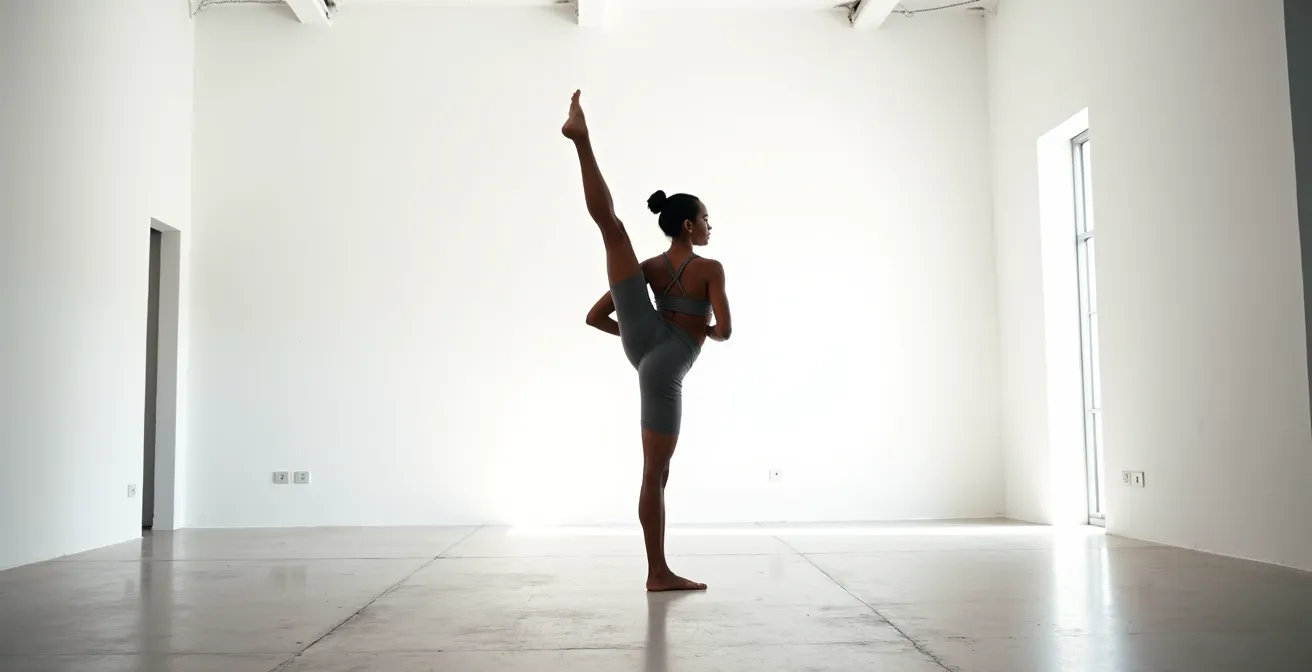
Ignoring this one-sided signal is a gamble. The body is telling you that its system is out of balance. Continuing to load it symmetrically will only reinforce the dysfunctional pattern, further stressing the painful tissue. In fact, physical therapy research shows that unilateral pain can indicate a significantly higher risk of developing a more serious injury. This is not a signal to “power through”; it’s a signal to stop, investigate, and correct. The problem may not even be at the site of the pain; left knee pain, for example, is often caused by a weak right glute.
The Pain-Free Rule: How to Grade Exposure After a Minor Tweak?
So you’ve listened to a red-flag signal and stopped. What now? For a dedicated athlete, the idea of complete rest is often more terrifying than the injury itself. The good news is that for minor tweaks, a “do nothing” approach is rarely the best answer. The modern, evidence-based approach is called Graded Exposure. This involves continuing to move but in a way that respects the healing tissue and does not provoke significant pain, a strategy that prevents de-conditioning and fear-avoidance behaviors.
The guiding principle is the “2/10 Rule.” On a pain scale of 0 (no pain) to 10 (worst imaginable pain), your modified activity should not cause your pain to rise above a 2. If it does, you need to regress the movement further. This allows you to find the “entry point” for safe movement, maintaining tissue load and blood flow, which are crucial for healing, without further irritating the injury. For example, if a barbell squat is an 8/10, you might try a bodyweight squat. If that’s still a 4/10, you might regress to an isometric wall sit, which may be a 1/10. That’s your starting point.
This method keeps you in control and actively participating in your recovery. It shifts the mindset from “I can’t train” to “How can I train today?” Finding a pain-free or pain-managed version of a movement is almost always possible. The following table provides some common regressions for major exercises, giving you a practical blueprint for applying graded exposure. This is your toolkit for staying active while your body heals.
| Original Exercise | Level 1 Regression | Level 2 Regression | Level 3 (Most Basic) |
|---|---|---|---|
| Barbell Back Squat | Goblet Squat | Bodyweight Box Squat | Wall Sit Isometric |
| Running | Incline Walking | Cycling | Pool Walking |
| Push-ups | Incline Push-ups | Wall Push-ups | Chest Squeeze Isometric |
| Deadlift | Romanian Deadlift | Hip Hinge with Stick | Glute Bridge |
Why Central Nervous System Fatigue Hits Harder Than Muscle Soreness?
Sometimes, the feeling of being run down isn’t localized in your muscles at all. You might not be particularly sore, but the weights feel impossibly heavy from the very first rep. You feel irritable, unmotivated, and your coordination is off. This is a sign of Central Nervous System (CNS) fatigue, a distinct and more profound state of exhaustion than simple muscle tiredness. While DOMS is about the “orchestra” (your muscles) being tired, CNS fatigue is when the “conductor” (your brain and spinal cord) is overworked.
This type of fatigue is driven by shifts in neurotransmitter levels in the brain, such as dopamine and serotonin, which regulate motivation, mood, and neural drive to the muscles. It’s the result of accumulated stress, not just from one workout but from a combination of high-intensity training, poor sleep, and external life pressures. Your muscles may be physically recovered, but your brain’s ability to recruit them effectively is diminished. This explains why performance can suddenly plummet even when you don’t feel “sore.”
Recognizing CNS fatigue is crucial because the recovery protocol is different. Pushing through muscle soreness with a lighter session can sometimes be beneficial (active recovery), but pushing through CNS fatigue is counterproductive and can lead to overtraining syndrome. The only cure for a tired nervous system is genuine rest, reduced training intensity, and high-quality sleep. Ignoring these signals means you’re not just risking poor performance, but also a much longer-term burnout. This is your body’s system-wide battery indicator flashing red.
Your Action Plan: Distinguishing CNS from Muscle Fatigue
- CNS Fatigue Signs: Check for apathy or irritability, poor coordination (e.g., stumbling), weights feeling unusually heavy from the first rep, and disrupted sleep patterns.
- Muscle Fatigue Signs: Look for a localized burning sensation during exercise, maintained motivation to train, and soreness that is limited to the specific muscles worked.
- Recovery Protocol: If CNS fatigue symptoms are present, immediately reduce training intensity and volume for at least 1-2 days. Don’t try to “push through.”
- Alternative Training: Focus on low-intensity activities like walking or stretching, or target completely unaffected muscle groups with light work to allow the CNS to recover.
- Sleep Optimization: Prioritize getting 7-9 hours of quality sleep, as this is when neurotransmitter restoration primarily occurs.
The Motivation Trap: Why ‘No Pain No Gain’ Leads to Quitting Within 3 Months
The “no pain, no gain” mantra has been a powerful motivator for generations of athletes, but it’s also a deeply flawed and dangerous philosophy when misinterpreted. It creates a mindset where pain is not just a byproduct of effort but the goal itself. This approach is psychologically unsustainable and is a primary driver of burnout and injury, particularly for those new to intense training. When every session is a battle against debilitating pain, exercise starts to feel like a punishment, not a pursuit.
The neuroscience behind this is clear. As pain science educator Professor Lorimer Moseley explains, the brain’s job is to protect you, and it interprets pain as a threat signal. The “no pain, no gain” approach constantly elevates this threat level without a proportional sense of reward or safety. Eventually, the brain learns to associate the entire activity of exercise with danger and threat, leading to fear-avoidance behaviors. You start making excuses not to go to the gym because, subconsciously, your brain is trying to protect you from what it perceives as a recurring source of harm.
Pain is a threat signal to the brain. The ‘No Pain No Gain’ approach constantly elevates this threat without proportional reward, leading to fear-avoidance behaviors around exercise.
– Professor Lorimer Moseley, Tame the Beast Pain Education
This isn’t just theory; it’s reflected in adherence rates. While specific numbers vary, research on exercise psychology shows that programs built on excessive pain and exertion often see a significant drop-off within the first few months. The initial motivation fades, replaced by dread. The sustainable path lies in “smart pain”—the productive, manageable soreness of DOMS—not in the “stupid pain” of constantly pushing your body to its breaking point. True progress is built on consistency, and you can’t be consistent if you’re always injured or dreading your next workout.
Key Takeaways
- “Good pain” (DOMS) is diffuse, symmetrical, and follows a predictable 48-hour peak, while “bad pain” is sharp, localized, or one-sided.
- Systematic self-assessment of Range of Motion (AROM vs. PROM) can help distinguish between a muscle issue and a more serious joint problem.
- Asymmetrical pain is a critical warning sign of imbalance; do not push through it. CNS fatigue requires rest, not more effort.
Recovery Strategies for Amateur Athletes Who Sleep Less Than 7 Hours
For many amateur athletes, the biggest challenge isn’t the training itself—it’s fitting it into a life already packed with work, family, and social commitments. The first thing to be sacrificed is often sleep. However, skimping on sleep is one of the most detrimental things you can do for your recovery, performance, and pain perception. Sleep is not a passive state; it’s an active and critical period for physiological repair, hormone regulation (like growth hormone), and CNS restoration.
When you consistently get less than seven hours of sleep, you’re fighting an uphill battle. Your body’s ability to repair those microscopic muscle tears is impaired, meaning DOMS lasts longer and feels more intense. Even more importantly, sleep deprivation directly impacts how you experience pain. In fact, NIH research demonstrates that poor sleep can amplify pain sensitivity by dulling the brain’s natural pain-killing response. That 3/10 ache can feel like a 5/10 simply because you’re tired.

While the ideal solution is to get more sleep, that’s not always realistic. Therefore, the goal becomes one of mitigation and optimization. You need to maximize the quality of the sleep you *do* get and supplement it with other recovery modalities. This means practicing strict sleep hygiene: keeping your room cool and dark, avoiding blue light from screens before bed, and maintaining a consistent sleep schedule. Furthermore, incorporating short, restorative practices like 20-minute power naps or 10-minute Non-Sleep Deep Rest (NSDR) protocols can provide a significant boost to CNS recovery during the day. Think of these not as luxuries, but as essential tools in your athletic toolkit to compensate for a sleep deficit.
By integrating these smart recovery tactics and prioritizing sleep quality over quantity when necessary, you can create a more resilient system that can handle the demands of both your training and your life. Your journey as an athlete is a marathon, not a sprint, and intelligent recovery is what will keep you in the race.