Losing technical skill to a wave of adrenaline is not a failure of will, but a predictable neurological event known as an amygdala hijack.
- True control comes from reprogramming the brain’s threat response, not just “toughing it out.”
- Tactical breathing and mental rehearsal are non-negotiable tools to down-regulate the nervous system in real-time.
Recommendation: Shift from ego-driven brawling to deliberate, technical sparring with constraints to accelerate skill acquisition under pressure.
You know the feeling. A solid shot lands, and suddenly the game plan vanishes. Your heart hammers against your ribs, your vision narrows, and every refined technique dissolves into a clumsy, reactive brawl. You’re no longer sparring; you’re surviving. Your coach yells “calm down,” but the advice feels useless, like trying to shout over a hurricane. This loss of composure is the single greatest barrier to progress for countless martial arts students. It’s a frustrating cycle of performing well in drills only to see it all fall apart under the pressure of live resistance.
The common advice—”get more mat time,” “breathe,” “toughen up”—is not wrong, but it’s critically incomplete. It fails to address the root cause of the problem, which isn’t a lack of courage or a weak chin. The problem is neurological. When your brain perceives a significant threat, a primal circuit overrides your rational mind. This is a technical issue that demands a technical solution, not just more grit. We must move beyond simply enduring the storm and instead learn to dismantle it piece by piece.
The key is to stop treating emotional overload as a character flaw and start treating it as a predictable system failure. The real path to control lies in understanding and then systematically reprogramming your brain’s hardwired threat responses. This is not about suppressing adrenaline but about learning to operate effectively while it surges. It’s about building a robust internal framework that remains stable even when external chaos erupts.
This guide will provide that framework. We will deconstruct precisely what happens in your brain during an adrenaline spike. From there, we will build a complete system of control, covering tactical breathing protocols to regain composure in seconds, the critical difference between productive and destructive sparring, drills to override your flinch reflex, mental rehearsal techniques to pre-program your reactions, and strategies for managing your physiological resources and recovery. Your objective is to re-engineer your response to pressure.
This article provides a structured approach to mastering your internal state during high-stress encounters. The following sections will guide you through the science and practical application of emotional regulation in combat sports.
Summary: A Systematic Approach to Emotional Control in Combat
- Fight or Flight: What Happens to Your Brain When You Get Punched?
- Tactical Breathing: How to Lower Your Heart Rate in 3 Seconds Mid-Fight?
- Technical Sparring vs. Brawling: Which Actually Improves Skill Speed?
- The Flinch Response: Why Closing Your Eyes is a fatal Reflex?
- Mental Rehearsal: How to Pre-Program Your Reaction to Being Cornered?
- Why Willpower Depletes Your Brain’s Fuel Reserves?
- Why Cortisol Levels Drop Faster With Outdoor Activities Than Gym Workouts?
- Situational Awareness: How to Spot Danger Before You Need Tactical Defense?
Fight or Flight: What Happens to Your Brain When You Get Punched?
When you take a hard, unexpected impact, your reaction is not a conscious choice. It’s a primal, sub-cortical event known as an amygdala hijack. The amygdala, your brain’s threat-detection center, flags the impact as a life-or-death situation and triggers a massive release of adrenaline and cortisol. This chemical cascade is designed for one purpose: survival. It increases heart rate, diverts blood to major muscle groups, and critically, it begins to shut down the prefrontal cortex—the part of your brain responsible for rational thought, strategy, and fine motor control. This is why your technique vanishes; the sophisticated part of your brain has been taken offline by the primitive part.
The feeling of “seeing red” or losing control is the subjective experience of the prefrontal cortex losing its regulatory grip. Your decision-making capacity plummets, and you revert to gross motor movements and instinctual aggression. This is not a failure of character; it is a biological process. The key insight is that this response can be trained. Through repeated, controlled exposure, it’s possible to change the brain’s threat assessment. Studies show that elite athletes rewire brain circuits to reduce the intensity of this amygdala reaction, allowing their prefrontal cortex to remain engaged under pressure.
Your goal is not to eliminate the fear response but to down-regulate it. You must learn to recognize the physical precursors of an amygdala hijack—tunnel vision, muscle tension, shallow breathing—and intervene before you lose executive function. This is the first and most critical skill in managing sparring intensity. Without this self-awareness, you will remain a passenger to your own nervous system, forever reacting instead of responding.
Your Action Plan: Recognizing and Managing the Amygdala Hijack
- Recognize Physical Signs: During sparring, actively scan for tells like sweaty palms, tight jaw or shoulders, an elevated heart rate, and the beginning of tunnel vision. Acknowledge these are signals of the amygdala activating.
- Utilize the 6-Second Window: Understand that the chemicals causing the emotional rush take about six seconds to be absorbed. When you feel the spike, consciously create a 6-second delay before any aggressive reaction. Use this time to breathe and reset.
- Increase Self-Awareness: Verbally label the emotion internally as it happens (e.g., “I am feeling anger,” “I am feeling panic”). This act of naming transfers activity from the reactive amygdala to the thinking prefrontal cortex, helping you regain control.
- Practice Self-Regulation: Connect to the emotion without being commanded by it. Acknowledge the feeling of panic or anger is present, then deliberately choose a technical, cognitive action (e.g., “I will circle left,” “I will re-establish my jab”).
- Implement Mindfulness: Stay fully present and focused on the sensory data of the moment—the feel of the canvas, the sound of your breath. This prevents sensory overload and helps your prefrontal cortex filter information effectively, stopping the hijack before it starts.
Tactical Breathing: How to Lower Your Heart Rate in 3 Seconds Mid-Fight?
Tactical breathing is the most direct and powerful tool for interrupting an amygdala hijack. When adrenaline spikes, your breathing becomes rapid and shallow, a state that signals to your brain that the threat is real and escalating. By deliberately taking control of your breath, you send a powerful physiological signal back to the brain that you are in control, initiating a parasympathetic (rest and digest) response that counteracts the sympathetic (fight or flight) activation. The goal is not just to “breathe” but to use a specific protocol to actively lower your heart rate and clear your mind.
The core principle is extending your exhalation. A longer exhale stimulates the vagus nerve, which acts as a primary brake on your body’s stress response. This is not a passive activity; it is an active intervention. In a high-stress moment, your attention is your most valuable resource. Directing it entirely to the physical sensation and sound of your breath forces your focus away from the perceived threat (your opponent) and onto an internal process you can dominate. This creates a cognitive “circuit break,” giving your prefrontal cortex the crucial moment it needs to come back online.
The “4-4 Combat Breathing Protocol” is a simple yet profoundly effective technique to implement during a brief pause in the action, such as in a clinch or creating distance.
- Inhale through your nose for a count of 4 seconds.
- Hold the breath briefly (1 second).
- Exhale fully through your mouth for a count of 4 seconds.
- Focus your entire attention on the sound of the breath, creating an ‘auditory anchor’.
- Repeat 2-3 times to redirect focus and create immediate calm.
This practice must be drilled until it becomes an automatic response to feeling overwhelmed.
Case Study: Post-Sparring Recovery Breathing for Heart Rate Management
Brazilian Jiu-Jitsu practitioners often use a specific recovery protocol to manage the intense physiological stress of rolling. After a hard round, they immediately implement a 1:2 breathing ratio: inhaling for 2 seconds and exhaling for 4 seconds. This extended exhalation focuses on maximizing the expulsion of CO2, which facilitates a more rapid return to a resting heart rate. By training this recovery mechanism, athletes teach their nervous systems to become more efficient at switching off the stress response, a skill that carries directly into their ability to stay calm during the roll itself.
Technical Sparring vs. Brawling: Which Actually Improves Skill Speed?
The most common mistake students make is treating every spar as a real fight. This “performance” mindset, driven by ego and the desire to “win” the round, is the single greatest inhibitor to skill development. When you go all-out, you are not learning; you are simply executing your most ingrained habits, which are often the least technical ones. This is brawling. True progress comes from technical sparring, a form of deliberate practice where the goal is not winning, but data collection and skill implementation under controlled pressure. Brawling reinforces bad habits; technical sparring refines good ones.
Technical sparring operates in the “learning zone,” where mistakes are not only accepted but are a necessary part of the process. It involves setting deliberate constraints to force the development of specific skills. For example, a round might be “lead hand only” to develop your jab, or “defense only” to focus on footwork and head movement. This approach keeps the intensity low enough for your prefrontal cortex to remain engaged, allowing you to make conscious decisions, observe your opponent’s patterns, and experiment with new techniques without the fear of being overwhelmed. Skill speed and reaction time improve faster in this state because you are actively building and strengthening new neural pathways, rather than just reinforcing old, clumsy ones.
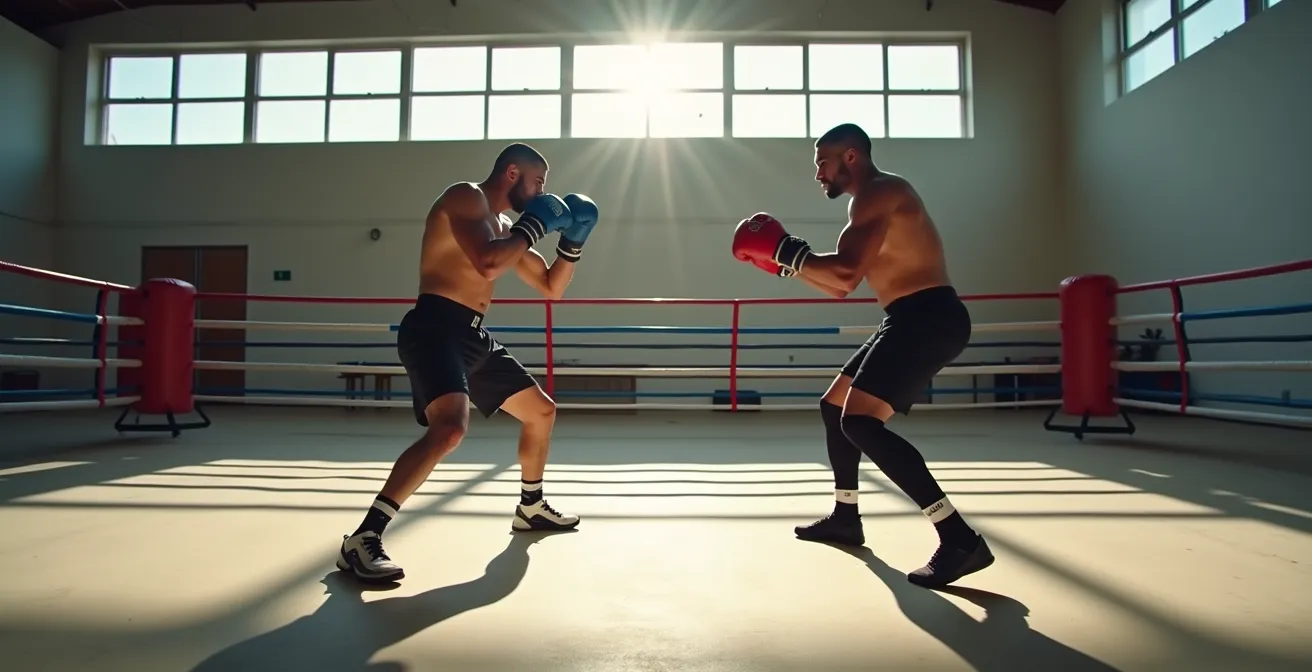
The contrast between these two modes is stark. A brawl is a test of toughness, while a technical spar is a laboratory for skill. A fighter who only brawls may develop a short-term boost in confidence but will inevitably hit a plateau, as they are never consciously improving their technique. The fighter who dedicates the majority of their time to technical sparring builds a deep, adaptable, and robust skill set that holds up under real pressure.
The following table, based on a detailed performance metric comparison, highlights the fundamental differences in outcomes between the two approaches.
| Aspect | Technical Sparring | Brawling |
|---|---|---|
| Decision-Making Frequency | High – Multiple conscious choices per round | Near zero – Pure reactive mode |
| Skill Development Zone | Learning Zone – Mistakes welcomed, data collection focus | Performance Zone – Ego-driven, shuts down neuroplasticity |
| Control Development | Teaches gear control and restraint | Reinforces full-throttle habits |
| Bad Habit Formation | Minimized through conscious practice | High risk of developing lazy defensive habits |
| Long-term Progress | Steady skill refinement and mastery | Quick confidence boost but skill stagnation |
The Flinch Response: Why Closing Your Eyes is a fatal Reflex?
The flinch is one of the most powerful and detrimental brainstem reflexes a fighter must overcome. When an object rapidly approaches your face, your instinct is to close your eyes, turn your head, and raise your hands in a protective but non-technical shell. This is a hardwired survival mechanism. In a fight, however, it is fatal. Closing your eyes, even for a millisecond, means you lose all incoming data. You cannot see the next strike, you cannot identify an angle of escape, and you cannot mount a counter-offensive. You become a static, blind target.
Overcoming the flinch response is a classic example of threat-response reprogramming. You cannot simply will yourself not to flinch; you must systematically train a new, more effective competing response. The prefrontal cortex must be trained to intercept the “flinch” command from the brainstem and substitute it with a learned, technical defensive maneuver like a parry, a slip, or a block. This requires progressive, controlled exposure to the stimulus that triggers the flinch in the first place.

The training must start at a level of intensity that is low enough for you to consciously keep your eyes open and track the incoming object. This could be as simple as a partner swinging a pool noodle towards your face. The key is to maintain a soft gaze, using your peripheral vision rather than a hard stare, which helps to keep your nervous system calm. As your brain habituates to the stimulus and learns that it does not result in harm, the intensity can be gradually increased. This process builds a new default reaction where the sight of an incoming strike triggers a calm, technical defense instead of a blind panic.
Case Study: Overriding Brainstem Reflexes Through Competing Response Training
In martial arts gyms, a clear distinction is seen between trained and untrained individuals. When taking solid hits during sparring, novices instinctively cover up, close their eyes, and shrink away from the contact. In contrast, experienced fighters, through thousands of repetitions in live training, develop a competing response. Their prefrontal cortex intercepts the flinch command. Instead of blinding themselves, the incoming strike becomes a trigger for a trained defensive action—a parry, a slip, a shoulder roll. This is not because they are “tougher,” but because their brain has been reprogrammed to replace the natural, unhelpful reflex with a superior, learned one.
Mental Rehearsal: How to Pre-Program Your Reaction to Being Cornered?
Your physical response in a high-stress situation is dictated by your pre-existing neural pathways. If you have not deliberately built a pathway for a specific scenario, your brain will default to its most primitive reaction—panic. Mental rehearsal, or visualization, is the process of building these pathways in a controlled, internal environment. By vividly and repeatedly imagining a worst-case scenario and then executing a calm, technical solution, you are effectively “pre-programming” your nervous system to respond correctly before the event ever happens.
Effective visualization is not about daydreaming of success. It is rigorous, procedural work. A particularly powerful method is Trigger-Action Programming. You must identify a specific, negative trigger and pair it with an immediate, positive technical response. For example: “IF my back foot touches the corner post, THEN I will execute a V-step to my left while throwing a check hook.” This creates a powerful, automatic stimulus-response link. When the trigger occurs in a real spar, your body already knows the solution and can execute it without the need for slow, conscious deliberation from a stressed prefrontal cortex.
This rehearsal must be multi-sensory. You should not just see the escape; you should feel the specific muscles in your core and legs engaging for the pivot. You should hear the sound of your feet on the canvas and your own controlled breathing. The more detailed and realistic the rehearsal, the stronger the neural pathway will become. Top-tier athletes spend significant time visualizing not just victory, but methodically navigating their way out of the most dangerous and overwhelming situations they can imagine.
Case Study: Visualization Protocol Used by Professional Fighters
The infamous “Dog House” sparring sessions at the Mayweather Boxing Gym are an example of combining environmental pressure with mental rehearsal. Fighters spar under intense conditions, surrounded by spectators and cameras, simulating a real fight environment. Crucially, fighters also spend 10-20 minutes daily visualizing these worst-case scenarios. They don’t just imagine landing the perfect punch; they specifically rehearse being cornered, exhausted, and overwhelmed. While visualizing, they mentally rehearse calm, technical escapes, and even engage the specific muscle groups required for those movements (like tensing the obliques for a pivot). This combination of pressure training and negative visualization builds an unshakable composure when those situations actually arise in a real fight.
Why Willpower Depletes Your Brain’s Fuel Reserves?
Maintaining emotional control under fire is not a mystical art; it is a metabolically expensive task. The part of your brain responsible for this regulation, the prefrontal cortex (PFC), is like a muscle. It requires a significant amount of energy, primarily in the form of glucose, to function effectively. Every time you consciously override an emotional impulse, suppress a flinch, or force yourself to stick to a game plan, your PFC is burning fuel. This phenomenon is known as ego depletion. Willpower is a finite resource.
The problem is that the amygdala, your primitive threat-response center, is far more energy-efficient. It can run on autopilot with minimal resources. This creates a critical imbalance during a long, grueling sparring session. As your brain’s glucose reserves diminish, the PFC’s ability to regulate the amygdala weakens. This is why you might be able to stay calm and technical for the first few rounds, only to lose control as you become more fatigued. Your “willpower” hasn’t failed; your brain has simply run low on the fuel required for executive function. Recent neuroscience research from 2024 demonstrates that the prefrontal cortex requires significantly more metabolic resources than the amygdala for emotional regulation.
This understanding shifts the problem from a mental one to a logistical one: strategic fuel management. You would never enter a sparring session dehydrated, and you should not enter it with a depleted brain. Proper nutrition and hydration before, during, and after training are not just for physical performance but are essential for maintaining cognitive control. Recognizing that your ability to stay calm is tied to a tangible energy source allows you to manage it tactically, just like you would manage your physical stamina.
To maintain peak cognitive performance, implement a strategic fueling protocol:
- 60-90 minutes pre-training: Consume low-glycemic carbohydrates like oatmeal or a sweet potato. This provides a stable, slow-release source of glucose.
- 30 minutes before: Have a small, easily digestible carb like a banana for immediate energy availability.
- During training: If sessions are long and intense, sip an electrolyte drink containing 10-15g of dextrose per hour to maintain brain glucose levels.
- Post-training: Replenish depleted reserves within 30 minutes by consuming a mix of protein and fast-acting carbohydrates.
Why Cortisol Levels Drop Faster With Outdoor Activities Than Gym Workouts?
The sparring session doesn’t end when the bell rings. Your body is still flooded with stress hormones, primarily cortisol. How quickly and efficiently you can clear these hormones from your system directly impacts your recovery, your sleep quality, and your readiness for the next training session. Remaining in the hyper-stimulating gym environment—with its bright artificial lights, loud noises, mirrors, and sense of constant activity—can keep your nervous system in a heightened state of alert, slowing the cortisol reduction process. Your body’s stress response remains active.
In contrast, engaging in a cool-down in a natural, outdoor setting has been scientifically shown to accelerate this recovery. Natural environments activate the parasympathetic nervous system, your body’s “brake pedal.” This effect is driven by several factors. The presence of natural fractals (the repeating, complex patterns found in things like tree branches, leaves, and coastlines) has a calming effect on the brain. Additionally, broad, open visual fields, especially looking towards a distant horizon, signal safety to our primal brain structures, reducing the feeling of being enclosed or threatened.
A simple 15-minute walk in a park after training can do more for your hormonal recovery than 15 minutes of stretching inside the gym. This isn’t a “soft” or psychological trick; it’s a physiological mechanism. By consciously changing your environment post-sparring, you provide your nervous system with the precise inputs it needs to switch from a state of high-stress “fight or flight” to one of “rest and digest.” This accelerates the removal of cortisol, lowers heart rate, and begins the physical and mental repair process much more effectively.
Case Study: Post-Sparring Nature Recovery vs. Gym Environment
Fighters who implement a 15-minute cool-down walk in a natural setting immediately after intense sparring sessions report significantly faster perceived recovery and show measurable decreases in heart rate compared to those who remain in the gym. The gym atmosphere maintains an elevated stress response. In contrast, outdoor environments with their natural patterns and wide-open views scientifically activate the parasympathetic nervous system. This direct environmental input is a powerful tool for accelerating cortisol reduction and completing the stress cycle, which is essential for long-term resilience and preventing burnout.
Key Takeaways
- Emotional overload in sparring is a predictable, physiological “amygdala hijack,” not a personal failing or lack of toughness.
- Control is a trainable, technical skill that is built through systematic practice of tools like tactical breathing and mental rehearsal, not just through more willpower.
- Prioritizing technical sparring with deliberate constraints is fundamentally superior to ego-driven brawling for long-term skill development and emotional regulation.
Situational Awareness: How to Spot Danger Before You Need Tactical Defense?
The ultimate form of self-control is not having to use it. Superior situational awareness allows you to identify and neutralize threats before they escalate to a point that triggers an adrenaline spike. In the context of sparring, this means reading your opponent’s intentions and controlling the space so effectively that you are rarely caught in a position of overwhelming danger. This is a proactive, cognitive skill that separates advanced practitioners from intermediates. It’s the difference between constantly putting out fires and preventing them from starting in the first place.
Effective awareness requires the ability to fluidly shift your attentional focus. This can be broken down into three modes:
- Broad Focus: A wide-angle view where you scan your opponent’s entire body and your own position within the ring. You are tracking distance to the ropes and corners, looking for large patterns of movement.
- Narrow Focus: A tight zoom on a specific area, typically the opponent’s chest or shoulders, to read the subtle telegraphs that precede a strike.
- Internal Focus: A quick, 1-second check of your own internal state—your breathing rate, your energy levels, your balance.
The art is in rotating through these modes continuously: broad focus between exchanges, narrow focus during an exchange, and a quick internal check during a clinch or reset. This practice keeps you from developing “tunnel vision” on a single threat and allows you to process the entire tactical landscape.
This skill is honed not just in live sparring but through systematic film study. Analyzing footage of yourself and your opponents with specific objectives—like identifying your three most common positioning errors or your opponent’s top three attack setups—transforms ambiguous patterns into concrete data. When you know an opponent always throws a faint to the body before a head kick, that pattern becomes a clear signal rather than just random noise. This turns sparring from a chaotic exchange into a high-speed game of pattern recognition, keeping your prefrontal cortex engaged and your amygdala quiet.
Case Study: Pattern Recognition Through Systematic Film Study
Professional MMA fighters consistently report that dedicated film study is a cornerstone of their in-ring awareness. They watch footage of their own sparring to identify recurring errors, such as drifting into an opponent’s power hand. They also study opponents to find their “tells”—specific, almost subconscious movements that precede a particular attack. By identifying these patterns, they can drill specific counters until the response is automatic. This analytical work done outside the ring dramatically improves their ability to anticipate threats and remain cognitively ahead of their opponent during the fight, reducing the number of panic-inducing surprises.
Begin implementing these protocols not as occasional tips, but as a core component of your training regimen. Your objective is to transform your response to pressure from a liability into a tactical advantage.