
The real difference isn’t striking versus grappling; it’s about which system best prepares your nervous system to function through the chaos of a real-world adrenaline dump.
- Krav Maga prioritizes simple, gross motor skills designed for rapid threat neutralization, making it faster to learn for immediate street threats.
- Brazilian Jiu-Jitsu builds exceptional control and calmness under pressure but can be dangerous against multiple attackers or on unpredictable terrain.
Recommendation: Choose Krav Maga if your primary goal is rapid proficiency for common street threats. Choose BJJ for long-term development of technical ground control and sparring-proven resilience.
When you’re walking to your car at night and hear footsteps approaching too quickly, the question isn’t theoretical. Which discipline will actually surface when your heart is pounding and your hands are shaking? Many debates pit Krav Maga against Brazilian Jiu-Jitsu (BJJ) by comparing techniques—strikes versus submissions, standing versus ground. This comparison often misses the most critical factor in a real confrontation: the overwhelming physiological event known as an adrenaline dump.
Traditional martial arts and combat sports are built on rules, referees, and weight classes. This is a controlled environment. The street is chaos. It has no rules, no honor, and often involves weapons or multiple assailants. A reflex built for the predictability of the mat can become a fatal liability on the concrete. The muscle memory you develop in training must be resilient enough to survive the cognitive shutdown that occurs under extreme duress.
But what if the key to effective self-defense isn’t just about knowing more techniques, but about programming your nervous system to execute the right, simple actions without conscious thought? This is the core of reality-based training. It’s not about which art is “better,” but which training methodology more effectively inoculates you against the paralytic effects of fear and adrenaline. It’s a question of building reflexes that are not just fast, but functional in the worst-case scenario.
This article will break down this critical difference. We will analyze how each discipline approaches training, what kind of reflexes they build, and how those reflexes hold up when the rules are thrown out the window. We will explore the science of muscle memory under stress and the psychological fortitude required to prevail in a genuine threat.
Summary: Krav Maga vs. BJJ for Reality-Based Reflexes
- Why Sport Fighting Rules Can Create Dangerous Habits on the Street
- How to Simulate Adrenaline Dump Safely in Training
- Striking vs. Grappling: Which Is Safer to Use Against a Larger Opponent?
- The Black Belt Illusion: Thinking a Belt Color Guarantees Safety
- Muscle Memory: How Many Reps Does It Take to React Without Thinking?
- Jogging vs. Sport-Specific Drills: Which Prepares the Nervous System Better?
- De-escalation vs. Physical Engagement: Which Has a Higher Success Rate?
- How to Maintain Self-Control When Adrenaline Spikes During Sparring?
Why Sport Fighting Rules Can Create Dangerous Habits on the Street
The fundamental disconnect between sport fighting and street self-defense lies in a single word: rules. Competition assumes a controlled environment with a referee, mutual respect, and an agreement to stop when someone “taps out.” A street attack has none of these luxuries. Training exclusively within a sport framework can inadvertently build dangerous habits. For example, a BJJ practitioner might instinctively pull an attacker into their guard, a dominant position on the mat. On concrete, against an opponent with a hidden knife or friends nearby, this action willingly immobilizes you and exposes you to catastrophic danger.
Sport rules also create a false sense of security regarding interventions. In a tournament, a dangerous move is stopped by the referee; on the street, there is no one to save you. This mindset is what separates a combat sport from a reality-based system. It’s a distinction articulated perfectly by Laurie Shaw in a feature for Men’s Health after his intensive training.
Krav Maga isn’t a martial art, it’s not a sport, because there cannot be rules in a pure self-defense fighting system.
– Laurie Shaw, Men’s Health
This “no rules” philosophy directly addresses the realities of street violence: the potential for multiple attackers, the presence of hidden weapons, and the lack of a “tap out” mechanism. Energy conservation strategies that are smart in a ten-minute match can be fatal when your life is on the line. The goal of self-defense isn’t to win points or control an opponent for an extended period; it is to neutralize the threat and escape as quickly and safely as possible.
How to Simulate Adrenaline Dump Safely in Training
You cannot prepare for the physiological chaos of a real fight in a calm, sterile dojo. To build reflexes that work under pressure, training must safely replicate the effects of an adrenaline dump: increased heart rate, tunnel vision, auditory exclusion, and loss of fine motor skills. This is the principle of stress inoculation. The goal is to make stress a familiar environment, allowing your pre-programmed responses to take over when your conscious mind is overwhelmed. This isn’t about making you immune to fear, but making you functional despite it.
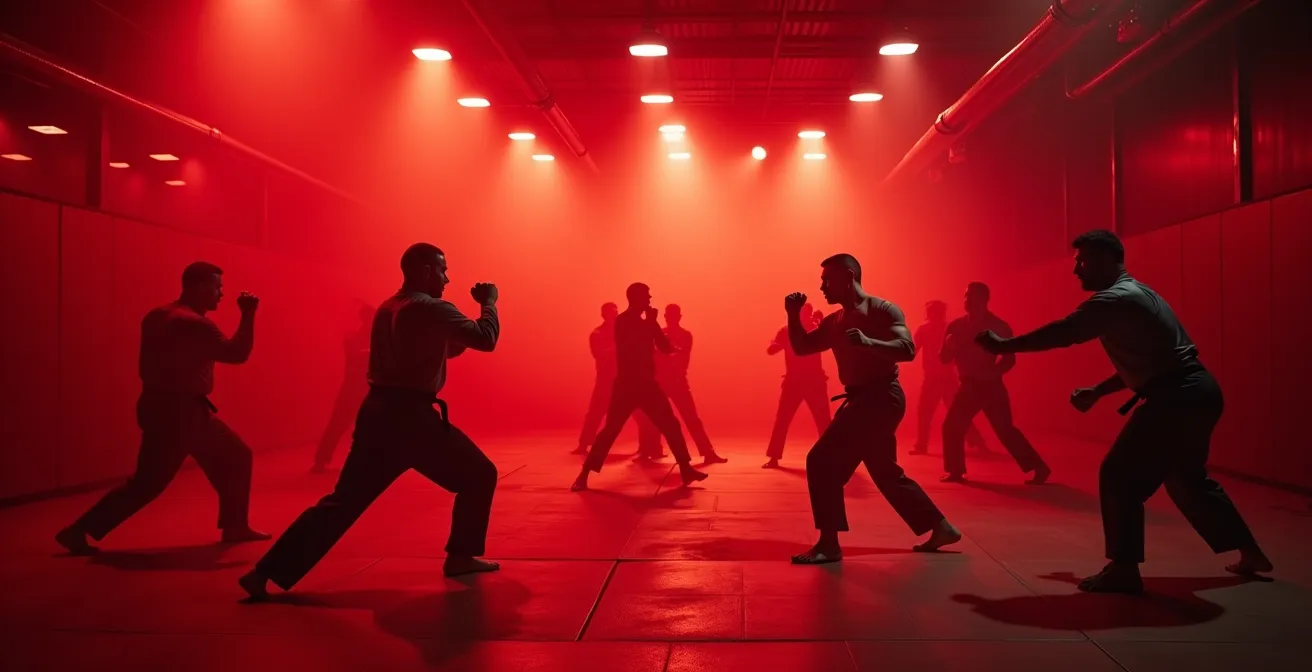
Krav Maga excels at this through drills that introduce chaotic variables. Training might involve defending against attacks from multiple directions after a series of exhausting sprints, using padded assailants, or practicing techniques in low-light conditions with loud, disorienting noise. This forces the practitioner to rely on simple, gross motor movements that are resilient to the effects of adrenaline. It programs the nervous system to react to a stimulus (the attack) with a pre-set solution without hesitation.
Case Study: The 30-Day Krav Maga Transformation
In a project documented by Men’s Health, YouTuber Laurie Shaw underwent 30 days of intensive Krav Maga. His training wasn’t just about learning moves; it was a progressive immersion into stress. The regimen evolved from basic striking to defending against chokes, holds, and weapons, culminating in high-pressure ground work. This layered approach demonstrates effective stress inoculation: by gradually increasing the complexity and intensity, his body and mind learned to apply techniques under simulated duress, with the singular goal of ending the fight and getting out fast.
This method builds a bridge between knowing a technique and being able to execute it during a genuine crisis. It’s about training your body to perform when your brain is screaming “danger.”
Striking vs. Grappling: Which Is Safer to Use Against a Larger Opponent?
When facing a larger, stronger attacker, the choice between striking and grappling becomes a critical tactical decision. Each approach has distinct advantages and severe risks. Krav Maga, a striking-focused system, teaches you to target an opponent’s vulnerable areas—eyes, throat, groin—to create an opportunity for escape. Its effectiveness relies on speed and explosive power, but it keeps you mobile. BJJ, a grappling art, uses leverage and technique to control and submit an opponent, effectively neutralizing a size and strength advantage once the fight is on the ground.
However, this very strength of BJJ can become its greatest weakness on the street. Grappling, by its nature, roots you to one spot with one person. This is extremely dangerous if the attacker has friends or a weapon you didn’t see. While the technical depth of BJJ is immense, with a study noting nearly 600 techniques in BJJ compared to Krav Maga’s 200+, this complexity can be a double-edged sword. Under adrenaline, simpler, more universal responses are often more reliable. The following table breaks down the tactical trade-offs.
| Factor | Striking (Krav Maga) | Grappling (BJJ) |
|---|---|---|
| Physical Requirements | Speed, explosiveness, power | Leverage, technique, positioning |
| Size Disadvantage Impact | High – requires vulnerable target areas | Lower – leverage neutralizes strength |
| Mobility | Maintains ability to escape | Roots you to the ground |
| Multiple Attackers | Better – allows movement | Very dangerous – immobilizes you |
| Legal Risk | Higher – may cause serious injury | Lower – controlled submission |
Ultimately, the “safer” option depends on the context. Grappling is safer in a one-on-one, unarmed altercation where control is the goal. Striking is often safer in the unpredictable chaos of a real street attack where mobility and escape are the top priorities.
The Black Belt Illusion: Thinking a Belt Color Guarantees Safety
In many martial arts, the black belt is the pinnacle of achievement, a symbol of mastery. But on the street, an attacker doesn’t care about the color of your belt. The “black belt illusion” is the dangerous assumption that rank automatically translates to real-world defensive capability. Proficiency in a sport and proficiency in survival are two different things. A BJJ black belt possesses an incredible depth of technical knowledge, but this mastery comes at a cost: time. The path to this level is a marathon, not a sprint.
For someone whose primary goal is immediate self-protection, the timeline to become effective is a major consideration. Krav Maga is designed from the ground up for rapid proficiency. It focuses on a limited toolset of high-impact, easy-to-learn techniques that can be applied quickly. The data on training time highlights this philosophical difference, showing that the time investment differs drastically, with an estimated 40 months to master Krav Maga versus 10 or more years to achieve a black belt in BJJ. This doesn’t mean a BJJ black belt isn’t a formidable opponent; it simply means the path to functional self-defense is significantly shorter in a system built for that specific purpose.
This isn’t to devalue the dedication required for a BJJ black belt, but to reframe the goal. For street survival, the objective isn’t to become a master of an art form, but to become a competent operator of a self-defense system in the shortest time possible. Consistency and the type of training matter far more than the color of a belt. As the experts at the Academy of Self Defense wisely state, “The best self-defense system is the one you actually train in consistently.” A blue belt who pressure-tests their skills weekly is often more prepared for reality than a high-ranking black belt who hasn’t been in a live sparring session in years.
Muscle Memory: How Many Reps Does It Take to React Without Thinking?
The concept of “muscle memory” is often misunderstood. It’s not your muscles that remember; it’s your central nervous system creating and strengthening neural pathways. Every time you repeat a motion, you make that pathway more efficient, allowing a signal to travel from brain to muscle with less conscious effort. In a high-stress situation, when your prefrontal cortex (the thinking part of your brain) goes offline, you are left with only these deeply grooved pathways. This is why the *quality* and *context* of your repetitions are far more important than the sheer quantity.

Simply repeating a technique in a calm setting builds a reflex that is only reliable in a calm setting. To build a reflex that works under duress, you must practice it under simulated stress. Your nervous system needs to learn to execute the move while your heart rate is elevated and your senses are being overloaded. This is where scenario-based training becomes critical. Instead of just practicing a choke defense, you practice it after being spun around to induce dizziness, with an instructor shouting to create auditory chaos. This forges a much more robust neural pathway.
The focus should be on gross motor movements—large, simple actions like pushing, pulling, and striking with an elbow—because these are less likely to degrade under adrenaline than fine motor skills like complex joint locks. The goal is to build a small library of universal, high-percentage responses that become your automatic default when a threat is detected.
Action Plan: Building Effective Muscle Memory
- Train Under Stress: Don’t just practice calmly. Incorporate fatigue and sensory overload (loud noises, flashing lights) into your drills to simulate real-world conditions.
- Use Scenario-Based Drills: Practice techniques in the context of a realistic encounter, not as isolated movements. For example, defend an attack inside a car or in a narrow hallway.
- Spar Against Resistance: Test your techniques against a resisting partner (“rolling” in BJJ or pressure testing in Krav Maga). This is the only way to know if they truly work.
- Focus on Gross Motor Skills: Prioritize simple, powerful movements that are reliable under adrenaline over complex sequences that require fine motor control.
- Train Universal Responses: Develop a few simple, default reactions (e.g., a “flinch block” that transitions into a strike) that can be applied to a wide variety of attacks.
Jogging vs. Sport-Specific Drills: Which Prepares the Nervous System Better?
Your cardiovascular fitness is the engine for any physical confrontation, but not all conditioning is created equal. The type of cardio you do directly impacts how well your nervous system is prepared for the explosive, unpredictable nature of a real fight. A long, steady-state jog is excellent for building an aerobic base, but a street fight is not an aerobic event. It is a series of short, violent, anaerobic bursts of maximum-effort output.
To prepare for this, your training must mirror this energy demand. High-Intensity Interval Training (HIIT), sprints, and, most importantly, sport-specific drills are vastly superior for combat readiness. These methods train your body to recover quickly between explosive efforts and, crucially, condition your nervous system to handle the rapid switch between rest and all-out exertion. This mimics the “fight-or-flight” response, training your body to perform when flooded with adrenaline.
Sport-specific drills, such as repeatedly practicing ground escapes in BJJ or performing “360 defense” against multiple striking pads in Krav Maga, offer the most significant benefit. They combine physical conditioning with technical practice, linking the cognitive and physical processes. Your nervous system doesn’t just learn to handle the heart rate spike; it learns to execute a specific, life-saving technique while that spike is happening. This is what builds true proprioception and reaction time—the ability of your body to react appropriately in space and time without conscious thought.
| Training Type | Energy System | Fight Application | Nervous System Benefit |
|---|---|---|---|
| Steady-State Jogging | Aerobic | Recovery between rounds | Limited – predictable movement |
| HIIT/Sprints | Anaerobic | Explosive bursts needed | Mimics fight-or-flight response |
| Sport-Specific Drills | Mixed anaerobic/aerobic | Direct technique application | Builds proprioception and reaction |
| Reactive Conditioning | Anaerobic bursts | Response to threats | Links physical and cognitive processing |
De-escalation vs. Physical Engagement: Which Has a Higher Success Rate?
The most successful fight is the one you avoid. While physical skills are essential, the ultimate goal of self-defense is personal safety, and that often begins with verbal skills and situational awareness. De-escalation is not about weakness; it is a tactical strategy with a significantly higher success rate than physical engagement. The ability to talk down an aggressor, create space, and remove yourself from a volatile situation is the most advanced self-defense technique you can possess. As one firearms academy aptly puts it, “If you can de-escalate the situation with words or even fists, it’s better than having to draw.”
Effective de-escalation requires a specific framework. It starts with maintaining a non-threatening but defensive “fence” position—keeping your hands up between you and the aggressor in a seemingly passive gesture that allows you to block or strike instantly. While doing this, you should verbally acknowledge the aggressor’s emotional state (“I understand you’re angry”) while simultaneously creating physical distance. This strategy offers the aggressor a face-saving exit from the confrontation, which is often all an ego-driven “social” aggressor is looking for.
However, it’s crucial to distinguish between a social/ego-driven threat and a truly predatory aggressor. A predator has already decided to attack you, and de-escalation will likely fail. The key is to use your verbal strategy as a screen. While you are talking, you are also reading their body language, scanning for weapons, and preparing your mind and body to transition instantly from verbal defense to explosive physical action. The best self-defense systems, including Krav Maga, integrate this awareness training, teaching you to prevent confrontations before they ever begin by simply being aware of your surroundings.
Key Takeaways
- Sport rules create dangerous habits for the street by ignoring weapons, multiple attackers, and hard surfaces.
- Effective training must include stress inoculation drills to prepare the nervous system for an adrenaline dump.
- The choice between striking and grappling is a tactical trade-off between mobility (striking) and control (grappling).
How to Maintain Self-Control When Adrenaline Spikes During Sparring?
Adrenaline can be your greatest asset or your worst enemy. It can grant you superhuman strength, but it can also shut down your ability to think. The ultimate skill in any self-defense discipline is the ability to harness this hormonal surge—to maintain cognitive function and self-control when your body is screaming at you to panic. This is a skill that is forged, not gifted, and it is built through consistent exposure to pressure. This is where the BJJ methodology offers a powerful lesson in emotional regulation.
Through its practice of “rolling,” or live sparring, BJJ constantly places its practitioners in high-pressure situations where panic and brute force lead to failure. You learn very quickly that uncontrolled aggression and wasted energy result in you being submitted. This forces a mental adaptation.
Case Study: BJJ’s Approach to Controlled Aggression
Brazilian Jiu-Jitsu training, as outlined by Journey BJJ Academy, fundamentally teaches that aggression harms the practitioner more than it helps. Through consistent sparring sessions, students learn to maximize efficiency and conserve energy, even when adrenaline spikes. This methodology teaches practitioners to maintain cognitive function under physical stress, relying on superior positioning and technique rather than panic-driven strength. They learn to “be comfortable in uncomfortable positions,” a mental skill that is directly transferable to the chaos of a real confrontation.
This process of learning to think and solve problems while under physical duress is a form of active meditation in chaos. Techniques like tactical breathing (e.g., box breathing) can be used to manually lower your heart rate, while developing a mental “reboot phrase” can help interrupt a panic spiral. Ultimately, the goal isn’t to remain perfectly calm—that’s unrealistic. The goal is to accept the chaos and function within it, using your training to guide your actions when conscious thought fails.
The first step to true readiness is choosing the training philosophy that aligns with your personal safety goals. Assess your priorities and commit to a path that builds not just techniques, but the mental fortitude to use them when it matters most.