
The chronic fatigue of urban life isn’t just in your head; it’s a measurable immune deficiency that can be reversed by a precise, scientific “dose” of nature.
- Breathing in forest aerosols (phytoncides) directly activates and increases your body’s cancer-fighting Natural Killer (NK) cells.
- The unique soundscape and light of a forest environment reset your nervous system, drastically lowering the stress hormone cortisol far more effectively than a gym session.
Recommendation: Practice ‘Shinrin-yoku’ (forest bathing) not as exercise, but as slow, multi-sensory immersion for at least two hours to trigger a measurable, lasting immune boost.
For the modern urban dweller, a persistent feeling of being run down has become the new normal. We attribute it to stress, poor sleep, or a demanding job, often reaching for another cup of coffee. The common advice—”get some fresh air”—feels simplistic, almost dismissive. We might take a quick walk in a city park, feel slightly better for a moment, but the underlying exhaustion remains. This vague sense of disconnection and fatigue is a hallmark of what some call “Nature Deficit Disorder,” a condition born from our separation from the natural world.
But what if the solution wasn’t just about “fresh air”? What if the forest engages in a direct, complex, and measurable biochemical conversation with your body? The truth is that a forest environment is not a passive backdrop; it is an active agent of health. It emits specific chemical compounds, generates unique sound patterns, and provides a quality of light that systematically recalibrates our stressed-out physiology at a cellular level. This isn’t folklore; it’s a rapidly emerging field of environmental health science.
This article moves beyond the platitudes to reveal the scientific mechanisms behind nature’s healing power. We will deconstruct the process, exploring exactly how breathing in tree-emitted aerosols supercharges your immune cells, why the silence of a forest resets your stress hormones more effectively than a workout, and how you can strategically use nature to build a more resilient immune system. We will explore the precise “how-to” of this natural therapy, transforming a simple walk in the woods into a potent, evidence-based health practice.
For those who prefer a visual introduction, the following video offers a wonderful immersion into the principles and atmosphere of Shinrin-yoku, perfectly complementing the scientific deep-dive in this guide.
To navigate the specific scientific pillars of how nature exposure enhances immunity, the following guide breaks down the key mechanisms and practices. Each section builds upon the last, creating a comprehensive picture of the forest as a pharmacy for the 21st-century human.
Summary: Decoding the Forest’s Impact on Human Immunity
- Why Breathing Tree Aerosols Increases Natural Killer Cell Activity?
- How to Practice ‘Shinrin-Yoku’ for Maximum Stress Reduction?
- Urban Park vs. Wild Forest: Does the Quality of Nature Matter?
- The Cortisol Baseline: Why Silence is Necessary for Nervous System Reset?
- Morning Light: How to Reset Your Circadian Rhythm While Outdoors?
- Why Cortisol Levels Drop Faster With Outdoor Activities Than Gym Workouts?
- Why Sarcopenia Treatments Cost 3x More Than a Gym Membership Over 10 Years?
- The Flow State: Why High-Speed Sports Quiet the Mind Better Than Sitting Still?
Why Breathing Tree Aerosols Increases Natural Killer Cell Activity?
The most profound impact of forests on the immune system comes from something you can’t even see: aerosols released by trees. These airborne compounds, known as phytoncides, are volatile organic compounds that trees produce to protect themselves from pests and disease. When we walk through a forest and breathe in the air, we are inhaling a complex cocktail of these molecules, including alpha-pinene and beta-pinene, which are common in trees like pine and cypress. This isn’t just a pleasant scent; it’s a form of chemical communication that directly modulates our biology.
The primary beneficiaries of this interaction are our Natural Killer (NK) cells. These are a type of white blood cell that acts as the immune system’s front-line defense, capable of identifying and destroying virus-infected cells and early-stage cancer cells without prior sensitization. Groundbreaking research demonstrates that phytoncides increase NK cell cytolytic activity in a dose-dependent manner. This means the more phytoncides you inhale, the more active and effective your NK cells become. Japanese Forest Therapy Research confirms this powerful link, stating:
Phytoncides emit levels that lower blood pressure and increase the production of natural killer cells (cells to fight off infections and cancer).
– Japanese Forest Therapy Research, JAPAN HOUSE Los Angeles
This effect is so potent that it can be replicated even outside of a forest environment, highlighting the direct biochemical pathway at play.
Case Study: The Hotel Room Experiment
In a notable Japanese study, twelve healthy men stayed in urban hotel rooms where essential oils from hinoki cypress trees were diffused for three nights. Despite being in a city, the men showed a significant increase in NK cell activity and in the percentage of cells expressing powerful anti-cancer proteins like perforin and granzymes. Air analysis confirmed the presence of phytoncides like alpha-pinene and beta-pinene, proving that exposure to these specific tree-derived compounds is a key driver of enhanced immune function.
This reveals that the “fresh air” of a forest is, in reality, a medicinal aerosol. It actively arms our immune system, making it more vigilant and powerful. This biochemical recalibration is a cornerstone of why time in nature translates to tangible, preventative health benefits.
How to Practice ‘Shinrin-Yoku’ for Maximum Stress Reduction?
Understanding the science is one thing; applying it is another. The Japanese practice of Shinrin-yoku, or “forest bathing,” is the art and science of absorbing the forest atmosphere. It’s a method designed to maximize the physiological benefits we’ve discussed, particularly for stress reduction and immune support. It is fundamentally different from hiking, jogging, or any other form of exercise. As Dr. Qing Li, a leading expert, explains, the goal is immersion, not exertion.
This is not exercise or hiking or jogging. It is simply being in nature, connecting with it through our sense of sight, hearing, taste, smell and touch.
– Dr. Qing Li, Forest Bathing: How Trees Can Help You Find Health and Happiness
The practice is about slowing down to the speed of nature. It involves engaging all five senses to create a deep connection with your surroundings. This mindful presence is what allows your parasympathetic nervous system—the “rest and digest” system—to take over from the chronically activated “fight or flight” sympathetic system that dominates urban life. The focus is on receiving the environment, not conquering it. This sensory engagement is key to unlocking the full suite of benefits.
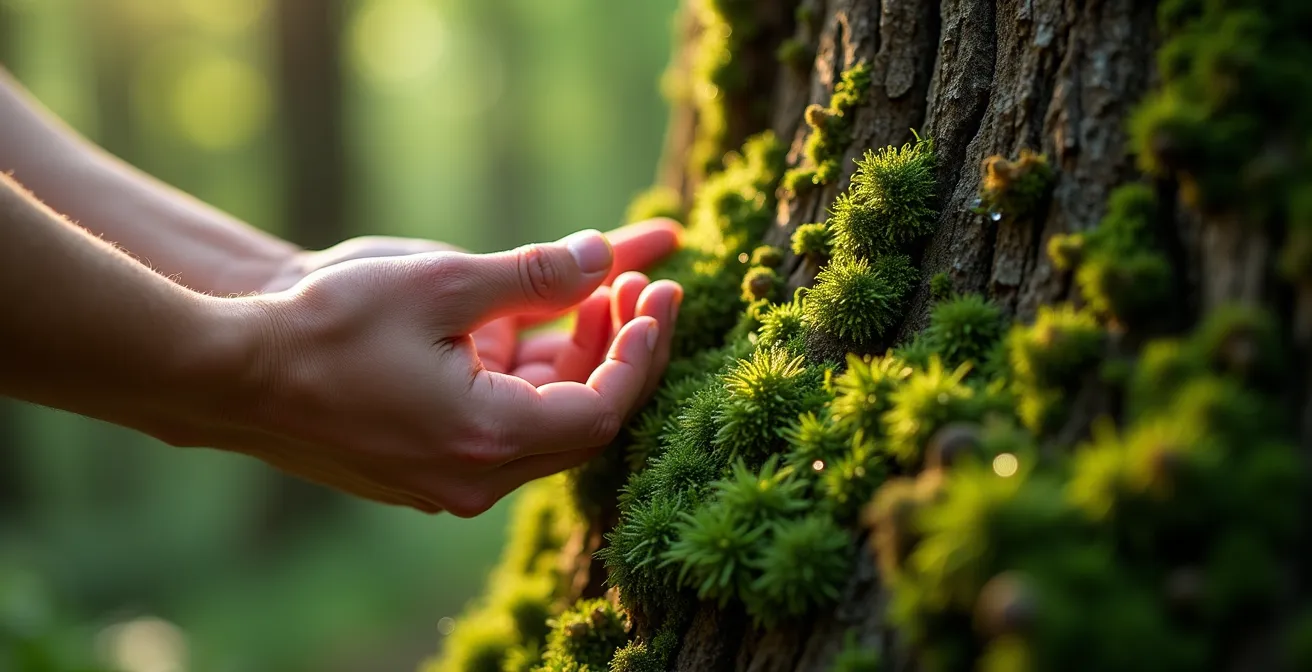
As the image suggests, the simple act of touching the texture of moss on a tree or noticing the glisten of dewdrops can be a powerful anchor to the present moment. It’s through this deliberate, multi-sensory immersion that the body begins its process of biochemical recalibration. To structure this practice for maximum benefit, specific guidelines have been developed based on research into its effects.
Your Action Plan: The Five Pillars of Effective Forest Bathing
- Commit the Time: Spend a minimum of 2 hours, and ideally up to 6, in a forest. Studies show this duration can increase NK cells for more than seven days.
- Move Slowly: This is not a workout. The goal is mindful presence. Walk at a pace that feels aimless, stopping frequently to observe your surroundings.
- Find Your Spot & Breathe: Find a place that feels welcoming. Sit and practice a simple breathing exercise: inhale for a count of two, and exhale slowly for a count of four to activate the parasympathetic response.
- Go Offline Completely: Turn off all digital devices. A true digital detox is non-negotiable for allowing the nervous system to fully reset and disengage from artificial stimuli.
- Embrace the Indoors Alternative: If you cannot access a forest, diffusing tree-based essential oils (like hinoki or pine) can provide an estimated 40-50% of the phytoncide-related benefits.
By following these steps, you transform a simple walk into a therapeutic intervention, consciously harnessing the forest’s ability to lower stress and bolster your body’s natural defenses.
Urban Park vs. Wild Forest: Does the Quality of Nature Matter?
For many urban dwellers, a city park is the most accessible form of “nature.” But does a manicured lawn with a few scattered trees provide the same potent immune-boosting benefits as a dense, wild forest? The evidence increasingly suggests that the quality and biodiversity of the natural environment matter significantly. While any green space is better than none, the biochemical and sensory inputs from a wild forest are far more powerful.
The primary difference lies in the concentration of phytoncides and the quality of the air. Wild, dense forests, particularly those with coniferous trees, create a rich atmospheric soup of immune-modulating aerosols. City parks, often surrounded by traffic and pollution, simply cannot replicate this environment. Research directly comparing these settings reveals a stark difference in outcomes. For instance, a comparative study revealed an astounding 80% boost in NK cell activity for individuals after a forest trip, whereas city walkers saw only a marginal 10% increase. This gap highlights that the environment itself is an active ingredient.
The “why” behind this difference is explained by what is present in the forest and what is absent. Forests are not just full of beneficial compounds; they are also free from many urban pollutants that tax the immune system.
Case Study: Air Quality and Immune Response
Researchers measuring air quality found significantly lower concentrations of gaseous air pollutants like nitrogen oxides (NOx) and sulfur dioxide (SO2) in forest environments compared to urban ones. Simultaneously, they detected high levels of beneficial phytoncides like α-pinene and cedrol emitted by the trees. This suggests a dual benefit: the forest environment reduces the body’s exposure to harmful pollutants (lessening the burden on the immune system) while simultaneously providing active compounds that enhance immune function. A city park, by contrast, offers a much-diluted version of this effect.
Therefore, while a stroll through an urban park can provide a mental break and mild stress relief, it lacks the potent biochemical punch of a true forest. For those serious about leveraging nature to enhance their immune system, seeking out more wild, dense, and biodiverse environments is not a luxury—it is a critical component of the therapy’s effectiveness. The quality of nature is directly proportional to the quality of the physiological response.
The Cortisol Baseline: Why Silence is Necessary for Nervous System Reset?
Beyond the chemical interactions of phytoncides, the forest engages another powerful sense: hearing. The soundscape of a city is one of anthrophony—chaotic, repetitive, and often jarring noises from traffic, construction, and crowds. This constant auditory stress keeps our nervous system in a state of low-grade alert, maintaining elevated levels of cortisol, the primary stress hormone. A wild forest, in contrast, offers a soundscape of biophony: the non-repeating, complex, and harmonious sounds of wind, water, birds, and insects. This type of auditory input is profoundly restorative.
Scientific studies confirm this link directly. When measured, salivary cortisol levels were significantly lower after forest walking compared to city walking. This hormonal shift is a direct indicator of a move away from sympathetic (“fight or flight”) dominance toward parasympathetic (“rest and digest”) activation. The natural silence, punctuated by biophony, signals safety to our primal brain, allowing the nervous system to stand down and begin repair and recovery processes. It’s not just quiet; it’s a specific *quality* of sound that facilitates a deep neurological reset.
The table below, based on recent research into soundscape effects, illustrates how different environments directly impact our stress response. The unique patterns of natural sounds are key to activating the body’s relaxation mechanisms, an effect that noisy, artificial environments like a gym cannot replicate.
This data from a recent analysis of soundscape effects on stress clearly shows the superior restorative power of natural environments.
| Environment | Sound Characteristics | Cortisol Response | Nervous System Effect |
|---|---|---|---|
| Forest (Biophony) | Non-repeating natural patterns | Decreased levels | Parasympathetic activation |
| Gym (Anthrophony) | Chaotic, repetitive noise | Elevated/maintained | Sympathetic dominance |
| Silent Nature | Minimal ambient sound | Lowest reduction | Maximum reset potential |
The “Silent Nature” category represents the ultimate state of auditory rest. In a truly quiet natural setting, the brain is freed from the task of processing constant external noise. This allows for what can be described as a cortisol baseline reset, where the body’s stress response can return to its natural, healthy equilibrium. This deep silence is not an absence of something, but a presence of profound calm that is a prerequisite for a full nervous system reset.
Morning Light: How to Reset Your Circadian Rhythm While Outdoors?
The third pillar of nature’s therapeutic effect is light. Our bodies run on an internal 24-hour clock known as the circadian rhythm, which governs sleep-wake cycles, hormone release, and metabolism. This rhythm is primarily synchronized by exposure to light. In our modern lives, we are overexposed to artificial blue light from screens late at night and underexposed to natural light during the day. This desynchronization contributes to poor sleep, fatigue, and a weakened immune system.
Getting outdoors, particularly in the morning, is the most effective way to reset this internal clock. Morning sunlight is rich in the specific wavelengths that signal to the suprachiasmatic nucleus—the body’s master clock in the brain—to suppress melatonin production and initiate the daytime cycle. This one act has a cascade of positive effects, including improved alertness during the day and better sleep quality at night. As Dr. Leela Magavi, a Johns Hopkins-affiliated psychiatrist, notes, this is especially critical in our screen-saturated world.

Time spent in nature and away from screens can reset children’s circadian rhythms and allow them to sleep better.
– Dr. Leela Magavi, Johns Hopkins Medicine
While the principle applies to adults just as much, the question becomes: how much exposure is needed? While even short bursts are beneficial, research points toward a consistent dose. General studies indicate that 120 minutes per week of nature immersion is associated with significantly better health and well-being. To specifically target your circadian rhythm, the timing is key. Aim for at least 20-30 minutes of outdoor light exposure within the first hour of waking. This doesn’t have to be intense; even the filtered light on an overcast day is far more powerful than indoor lighting.
By combining your morning walk with a natural setting, you achieve a dual benefit: you receive the phytoncides and restorative sounds of the forest while simultaneously giving your brain the precise light signal it needs to anchor your body clock for the day. This simple habit is a cornerstone of restoring natural energy cycles and combating the fatigue of Nature Deficit Disorder.
Why Cortisol Levels Drop Faster With Outdoor Activities Than Gym Workouts?
Many people turn to the gym for stress relief, but often emerge feeling just as wired, if not more so. This paradox can be explained by the body’s hormonal response to different types of physical activity. While a gentle, mindful walk in the forest lowers cortisol, a high-intensity gym workout can have the opposite effect, at least temporarily. This is because intense exercise is a physical stressor that the body responds to by releasing cortisol to mobilize energy stores.
The key variable is exercise intensity. Our bodies don’t differentiate between the “good” stress of a workout and the “bad” stress of a looming deadline; the hormonal response is similar. In fact, specific exercise physiology research reveals that cortisol increased 83.1% at a high intensity of 80% VO2max, compared to a negligible 5.7% at a low intensity of 40%. The study found that moderate and high intensities both led to significant cortisol spikes, which is typical of many popular gym classes and workout routines.
This contrasts sharply with the activity profile of Shinrin-yoku or a gentle outdoor walk. The low intensity of forest bathing keeps the body below the threshold that triggers a significant cortisol release. Furthermore, this gentle movement is paired with the actively cortisol-reducing environmental inputs of the forest: the phytoncides, the biophonic soundscape, and the fractal patterns in nature that are inherently calming to the human brain. The gym, on the other hand, combines high-intensity exercise with a stressful sensory environment—loud, repetitive music, artificial lighting, and crowded spaces—which can further elevate sympathetic nervous system activity.
Therefore, a gym workout may be excellent for cardiovascular health and muscle building, but it is not an optimal tool for nervous system regulation and cortisol reduction. An outdoor walk in a natural setting provides a unique combination of low-intensity movement and a restorative sensory environment, causing cortisol levels to drop far more effectively. For the chronically stressed urban dweller, choosing a forest walk over a high-intensity spin class can be a more direct path to true recovery and stress relief.
Why Sarcopenia Treatments Cost 3x More Than a Gym Membership Over 10 Years?
This question, while seemingly about sarcopenia (age-related muscle loss), highlights a much broader principle: preventative health is exponentially more valuable than reactive treatment. The long-term costs of managing chronic, age-related decline far outweigh the small, consistent investments in maintaining health. In this context, regular exposure to nature can be viewed as one of the most powerful and cost-effective forms of long-term preventative medicine for the immune system.
The immune-boosting effects of forest bathing are not fleeting. While a single two-hour session can produce benefits, research shows that the most significant and lasting changes come from consistency. The increase in Natural Killer (NK) cell activity is not just a temporary spike; immunological research indicates it can remain elevated for up to 30 days after a forest trip. This creates a powerful, cumulative effect on the body’s ability to police itself for infections and malignancies.
Based on this durable response, a general recommendation has emerged for long-term immune strengthening: engaging in a significant forest bathing session (a “forest day”) at least twice per month. This consistent “top-up” ensures that NK cell function remains at an elevated baseline, providing a constant state of enhanced immunosurveillance. This is the biological equivalent of having more vigilant guards on patrol throughout your body, day in and day out.
When you frame this practice as a long-term health investment, the value becomes clear. The “cost” is simply a few hours of time each month. The “return” is a more resilient, robust, and proactive immune system, potentially warding off illnesses that carry immense financial, physical, and emotional costs down the line. Just as a gym membership is a proactive investment to prevent the high costs associated with sarcopenia and frailty, a “nature membership” is an investment to prevent the decline of immune function that often accompanies modern, high-stress lifestyles.
Key Takeaways
- Your immune system is not a passive system; it actively responds to environmental signals, and forests provide a uniquely powerful set of positive signals.
- The benefits are not just a “feeling” but measurable biochemical events: increased Natural Killer cells from phytoncides, reduced cortisol from natural soundscapes, and reset circadian rhythms from morning light.
- Consistency and quality are key. A wilder forest environment is superior to a city park, and regular “doses” of nature provide a lasting, cumulative boost to immunity.
The Flow State: Why High-Speed Sports Quiet the Mind Better Than Sitting Still?
The concept of “flow state”—a state of complete absorption where the mind becomes quiet and focused—is often associated with high-speed, high-skill activities. However, the deep mental quietude it describes is not exclusive to extreme sports. A profound state of focused calm, free from the “monkey mind” of daily anxiety, can also be achieved through the deep, multi-sensory immersion of Shinrin-yoku. This offers a more restorative path to the same goal: quieting the mind to allow the body to heal.
This state of deep immersion, whether through sport or nature, facilitates a powerful shift in the nervous and endocrine systems, leading to tangible health benefits. The power of creating an immersive, healing environment is so strong that it can produce measurable physiological improvements even for individuals facing serious health challenges, and even when they cannot physically be in a forest. This demonstrates that the core mechanisms—the biochemical signals—are the true drivers of the outcome.
The following study on cancer survivors provides a stunning example of how inducing a state of calm with nature’s tools can have profound effects on immunity and stress hormones.
Case Study: Phytoncide Meditation for Cancer Survivors
Fifty-five gynecological cancer survivors participated in an 8-week program. One group practiced meditation while being exposed to phytoncides via a diffuser. After eight weeks, the phytoncide group showed a 9.3% reduction in stress, a 5.3% decrease in the stress hormone epinephrine, and a remarkable 24.9% reduction in cortisol. Most importantly, they had significant increases in their NK cell subsets. The control group, which meditated without phytoncides, showed no such improvements. This proves that even without the visual or physical experience of a forest, the chemical signals alone are powerful enough to modulate the nervous, endocrine, and immune systems.
This brings the entire concept full circle. The antidote to Nature Deficit Disorder is a conscious, scientific application of nature’s tools. It is about understanding that the forest offers a precise prescription: phytoncides to arm your immune cells, biophony to calm your nervous system, and natural light to reset your internal clock. By engaging in this practice, you are not just taking a walk; you are entering a flow state of health, creating an internal environment where your body can quiet the noise and focus on what it does best: protecting and healing itself.
The evidence is clear: making regular, mindful nature exposure a non-negotiable part of your health regimen is one of the most effective strategies for building a resilient body and a calm mind. Start today by scheduling your first two-hour forest bathing session.