
In summary:
- Treating your travel as a logistical final phase of training, not a vacation, is the key to protecting your performance.
- Proactively manage physiological stressors like circadian rhythm disruption and gut sensitivity with a precise plan.
- Maintain absolute control over your environment, nutrition, and energy expenditure in the critical days before the race.
- Implement risk mitigation strategies for everything from lost luggage to medical emergencies to ensure you make it to the start line healthy.
The “racecation” is a powerful motivator: the allure of a new city, a challenging course, and a medal that doubles as a souvenir. For the amateur athlete traveling internationally, however, this dream can quickly sour. The fear is real and justified: that the combined stress of long-haul flights, unfamiliar food, and the temptation of tourism will systematically dismantle months of hard work, leaving you fatigued and underperforming on race day. Many athletes focus on simply avoiding rookie mistakes, like eating a spicy meal the night before the race.
This approach is fundamentally reactive. The standard advice—arrive early, stay hydrated, don’t walk too much—is a good start, but it lacks the strategic precision required for competitive performance. It treats travel as a passive period of waiting, rather than what it truly is: a critical and demanding final stage of your training block. The real challenge isn’t just about what to avoid, but what to proactively control. This requires a shift in mindset from tourist to logistics manager.
The secret to a successful racecation isn’t about luck or hoping for the best. It lies in applying the same discipline and planning to your travel as you do to your intervals and long runs. It’s about understanding the physiological variables at play—from circadian desynchronization to glycogen depletion—and building a robust operational plan to manage them. This guide is built on that principle. We will deconstruct the racecation into its core logistical components, providing an expert framework to protect your performance, control your environment, and ensure you arrive at the start line feeling prepared, not panicked.
This article provides an organizational framework to transform your travel anxiety into logistical confidence. Below, you will find a detailed breakdown of the key strategic areas you must master to ensure your travel enhances, rather than compromises, your race day performance.
Summary: Racecation Strategy for Peak Performance
- Why Eastward Travel Impacts Athletic Performance More Than Westward?
- How to Source Safe Carbs in a Country with Different Cuisine?
- Hotel vs. Rental Apartment: Which Is Better for Pre-Race Routine?
- The Sightseeing Trap: Why You Should Avoid Walking Tours Before Race Day?
- Carry-On Essentials: What Race Gear Must Never Be Checked?
- Eating for Energy: How to Navigate Local Cuisine Without Crashing Mid-Hike?
- Solid Food vs. Gels: What Stomachs Can Handle During 4+ Hour Runs?
- Adventure Travel Insurance: Why Your Standard Policy Won’t Cover Helicopter Rescue?
Why Eastward Travel Impacts Athletic Performance More Than Westward?
The term “jet lag” is often used casually, but for an athlete, its effects are a direct threat to performance. The scientific term, circadian desynchronization, more accurately describes the misalignment between your internal body clock and the new time zone. This isn’t just about feeling tired; it affects hormone regulation, core body temperature, and metabolism—all critical for peak athletic output. The impact is quantifiable; research shows a 1-3% decrease in time-trial performance for every hour of desynchronization. This means a 6-hour time zone shift could slow your marathon time by several minutes, a devastating outcome after months of training.
The direction of travel matters immensely. Our natural circadian rhythm is slightly longer than 24 hours, making it biologically easier to delay our internal clock (traveling west) than to advance it (traveling east). When you fly east, you are fighting against your body’s natural tendency to drift later. This makes eastward travel significantly more disruptive and requires a more aggressive adaptation strategy. Simply arriving a few days early is not enough; you need a proactive plan to force your body clock into alignment.
A structured protocol involving light exposure and melatonin is the most effective method. Light is the most powerful signal for resetting your circadian rhythm. Melatonin, a hormone that regulates sleep-wake cycles, can be used strategically to signal “nighttime” to your brain. Here is a proven protocol for managing eastward travel:
- Begin exposing yourself to bright light immediately upon waking, starting 3 days before you travel.
- Consider taking a low dose of melatonin approximately 6 hours before your new target bedtime to start shifting your cycle.
- Plan to arrive at least one day for every time zone crossed, with a minimum of 2-3 days for any significant international trip.
- If possible, avoid races that start early in the morning after eastward travel, as your body will still be close to its physiological low point.
- At your destination, use blackout curtains and an eye mask to create total darkness for sleep, controlling your light exposure precisely.
How to Source Safe Carbs in a Country with Different Cuisine?
Maintaining your pre-race nutrition plan is non-negotiable, but it becomes a significant logistical challenge in a foreign country. The goal is what can be termed nutritional sovereignty: the ability to consume your trusted, simple carbohydrates without stress or uncertainty. Relying on finding “something plain” at a local restaurant is a high-risk gamble. Exotic spices, hidden fats, and different food preparation methods can easily lead to gastrointestinal distress, ruining your race.
Your strategy should be one of proactive scouting and packing. Before you even book your accommodation, use tools like Google Maps to locate supermarkets near your potential hotel or apartment. Look for larger chains, which are more likely to carry universally safe staples. The objective is to secure a reliable source for boring, predictable fuel. This advanced planning removes a massive variable and source of pre-race anxiety.

Even with scouting, a backup plan is essential. Packing some of your own nutrition is a non-negotiable part of risk mitigation. Powdered sources are lightweight and travel-friendly. This isn’t just about having your preferred brand; it’s about having a guaranteed safe option if your primary plan fails. Below is a checklist for securing your pre-race fuel abroad:
- Scout Supermarkets: Use Google Maps to identify and vet grocery stores near your lodging before finalizing your booking.
- Identify Universal Options: Stick to globally available, low-risk carbohydrates like white rice, potatoes, plain pasta, oatmeal, and bananas.
- Pack a Backup: Always carry powdered carb sources like oatmeal packets or maltodextrin that you can mix with water.
- Create a Translation Card: Have key phrases like “no spice,” “no oil,” “plain,” and any allergies written in the local language.
- Book Restaurants Wisely: If you must eat out, make reservations well in advance at places recommended by other runners in online forums for their ability to accommodate simple requests.
Hotel vs. Rental Apartment: Which Is Better for Pre-Race Routine?
The choice between a hotel and a rental apartment is a critical decision that directly impacts your level of logistical control. This isn’t about luxury; it’s about which option best allows you to replicate your proven pre-race routine. The familiarity of your own rituals—the same breakfast at the same time, a quiet space for stretching, controlled noise levels for sleep—is a powerful tool for managing pre-race anxiety. A hotel, with its built-in conveniences, can paradoxically introduce uncontrollable variables like noisy neighbors, inflexible meal times, and limited food options.
An apartment rental with a kitchen provides the highest degree of control. It guarantees your nutritional sovereignty, allowing you to prepare the exact meals you’ve trained with. It also typically offers more space and privacy, minimizing the risk of being woken up by hallway noise or adjacent rooms. However, this control comes at the cost of convenience. You are responsible for cooking, cleaning, and sourcing your own food, which adds another layer of tasks to your pre-race schedule. For post-race recovery, the lack of services like room service can be a significant drawback when you are exhausted and sore.
The following table, based on common race travel planning considerations, breaks down the decision matrix to help you choose the best option for your specific needs.
| Factor | Hotel | Apartment |
|---|---|---|
| Food Control | Limited to restaurant/buffet | Full kitchen access |
| Noise Control | Risk of disruption | More privacy |
| Convenience | High (front desk, cleaning) | Low (self-service) |
| Pre-Race Anxiety | Higher (less control) | Lower (familiar routine) |
| Post-Race Recovery | Better (room service) | Requires planning |
Elite Strategy: The Hybrid Accommodation Approach
A strategy increasingly used by experienced runners is the hybrid model. They book an apartment for the 3-4 nights leading up to the race to maintain complete control over their nutrition and sleep schedule. After the race, they switch to a hotel conveniently located near the finish line. This approach cleverly combines the best of both worlds: the unwavering routine control of an apartment for pre-race preparation and the effortless recovery comfort of a hotel with room service and other amenities when they need it most.
The Sightseeing Trap: Why You Should Avoid Walking Tours Before Race Day?
One of the biggest mistakes athletes make during a racecation is underestimating the impact of pre-race tourism. The desire to explore a new city is strong, but a few hours of walking can have a devastating effect on your performance. The issue is a matter of simple physiology: glycogen discipline. Your muscles store a finite amount of glycogen, which is your primary fuel source for a marathon. Every step you take in the days leading up to the race depletes these precious stores.
The impact is far from trivial. According to sports science research, just 3-5 hours of casual walking can deplete your muscle glycogen stores by 20-30%. This is energy you are stealing directly from your race day performance. You might not feel “tired” from a walking tour, but you are arriving at the start line with a partially empty tank. The goal in the 48 hours before a marathon is radical conservation of energy. Every decision should be filtered through the question: “Does this help me conserve glycogen?”
This doesn’t mean you have to lock yourself in your hotel room. The key is to switch to low-impact tourism. Seeing the city from a seated position allows you to experience the destination without sabotaging your race. Think of yourself as an athlete in a taper period, where rest and fuel preservation are the top priorities. The major sightseeing can, and should, be saved for after the race. In fact, light walking post-race is an excellent form of active recovery.
Consider these low-impact alternatives to preserve your energy:
- Book a scenic bus tour or “hop-on, hop-off” bus to get an overview of the city.
- Take a short river cruise for a different perspective.
- Visit museums that have ample seating areas, allowing you to rest frequently.
- Watch a local movie or attend a theater performance to soak in the culture.
- Relax at strategically chosen cafés to observe city life without extensive walking.
Carry-On Essentials: What Race Gear Must Never Be Checked?
An airline losing your checked baggage is an inconvenience for a tourist, but it’s a potential disaster for a marathon runner. The ultimate act of risk mitigation in race travel is ensuring that your irreplaceable gear travels with you in the cabin. Relying on buying new gear at the race expo is a rookie mistake; nothing should be worn for the first time on race day. Your entire race-day system—shoes, kit, and nutrition—has been tested and proven over hundreds of miles in training. It is a personalized, irreplaceable system.
The core principle is to identify the items whose failure or absence would be catastrophic. The “Irreplaceable Three” are your race shoes, your race kit, and your specific race-day nutrition. These items must be in your carry-on bag or personal item, without exception. Your shoes are perfectly broken in to the contours of your feet. Your singlet and shorts have been tested for chafing over long distances. Your specific brand and flavor of gels are what your stomach has been trained to tolerate.
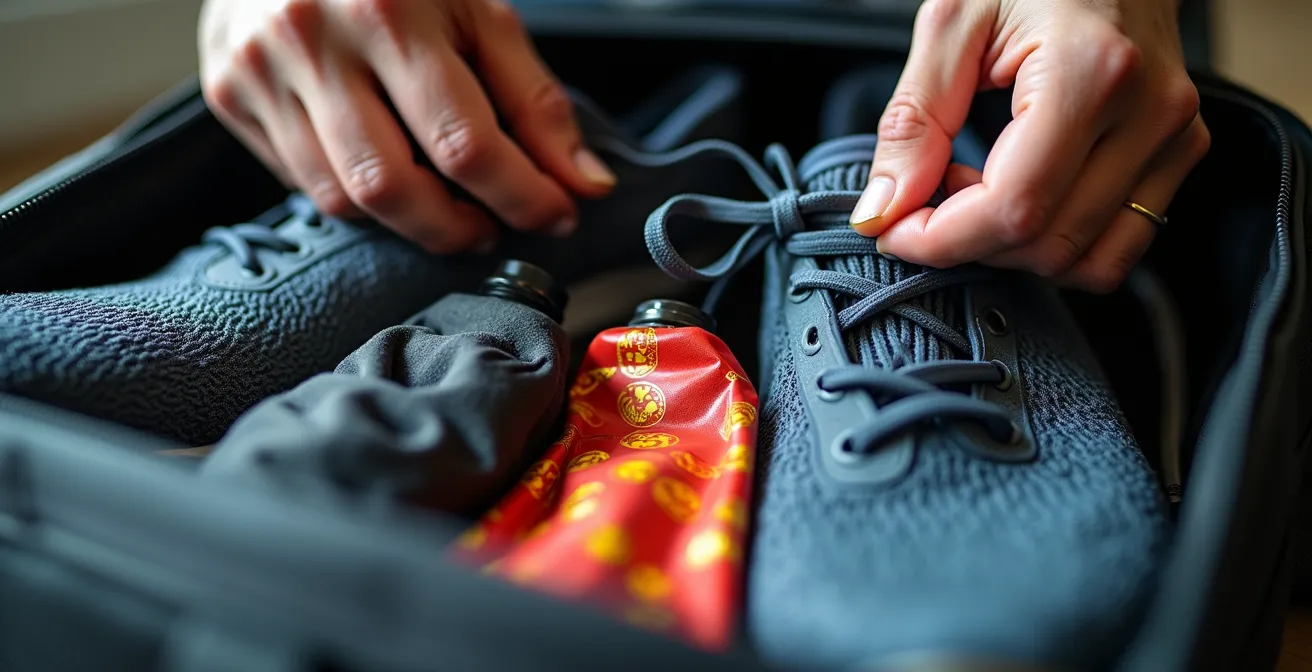
Beyond the physical gear, your logistical information is also critical. A dead phone battery or lack of international data can create immense stress. A digital backup plan is just as important as your physical one. Redundancy is the goal. Split essential items between your carry-on and your personal item (like a backpack). If you are traveling with a companion, give them a backup piece of your kit to carry. This distributed approach minimizes the risk of a single point of failure.
Follow this checklist for your carry-on luggage:
- Race Shoes: Your primary, perfectly broken-in pair. Some runners even wear them on the plane.
- Race Kit: The exact singlet, shorts, and socks you have trained in and plan to race in.
- Race Nutrition: A sufficient quantity of the specific gels, chews, or powders your stomach is accustomed to.
- Digital Backup: Download offline maps of the race area and take screenshots of your hotel confirmation, race registration, and any other critical documents.
- Redundancy Plan: Split your essential gear between your carry-on suitcase and your personal item.
- Partner Strategy: If traveling with someone, have them carry a duplicate of your race shorts or another key item in their bag.
Eating for Energy: How to Navigate Local Cuisine Without Crashing Mid-Hike?
The combination of travel anxiety, dehydration from flying, and altered routines makes the gut more sensitive. A nutrition plan that works at home might fail abroad.
– Amanda Brooks, RunToTheFinish Marathon Travel Guide
After you cross the finish line, the nutritional focus shifts from pure, simple carbohydrates to balanced recovery. This is your opportunity to finally enjoy the local cuisine you’ve been cautiously avoiding. The goal now is to replenish depleted glycogen stores, repair muscle damage, and rehydrate. The key is to consume a meal with a carbohydrate-to-protein ratio of approximately 3:1 or 4:1 within the “golden window” of two hours post-race, when your body is most receptive to nutrient absorption.
Navigating foreign menus for this purpose requires a bit of knowledge. Fortunately, many global cuisines offer excellent natural recovery meals. You are looking for a combination of a significant carb source (rice, pasta, noodles, potatoes) and a lean protein source (fish, chicken, lentils, beans). This is the time to be adventurous, but still smart. Avoid excessively fatty or heavy cream-based dishes, as they can slow digestion and absorption when your body needs nutrients most.
Having a plan for your first post-race meal is just as important as your pre-race plan. Research a few restaurants near the finish line that fit your recovery needs. This avoids the “hanger” induced indecision when you are exhausted and just want to eat anything. Knowing what you’re looking for on the menu can make the experience both delicious and effective for your recovery. Here are some excellent recovery meal options found in common international cuisines:
- Japanese: Sushi or chirashi bowls offer a perfect mix of white rice (fast-absorbing carbs) and fish (lean protein and omega-3s).
- Italian: A simple pasta with a tomato-based sauce (like pomodoro) and a side of grilled chicken provides ample glycogen replenishment.
- Indian: Lentil dal with a large portion of basmati rice delivers a powerful combination of plant-based protein and carbohydrates.
- Mexican: Chicken or fish fajitas with corn or flour tortillas, rice, and beans tick all the boxes for a balanced recovery meal.
Solid Food vs. Gels: What Stomachs Can Handle During 4+ Hour Runs?
Your in-race nutrition strategy, honed over months of training, faces its ultimate test in a foreign environment. The cumulative stress of travel, altered sleep, and a new climate makes your gut significantly more sensitive. This is why relying on aid station offerings without prior research is one of the riskiest decisions an athlete can make. What works for local runners may not work for your travel-stressed system. The debate between solid food and gels becomes even more critical under these conditions.
For longer endurance events, especially in warm climates, liquid calories are almost always the safer bet. The physiological reason is straightforward: heat and physical exertion divert blood flow away from the digestive system to the working muscles and skin (for cooling). This dramatically slows gastric emptying, making it harder for your stomach to break down solid food. Attempting to digest a piece of banana or a pretzel can lead to cramping, bloating, and nausea, effectively ending your race.
Case Study: The Impact of Heat on Gastric Emptying
Studies of marathoners competing in hot-weather destinations provide clear evidence. They show that racing in temperatures above 70°F (21°C) can cause a significant slowdown in digestion. In these studies, athletes who relied exclusively on liquid nutrition like gels and sports drinks reported 40% fewer gastrointestinal issues compared to those who consumed solid foods during the race. This highlights that in challenging conditions, easily absorbed liquid calories are not just a convenience, but a critical tool for avoiding GI distress.
This data underscores the need for a rigorous decision-making framework when approaching aid stations. Never assume the nutrition offered will be suitable. Your default plan should always be to carry your own proven nutrition. Aid station supplies should be considered a backup, not a primary fuel source.
Your Action Plan: Vetting Aid Station Nutrition
- Research the Brand: Weeks before the race, find out the exact brand and flavors of gels/drinks offered on the course.
- Check Ingredients Online: Scrutinize the ingredient list for any potential triggers or components your system is not used to.
- Never Try on Race Day: This is the golden rule. Do not consume anything for the first time during the marathon.
- Carry Your Own Supply: Always carry enough of your own tested nutrition to get you through the race, even if you plan to supplement with on-course options.
- Practice with Packables: In your final long runs, practice your race-day plan using only nutrition you can easily pack and carry, simulating race conditions.
Key takeaways
- Proactive management of your circadian rhythm through light and melatonin protocols is more effective than simply “getting used to” a new time zone.
- Nutritional sovereignty—maintaining absolute control over your pre-race fuel by scouting supermarkets and packing backups—is essential to avoid GI distress.
- Glycogen discipline, which involves choosing low-impact tourism and consciously conserving energy, is critical for arriving at the start line with a full tank.
Adventure Travel Insurance: Why Your Standard Policy Won’t Cover Helicopter Rescue?
It’s not about covering a sprained ankle; it’s about covering the potentially enormous cost of a medically-supervised flight home if a serious injury occurs.
– Jessie Zapotechne, Men’s Health International Marathon Guide
The final, and perhaps most overlooked, aspect of racecation planning is insurance. Many athletes assume their standard travel or health insurance will cover them, but this is a dangerous and often costly assumption. Most standard policies contain specific exclusions for “organized sporting events,” “timed competitions,” or “professional sports” (a category into which even amateur marathon running can fall). This means that if you suffer a serious injury during the race, you may not be covered for medical treatment or, more critically, for medical evacuation.
The real value of specialized race insurance is not for minor issues like a twisted ankle. It is for catastrophic events. A serious medical incident in a foreign country can be financially devastating. The cost of a medical evacuation, especially a medically-supervised flight back to your home country, can easily run into the tens or even hundreds of thousands of dollars. Standard policies rarely cover this, or have limits that are far too low. Verifying your coverage is a non-negotiable step in your final race preparations.
You must read the fine print of any policy you consider. Look for specific language that confirms coverage for competitive marathon running. Differentiate between race fee insurance (which just refunds your entry fee if you can’t start) and comprehensive medical travel insurance. For major international marathons, it is often wise to consider specialized providers who design policies specifically for runners. This final layer of risk mitigation provides peace of mind, allowing you to focus completely on your race.
Use this checklist before you travel:
- Verify Explicit Coverage: Your policy must explicitly state that it covers competitive, timed running events.
- Check Evacuation Limits: The medical evacuation and repatriation limit should be a minimum of $1 million to be considered adequate for most situations.
- Look for Exclusion Phrases: Be vigilant for phrases like “organized sports,” “timed events,” or “hazardous activities,” which could be used to deny a claim.
- Understand the Difference: Know whether you have race fee insurance or comprehensive medical coverage. They are not the same.
- Save Emergency Numbers: Store the 24/7 emergency contact number for your insurance provider in multiple locations (phone, wallet, with a family member at home).
- Consider Specialized Providers: For high-stakes races, look into companies that specialize in insurance for endurance athletes.
Ultimately, a successful racecation is the product of disciplined, proactive planning. By shifting your mindset from that of a passive tourist to an active logistics manager, you take control of the variables that can undermine your performance. This structured approach to managing your biology, nutrition, and environment is what allows you to step up to the start line not just as a visitor, but as a prepared competitor ready to execute your race plan. Your next step is to apply this framework to your own upcoming event, transforming travel from a source of stress into a competitive advantage.