
The hard truth for road runners: your finely-tuned pace is the primary cause of your burnout on trails.
- Success on trails isn’t about maintaining speed but about relentlessly plugging “energy leaks” caused by mud, hills, and unstable ground.
- Your powerful road engine is useless if your chassis—stabilizer muscles and technical skill—can’t handle the chaotic feedback from the terrain.
Recommendation: Shift from a pace-focused mindset to an efficiency-focused one. Learn to measure success in ‘time on feet’ and effort, not miles per minute.
You’ve done the work. You’ve logged the miles on asphalt, honed your cadence, and can hold a specific marathon pace with metronomic precision. You have a powerful, efficient engine. Then you step onto a trail, and within a few miles, your legs are heavy, your heart rate is redlining on a moderate incline, and you feel utterly spent. The frustration is palpable: “Why am I so slow? What’s wrong with my fitness?” The common advice—to slow down or buy trail shoes—barely scratches the surface of the issue. These are symptoms, not the cause.
The transition from road to trail is not an upgrade; it’s a paradigm shift. Most runners fail to grasp that the very principles that make them fast on the road become their greatest liabilities in the wild. The consistent, predictable surface of the road rewards a rigid, forward-propulsion-only form. The trail, a constantly changing landscape of mud, roots, rocks, and vert, punishes it severely. It demands adaptability, not rigidity. It taxes muscles you never knew you had and drains energy in ways pavement never could.
The key isn’t to run harder, but to run smarter. This means letting go of the pace that defines you and embracing a new philosophy centered on one concept: plugging energy leaks. Your road-running engine is powerful, but the trail is a terrain of constant energy drains. Success isn’t about overpowering the trail; it’s about learning to flow with it. This guide deconstructs the core reasons your road fitness doesn’t translate and provides a framework for rebuilding your approach from the ground up.
We will dissect the unique physical demands—the “biomechanical tax”—of every aspect of trail running. By understanding these principles, you will transform from a frustrated road warrior into an efficient and resilient trail runner, finally able to unleash your endurance where it truly matters.
Summary: Rethinking Your Run for the Trail
- Why Running on Mud Costs 30% More Energy Than Asphalt?
- How to Switch to ‘Power Hiking’ Efficiency on Grades Over 15%?
- Road Shoes on Trail: Why Soft Foam Becomes Unstable on Rocks?
- Lug Depth: Deep Cleats vs. Hybrid Tread for Mixed Terrain?
- The Downhill Destruction: Why Your Quads Fail Before Your Lungs?
- Solid Food vs. Gels: What Stomachs Can Handle During 4+ Hour Runs?
- From Walking to Sprints: A 12-Week Roadmap for Total Beginners
- Racecations: How to Plan Travel Around a Marathon Without Ruining Performance?
Why Running on Mud Costs 30% More Energy Than Asphalt?
The first and most immediate energy leak you’ll encounter is the ground itself. On asphalt, every ounce of force you generate propels you forward. The surface is a reliable partner, giving back nearly all the energy you put into it. Mud, sand, and loose dirt are energy thieves. Instead of returning your force, they absorb it. Each footstrike becomes a miniature power sink, deforming the ground rather than pushing you ahead. This is a fundamental reason why your road pace is unsustainable; you’re paying a heavy biomechanical tax with every step.
The effect is not trivial. While the exact cost varies, research on technical terrain shows running on soft, uneven surfaces can increase energy expenditure significantly. A study that measured runners on trails of varying technicality found that just the act of navigating a more complex surface, even at the same grade, demanded more from the body. You are forced to constantly adjust your stride, fire stabilizer muscles, and overcome the suction and slippage of the soft ground.
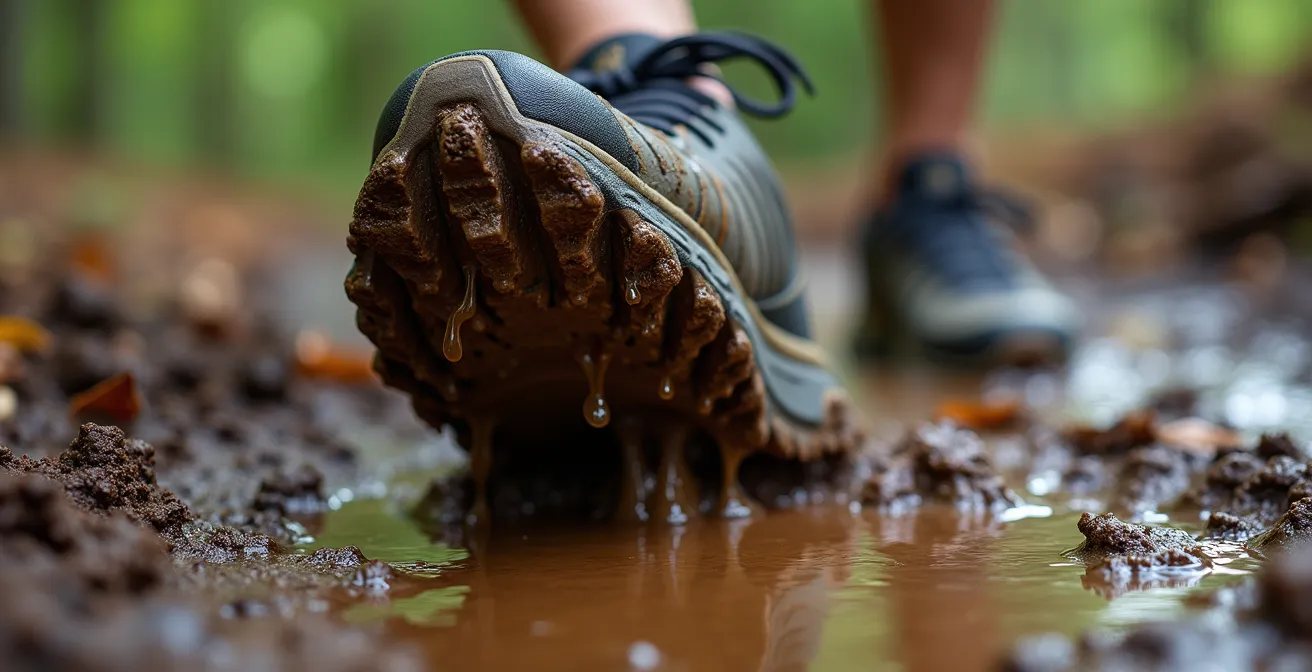
This image perfectly captures the concept of the energy leak. That deep impression is force that didn’t contribute to forward motion. To compensate, your body must work harder just to maintain a slower speed, leading to premature cardiovascular fatigue. The solution isn’t to power through it—that’s a losing battle. The solution is to adapt your form: shorten your stride, increase your cadence, and focus on lifting your feet rather than pushing off forcefully. You must learn to glide over the mud, not fight it.
How to Switch to ‘Power Hiking’ Efficiency on Grades Over 15%?
On the road, hills are obstacles to be conquered by maintaining rhythm and drive. On the trail, steep grades are a different beast entirely. Attempting to run a 15% or steeper incline is one of the biggest and most common energy leaks for a transitioning road runner. At a certain point, the biomechanical cost of running uphill becomes so high that it is dramatically less efficient than a strong, purposeful hike. Insisting on running when the grade gets severe is an act of ego, not efficiency, and it will drain your reserves for the miles to come.
This is where the efficiency mindset must override the pace mindset. Is it okay to walk during a trail run? It’s not just okay; it’s essential. Power hiking is a specific, powerful gear in every skilled trail runner’s toolkit. It’s not a sign of failure; it’s a strategic decision to conserve energy. The goal is to maintain a consistent effort level, not a consistent gait. When your heart rate spikes into your highest zones on an incline, that is the signal from your body to switch gears. An optimal transition occurs when the gradient makes running feel like bounding rather than flowing, typically on grades above 15-20%.
The technique involves a forward lean from the ankles, a powerful arm swing, and often using your hands on your thighs to help push off and engage your quads directly. This “quad press” transfers some of the load from your legs to your upper body, providing a micro-rest for your primary running muscles while still making steady upward progress. Mastering this switch is key to surviving and even thriving in mountainous terrain.
Your Action Plan: Master the Power-Hiking Switch
- Monitor the gradient: Recognize that on inclines of 15% (or a 0.15 gradient) and above, walking often becomes more efficient than running.
- Track heart rate zones: Use your heart rate as your primary guide. Switch to a powerful hike as soon as you enter your maximum effort zone (Zone 5).
- Focus on consistent effort: Maintain a high but sustainable level of perceived exertion (RPE), rather than chasing a specific pace on your watch.
- Use the ‘Hands-on-Thighs’ press: On the steepest sections, place your palms on your quads and use your arms to help propel yourself upward with each step.
- Return to running strategically: Once the grade lessens and your heart rate drops back into a sustainable tempo or threshold zone (Zone 3-4), smoothly transition back to a running gait.
Road Shoes on Trail: Why Soft Foam Becomes Unstable on Rocks?
Your high-stack, soft-cushioned road shoes are engineered for one thing: repetitive shock absorption on a flat, predictable surface. They are brilliant at this job. But on a trail, that same design becomes a major liability and a source of significant energy leaks. The thick, soft midsole that feels so protective on pavement acts like a wobbly platform on rocks, roots, and side-slopes. It elevates your foot far from the ground, muting the precious terrain feedback needed for quick adjustments.
This instability forces your body to work overtime. As David Roche, a renowned trail running coach, notes, your smaller stabilizing muscles are critical for staying upright on uneven surfaces. When you wear unstable shoes, these muscles in your feet, ankles, and hips are in a constant state of high alert, firing relentlessly to prevent a rolled ankle or a fall. This constant, low-level muscular activity is exhausting. It’s an invisible energy drain that contributes to that feeling of heavy, tired legs long before your cardiovascular system gives out. Your ankles might feel sore after a run, not because the trail is inherently “harder,” but because your footwear forced them into a desperate battle for stability.
Furthermore, the lack of a protective rock plate in most road shoes means sharp rocks and roots press directly into the soft foam and your foot, causing painful bruising and forcing you into tentative, inefficient strides. You are not just wasting energy on stabilization; you are actively trying to avoid pain, which completely disrupts your running form. The right tool for the right job is a core principle in the mountains, and road shoes are simply the wrong tool.
Lug Depth: Deep Cleats vs. Hybrid Tread for Mixed Terrain?
If unstable foam is the problem, then a proper trail shoe is the solution. But “trail shoe” is a broad category. The most crucial feature that directly addresses the energy leaks of instability and poor traction is the outsole, specifically the depth and pattern of its lugs. Unlike the flat, smooth outsoles of road shoes designed for maximum surface contact on asphalt, trail shoes feature aggressive, lugged outsoles that act like claws, digging into soft earth and gripping onto wet rock.
As the TrailHeads Editorial Team puts it, “Trail shoes are absolutely essential for the uneven ground of trail runs. Unlike regular running shoes, these feature soft lugs to better grip the terrain.” This grip is not a luxury; it’s the foundation of efficiency. Without it, you slip. A small slip backward on mud or a skid on a wet root may seem minor, but each one is an energy leak. It’s wasted propulsion that your body must immediately compensate for. Over thousands of steps, this wasted effort accumulates into profound fatigue.
Choosing the right lug depth depends on the terrain. Deep, widely spaced cleats (5mm or more) are ideal for thick mud and very loose ground, as they bite deep and shed mud effectively. However, on hard-packed trails or sections of rock, they can feel clumsy and wear down quickly. A hybrid tread with shorter, more numerous lugs (3-4mm) offers a versatile compromise, providing good grip across a mix of conditions without sacrificing too much performance on firmer sections. The key is to match your shoe’s tread to the majority of the terrain you’ll be running.
This table from Salomon provides a clear overview of the fundamental design differences driven by the demands of the terrain. Notice how every feature of the trail shoe is geared towards control and protection, not just raw speed.
| Feature | Trail Shoes | Road Shoes |
|---|---|---|
| Outsole Design | Lugged outsoles for grip on loose, uneven terrain | Flat outsoles for speed on smooth surfaces |
| Toe Box | Closer fit for precision and control on technical terrain | Wider, more comfortable toe box |
| Cushioning | Less cushioning but protection against rough terrain | Ample cushioning for shock absorption on hard surfaces |
The Downhill Destruction: Why Your Quads Fail Before Your Lungs?
For many road runners, the downhills feel like a chance to “make up time.” On the trail, this mindset leads to disaster. Uncontrolled, high-speed descending is perhaps the single most destructive activity for your leg muscles. Your lungs may feel fine, but your quads will be screaming in protest, turning to jelly long before you’re cardiovascularly tired. This is due to the intense demands of eccentric muscle contractions.
When you run downhill, your quadriceps act as brakes to control your descent and absorb impact. This braking action, where the muscle lengthens under tension, is an eccentric contraction. As coach David Roche explains, “On downhills, your quad muscles lengthen more than they would on a flat or uphill, putting more tension on the muscle fibers.” This action creates microscopic tears in the muscle fibers far more rapidly than any other type of running. It’s the reason you feel so sore after a day of hiking in the mountains. For a runner, this damage accumulates rapidly, leading to a catastrophic loss of power.

The consequences are measurable and severe. Post-race studies on mountain ultramarathon fatigue show a significant increase in the energy cost of downhill running, indicating that muscle damage has made the movement far less efficient. Your body is forced to recruit more muscle fibers to do the same job, accelerating fatigue. The key to survival is not to avoid downhills, but to master the art of controlled braking. This involves leaning back slightly, keeping your feet under your center of gravity, taking short, quick steps, and using your arms for balance. You are not letting gravity win; you are negotiating with it, minimizing the braking forces and preserving your quads for the long haul.
Solid Food vs. Gels: What Stomachs Can Handle During 4+ Hour Runs?
On the road, fueling is often a simple equation of consuming a specific number of calories per hour, usually in the form of easily digestible gels or chews. This works because the effort is relatively constant. On the trail, the variable intensity throws a wrench in this system. The lower average speed and longer duration of trail runs, combined with periods of intense effort (uphills) and jarring descents, can wreak havoc on a stomach trying to process simple sugars.
This is why trail race aid stations look more like a picnic than a science lab. You’ll find potato chips, pretzels, cookies, and even sandwiches alongside the familiar gels. This isn’t just for fun; it’s a practical response to the body’s needs during prolonged, variable-intensity exercise. During the lower-intensity power-hiking sections, your heart rate is lower, and your digestive system can handle more complex, solid foods. These foods provide a more sustained energy release and can help combat “flavor fatigue”—the overwhelming aversion to sweet gels after hours on the trail.
A successful trail fueling strategy is about variety and timing. Use fast-acting gels and chews for high-intensity periods like steep climbs or a final race push. During the long, slower grinds and hiking sections, turn to solid foods. A small piece of a peanut butter sandwich, a handful of salty chips, or a few dates can provide crucial calories and a psychological boost. The salt in foods like chips and pretzels is also vital for replacing sodium lost through sweat, a factor that becomes much more critical over the 4+ hours typical of many trail events. Self-sufficiency is paramount; you must carry a mix of options, as aid stations can be sparse and unpredictable.
From Walking to Sprints: A 12-Week Roadmap for Total Beginners
Understanding the theory is one thing; applying it is another. Transitioning from a road-running chassis to a trail-ready one requires a structured, patient approach. You can’t simply take your road training plan and execute it on dirt. You need to rebuild your foundation with a focus on strength, stability, and new metrics for success. A 12-week roadmap can help you make this shift methodically.
Weeks 1-4: Neuromuscular Activation. The first month is about teaching your body to talk to itself again. Your focus should be less on mileage and more on strength and stability. This means incorporating workouts that target not just the primary movers (quads, glutes, hamstrings) but also the smaller stabilizing muscles in your hips, core, and ankles. Single-leg squats, balance exercises, and core work are not optional accessories; they are the primary work of this phase. Your goal is to build the support structure that prevents energy leaks from instability.
Weeks 5-8: Develop Vertical Mastery. Now, you take that new strength to the hills. This phase is about letting go of pace entirely. Your key metrics become “Time on Feet” and “Vertical Feet per Hour.” Deliberately practice your power-hiking technique on the steepest inclines and your controlled-braking on descents. A great workout is to find a moderately steep hill and do repeats, focusing purely on efficient form up and down, with full recovery in between. You are training movement patterns, not your cardiovascular system.
Weeks 9-12: Race Simulation and Integration. In the final phase, you put it all together. Plan long runs on terrain that mimics your goal race. This is where you test your nutrition and hydration strategy, practice running with a full pack, and learn what it feels like to run on fatigued legs after a long, grinding climb. Your training should be based on effort (Rate of Perceived Exertion or RPE) rather than pace. A tempo run on a trail is a sustained, controlled effort, not a specific speed. This phase builds the confidence and resilience needed to tackle race day.
Key Takeaways
- Your road pace is irrelevant; trail running success hinges on managing effort and plugging “energy leaks” from terrain and inefficient technique.
- Mastering technical skills like power-hiking on ascents and controlled braking on descents is more important than raw cardiovascular fitness.
- Your gear must match the terrain. Stable, lugged trail shoes are non-negotiable tools for preventing injury and improving efficiency.
Racecations: How to Plan Travel Around a Marathon Without Ruining Performance?
As you evolve as a trail runner, your definition of success will change. The sport is less about setting personal bests and more about the experience, the journey, and the ability to spend long, sustained hours moving through beautiful, challenging landscapes. The “racecation”—planning a trip around a trail race—becomes a natural extension of this ethos. The goal shifts from shaving minutes off a time to successfully completing an adventure.
This is where the metric of “Time on Feet” truly comes into its own. A road marathon might be a 3, 4, or 5-hour effort. A trail marathon in the mountains could take 6, 7, or even 8 hours for the same runner. In fact, research on mountain ultra-endurance runners shows an average completion time of over 12 hours for a 50-mile race. These are events of endurance and problem-solving, not pure speed. When planning a racecation, the performance goal should be to manage your effort so that you can finish strong and still have the energy to enjoy the destination you traveled to.
This means training for the specific demands of the course—the total vertical gain, the type of terrain, the likely weather. Your performance is not ruined by a “slow” time; it’s ruined by a DNF (Did Not Finish) caused by going out too hard, poor nutrition, or muscle failure from unpreparedness. The ultimate success is crossing the finish line feeling tired but whole, with a deep sense of accomplishment and the capacity to celebrate your journey.
By shifting your mindset from pace to efficiency, from conquering to navigating, you can unlock your true endurance potential. Stop fighting the trail and start working with it. Your engine is strong enough; it’s time to build a chassis that can handle the ride.
Frequently Asked Questions About Trail Running Nutrition and Technique
Why is nutrition different for trail running compared to road running?
The effort in trail running is far more variable. Softer surfaces can make holding speed harder, as some of the energy you exert is absorbed by the ground. This requires a more flexible fueling strategy that mixes fast-acting energy for intense sections and more substantial, solid foods during lower-intensity hiking periods when your body can digest them more easily.
Should I carry my own nutrition on trail runs?
Absolutely. Trail aid stations are often less frequent and their offerings less consistent than on the roads. Because most trail races are in remote areas, access can be limited. Trail runners need to cultivate a greater level of self-sufficiency, carrying their own water and a variety of fuel, because you never know what the trail may bring or how long a section will take.
What types of food work best for long trail efforts?
A mix of simple and complex carbohydrates is ideal. Use energy gels or chews for quick energy during high-intensity efforts like steep climbs. During slower, lower-intensity hiking sections, turn to solid foods like fruit, small sandwiches, salted potatoes, or energy bars. These are easier to digest when your heart rate is lower and help prevent flavor fatigue from too many sweet products.