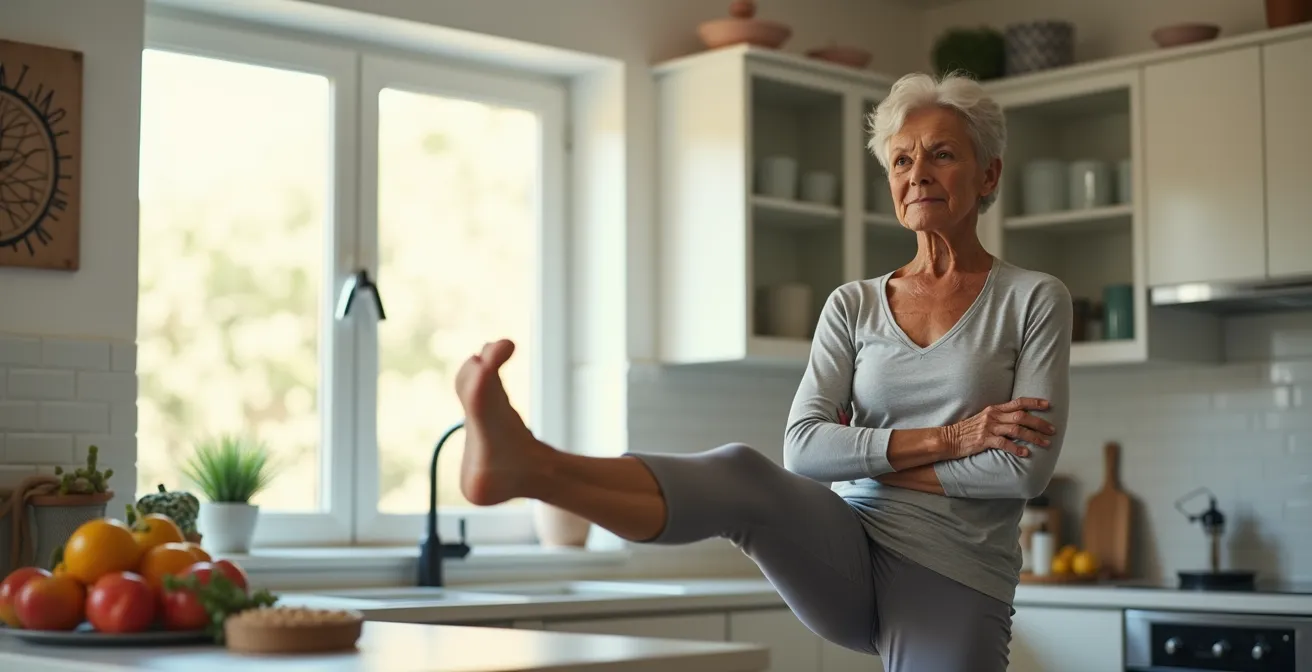
Contrary to popular belief, preventing falls after 60 isn’t about building massive leg strength on machines. The true secret lies in retraining your body’s forgotten sense of balance—proprioception. This guide focuses on simple, safe, bodyweight exercises that re-establish the crucial brain-body connection, giving you the confidence and stability to maintain your independence for years to come.
The fear of falling can cast a long shadow over our later years. It’s a quiet concern that can limit our activities, shrink our world, and threaten the independence we cherish. For many, the common advice is to “strengthen your legs,” leading to hours spent on gym machines like the leg press. While strength is important, this approach misses the most critical piece of the puzzle. It’s like upgrading a car’s engine without fixing the steering—you have power, but no control.
The real culprit behind most age-related balance issues isn’t a lack of raw muscle power, but a decline in a crucial sense you may have never heard of: proprioception. Think of it as your body’s internal GPS. It’s the silent, constant conversation between your brain, joints, and muscles that tells you where you are in space without you having to look. As we age, this signal can weaken, making us less able to react to a stumble or an uneven surface.
But what if the key to staying upright wasn’t just about being stronger, but about becoming smarter in our movements? What if we could retrain this internal GPS? This is the core of our approach. We are not just building muscle; we are rebuilding the intricate communication network that grants you effortless stability. This guide will walk you through why this system fails, how to reawaken it with safe and effective exercises, and how to create a lifestyle that fosters unshakable confidence in your every step.
This comprehensive guide is structured to empower you with knowledge and practical tools. We will explore the science behind balance, provide step-by-step exercise instructions, and help you turn your home into a safer environment. Let’s begin your journey back to confident movement.
Summary: The Complete Guide to Reclaiming Your Balance
- Why Proprioception Degrades Faster Than Strength as You Age?
- How to Safely Practice Single-Leg Stands Near a Kitchen Counter?
- Leg Press vs. Goblet Squat: Which Recruits More Stabilizer Muscles?
- The Carpet Edge: Common Household Hazards That Challenge Weak Stabilizers
- Daily vs. Weekly: How Often Must You Train Balance to See Improvement?
- Why Controlling Your Own Weight Improves Balance Better Than Machines?
- Static Road Posture vs. Dynamic MTB Body Language: When to Move?
- Mobility vs. Flexibility: What You Need to Fix Chronic Stiffness?
Why Proprioception Degrades Faster Than Strength as You Age?
As a physical therapist, one of the most common misconceptions I address is the belief that falls are simply a result of weak legs. While strength plays a role, the more significant factor is the degradation of proprioception—your body’s sixth sense. This is the intricate system of sensors in your muscles and joints that communicates with your brain, creating a real-time map of your body’s position. It’s what allows you to walk in the dark or touch your nose with your eyes closed. This sense, unfortunately, often declines more rapidly than pure muscle strength.
As we age, the speed and clarity of this “body-to-brain” communication can diminish. The signals become fuzzier and slower. Imagine your phone’s GPS lagging in a busy city; the map is slightly off, causing you to miss a turn. Similarly, when your proprioceptive system lags, your reaction to a slight trip or slip is delayed. Your muscles don’t get the message fast enough to make the tiny, instantaneous adjustments needed to stay upright. This is why a stumble that you would have easily recovered from at 30 can lead to a fall at 70, even if you’re still quite strong.
Research confirms this sensory decline. A study in Scientific Reports investigated how proprioception changes with age and found that older adults had significantly larger errors when trying to judge their limb position without looking. The study noted that young adults could correct these errors over time, but for older adults, the error was almost constant, indicating a breakdown in the learning and adaptation process. This highlights that fall prevention must be a sensory re-education program, not just a strength program.
How to Safely Practice Single-Leg Stands Near a Kitchen Counter?
Re-educating your proprioceptive system doesn’t require a fancy gym. Your kitchen counter is the perfect training partner. The goal is to challenge your balance just enough to force your brain and muscles to communicate better, while always remaining in a zone of safety. The single-leg stand is a cornerstone of this practice. It forces the hundreds of small stabilizer muscles in your foot, ankle, and hip to fire in coordination to keep you centered.
The key is progression. You start with maximum support and gradually reduce it as your “movement intelligence” improves. Your hand on the counter is not a crutch; it’s a dial you can turn down. Think of it as transitioning from a training wheel to a free-floating bicycle. Each small step forward rewires your brain for better balance. Your safety is the absolute priority, so never progress to a level that feels reckless or causes anxiety. Confidence is built on a foundation of successful, safe practice.
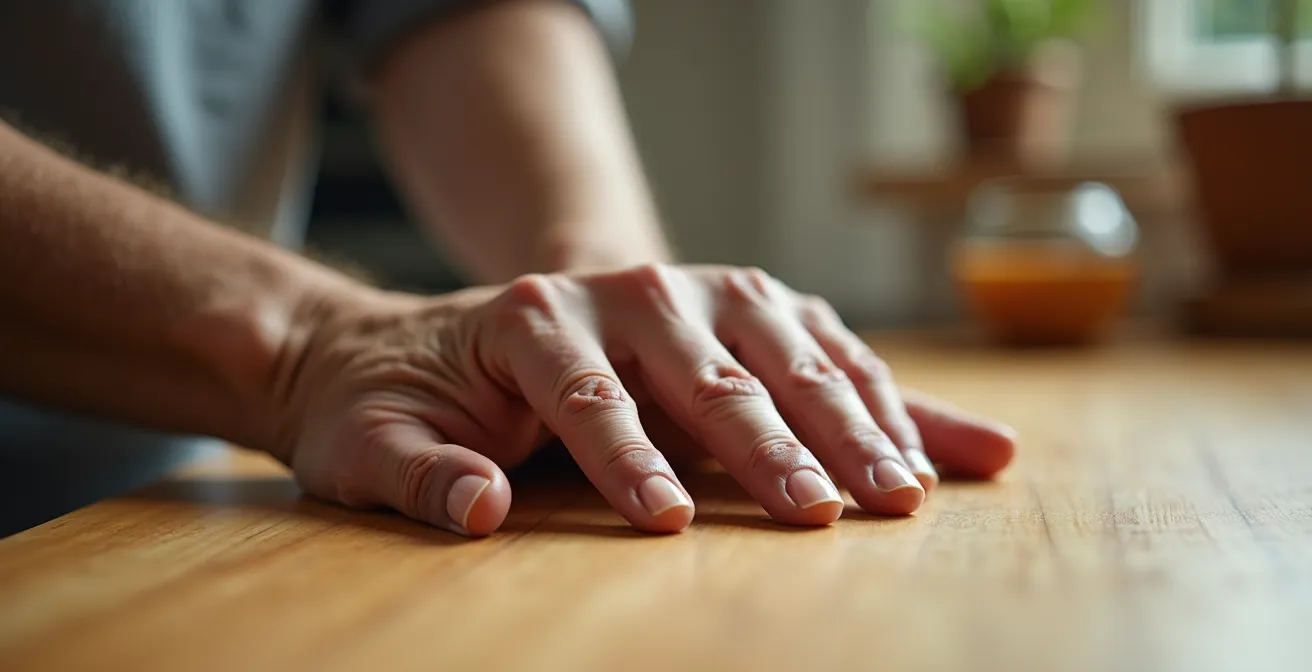
The image above perfectly captures the essence of this progression. Notice the transition from a full, supportive palm to a light, guiding fingertip. This is the journey you will take, slowly telling your body, “I trust you to handle more.” Listen to your body’s feedback; some days you may feel more stable than others. That’s normal. The goal is consistent practice, not perfect performance every single time.
Your 5-Step Balance Self-Assessment Protocol
- Establish Your Baseline: Stand near a counter with your feet shoulder-width apart, holding on lightly. Close your eyes for 10 seconds. Note any swaying. This is your starting point.
- Test Your Static Stance: Bring your feet completely together. Hold onto the counter and aim to stand still for 30 seconds. This removes the wide base of support and challenges your stability.
- Introduce Single-Leg Challenge: Lift one foot just an inch off the ground. Your goal is to work up to holding this for 30 seconds per leg, using the counter for support as needed.
- Audit Your Hand Support: Systematically reduce your reliance on the counter. Progress from a full palm, to four fingers, then two, one, and finally just a fingertip. Spend a few days at each level.
- Plan Your Integration: Once you can balance on one leg with minimal support, practice integrating it into daily life. Try balancing for a few seconds while waiting for the kettle to boil or brushing your teeth.
Leg Press vs. Goblet Squat: Which Recruits More Stabilizer Muscles?
Not all strength training is created equal when it comes to fall prevention. This is where we must distinguish between building brute strength and building functional, “intelligent” strength. The leg press machine is a perfect example of the former. It allows you to move heavy weight in a fixed, supported path. While it strengthens your quadriceps, it does very little to train the stabilizer muscles or your proprioceptive system. The machine provides all the stability, so your body doesn’t have to learn how.
In contrast, a bodyweight or goblet squat is a masterclass in stabilizer recruitment. When you squat, you aren’t just moving up and down. Your body is making thousands of micro-adjustments per second to keep you from falling forward, backward, or sideways. Your feet grip the floor, your ankles flex and stabilize, your knees track over your toes, your hips control the descent, and your core braces your entire torso. It’s a full-body conversation, orchestrated by your internal GPS to manage your center of gravity in open space—exactly what you need to do to prevent a fall.
Strengthening your legs and improving your balance are proven falls-prevention tools. These specific exercises need no special equipment and can be done anywhere.
– National Council on Aging, NCOA Falls Prevention Guide
This comparative table, based on principles outlined by experts like the National Council on Aging, clearly illustrates why free-standing exercises are superior for fall prevention.
| Aspect | Leg Press | Goblet Squat |
|---|---|---|
| Stability Type | External (machine provides) | Internal (body must create) |
| Planes of Motion | Single plane (forward/back) | Three planes simultaneously |
| Stabilizer Activation | Minimal | High (feet to shoulders) |
| Core Engagement | Passive | Active anti-flexion |
| Proprioceptive Richness | Poor (fixed movement) | Rich (constant micro-adjustments) |
| Fall Prevention Value | Limited | High |
The Carpet Edge: Common Household Hazards That Challenge Weak Stabilizers
Improving your internal stability is half the battle; the other half is managing the external environment. Your home should be your sanctuary, but it’s often filled with hidden challenges that can instantly overwhelm a weakened proprioceptive system. The edge of a throw rug, a stray cord, a poorly lit hallway, or a slippery bathroom floor can be the trigger for a devastating fall. In fact, an estimated 25% of older adults experience a fall each year, and the majority of these happen at home.
A healthy balance system can navigate these minor obstacles without a second thought. Your foot might catch the edge of a carpet, but your internal GPS instantly fires a signal to your other leg and core to adjust your weight, and you recover before you even realize you tripped. However, when that system is slow, that small trip becomes a moment of panic. The correction signal doesn’t arrive in time, and your center of gravity shifts too far, too fast. This is why making your home “fall-proof” is a non-negotiable part of a comprehensive stability plan.
It’s not about living in a padded room; it’s about making smart, simple changes to reduce the number of unexpected challenges your body has to face. This proactive approach buys your balance system precious time and reduces the odds of it being overwhelmed. Conduct a simple “safety walk” through your home today and look for these common culprits:
- Walking Paths: Clear all pathways of clutter like shoes, books, or papers. You should have a clear line of sight and movement.
- Rugs and Carpets: Remove small, unsecured throw rugs. For larger area rugs, use double-sided tape to firmly secure all edges and corners to the floor.
- Lighting: Ensure all hallways, stairways, and bathrooms are brightly lit. Use nightlights to illuminate the path from your bedroom to the bathroom at night.
- Bathrooms: This is a high-risk area. Install grab bars next to the toilet and inside the tub or shower. Use non-slip mats both inside and outside the shower.
Daily vs. Weekly: How Often Must You Train Balance to See Improvement?
Improving your balance is more like learning a language than lifting a weight. It thrives on consistency and frequent practice, not on single, exhausting sessions. The brain-body connection you are trying to strengthen is reinforced through repetition. Think of it as saving a new file to your brain’s hard drive; the more often you access and use that file, the faster and more reliable the connection becomes. A single, long session once a week is less effective than short, focused sessions practiced daily.
The National Council on Aging reinforces this, stating, “These exercises you can do daily, as part of your routine. The best part is they can be done anywhere, anytime, any place.” This is empowering. You don’t need to block out an hour of your day. You can integrate “balance snacks” throughout your routine: practice single-leg stands while the coffee brews, do heel-to-toe walks down your hallway, or perform a few chair stands during a commercial break. These small, consistent inputs add up to significant improvements in your stability and confidence.
While balance-specific exercises should be practiced daily, they are part of a larger activity picture. Your overall goal for health and fall prevention should align with official recommendations. For instance, the CDC recommends that adults 65 and over get at least 150 minutes of moderate-intensity exercise weekly, plus two days of muscle-strengthening activity. Your daily balance work is the perfect complement to this, ensuring that the strength you build is usable, functional, and directly contributes to your stability.
Don’t be discouraged if progress feels slow. You are re-wiring decades-old neural pathways. Be patient and persistent. Celebrate the small victories: holding a stand for two seconds longer, feeling more stable on a walk, or navigating a crowded space with newfound confidence. These are the true markers of success.
Why Controlling Your Own Weight Improves Balance Better Than Machines?
As we’ve discussed, machines provide external stability, which is the exact opposite of what you need to prevent falls in the real world. A fall is, by definition, a loss of control over your own body weight in space. Therefore, the most effective training involves practicing precisely that: controlling your own body weight through multiple planes of motion. Exercises like sit-to-stands, lunges, and step-ups are far superior to their machine-based counterparts.
Consider the reverse lunge. As you step back, your body must actively work to decelerate your momentum. Your core engages powerfully to prevent you from collapsing forward. The stabilizer muscles in your standing leg’s hip and ankle fire constantly to maintain balance. When you push back up to the starting position, you are coordinating a complex sequence of muscle contractions against the force of gravity. This is dynamic, three-dimensional movement control—the very skill that keeps you upright when you stumble.
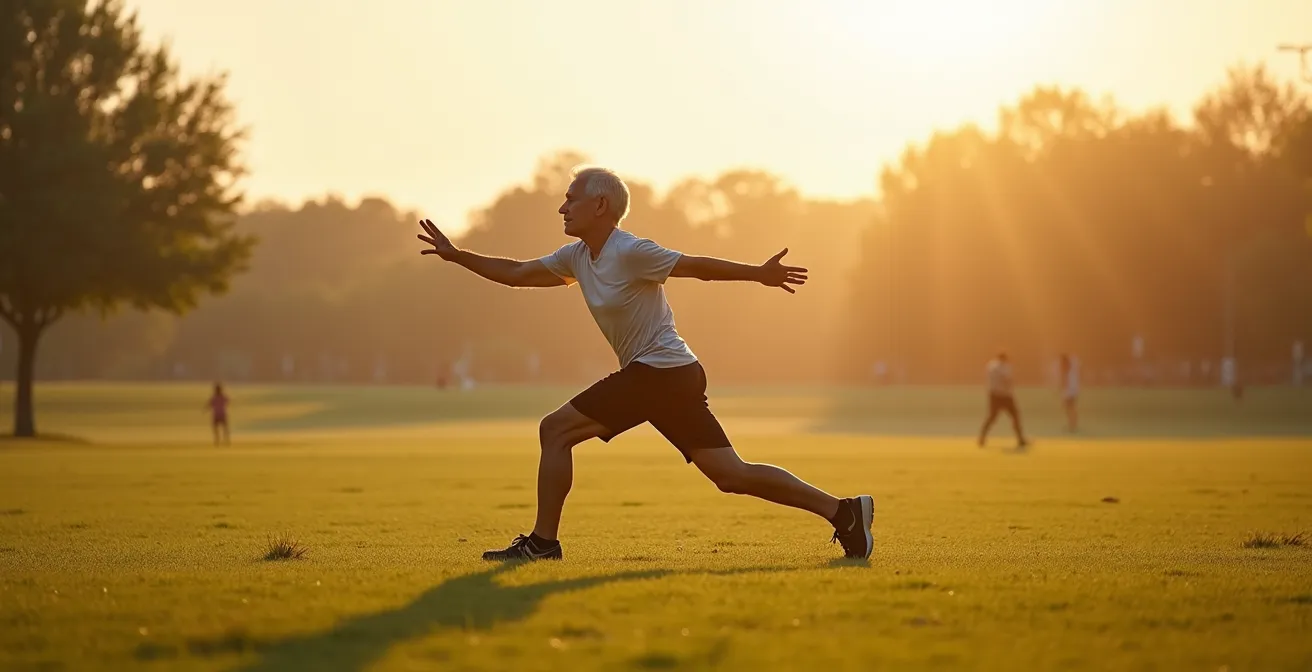
The freedom of bodyweight training, as shown above, directly translates to the freedom and confidence you want in your daily life. You are teaching your body to be its own support system. You can start this journey safely with simple progressions that build a foundation of functional strength:
- Sit-to-Stands: Begin by standing up from a sturdy chair and sitting back down slowly. Use your hands for support at first, then progress to performing the movement hands-free. This builds fundamental leg and glute strength.
- Heel-to-Toe Walking: Practice walking in a straight line, placing the heel of one foot directly in front of the toe of the other. This narrows your base of support and challenges your dynamic balance.
- Reverse Lunges: Hold onto a counter for support and take a slow, controlled step backward. Focus on keeping your torso upright. This is a powerful exercise for building single-leg stability.
Key Takeaways
- Proprioception (your body’s ‘GPS’) declines faster than strength and is the primary target for fall prevention.
- Bodyweight exercises like squats and single-leg stands are superior to machine-based training for building real-world stability.
- Consistency is key: Aim for short, daily balance practice combined with at least 150 minutes of weekly activity.
Static Road Posture vs. Dynamic MTB Body Language: When to Move?
To truly master balance, we need to move beyond static holds and embrace dynamic stability. Let’s use an analogy from cycling. Imagine a road cyclist on a smooth, flat road. They hold a rigid, unchanging posture for hours. This is static posture. Now, picture a mountain biker (MTB) navigating a rocky, unpredictable trail. Their body is never still. They are constantly shifting their weight, absorbing bumps, and adjusting their position to stay upright. This is dynamic body language.
To prevent falls, you want to train more like the mountain biker. Life is not a smooth, flat road; it’s an unpredictable trail. Your balance training should reflect this. Static exercises like the single-leg stand are the starting point—they teach your body to find its center. But dynamic exercises teach your body to *re-find* its center after being disturbed. This ability to react and adapt is the essence of functional balance.
What does this “dynamic body language” look like in practice? It means moving your head while trying to balance, which challenges your vestibular system (your inner ear’s balance center). It means practicing stepping over small obstacles, or gently tossing a ball from hand to hand while standing on one leg. Each of these small, unpredictable movements forces your internal GPS to update faster and more accurately. You are training your nervous system to expect the unexpected and respond with skill, not panic. This improved coordination between your brain and body is crucial for staying upright in challenging environments.
This dynamic training is what builds true resilience. You are not just building the ability to stand still; you are building the ability to move through the world with confidence, ready to handle whatever the “trail” throws at you.
Mobility vs. Flexibility: What You Need to Fix Chronic Stiffness?
Finally, we must address the foundation upon which all balance is built: mobility. People often use the terms “flexibility” and “mobility” interchangeably, but they are critically different. Flexibility is the passive ability of a muscle to be lengthened, like when someone else pushes your leg up in a stretch. Mobility, on the other hand, is your ability to actively control your joints through their full range of motion.
You can be flexible but have poor mobility. If you lack the strength and control to move your own leg into that position, you don’t own that range of motion. For fall prevention, mobility is king. Chronic stiffness, especially in the ankles, hips, and thoracic spine (your upper back), severely limits your ability to make the adjustments needed to stay balanced. If your ankles are stiff, you can’t make the fine-tuned movements to stay centered. If your hips are tight, you can’t sink into a stable squat position to lower your center of gravity during a stumble.
Improving mobility isn’t about holding static stretches for minutes on end. It’s about active, controlled movements. Think of circles with your ankles, slow and controlled leg swings, and gentle torso twists. These movements lubricate the joints and teach the nervous system how to control your body in its end ranges of motion. This is directly linked to better proprioceptive feedback. In fact, research comparing age groups found that significant differences in proprioception were observed between active and sedentary older adults, suggesting that regular activity that promotes mobility can help slow this sensory decline.
Without adequate mobility, you simply cannot get into the correct positions to perform balance and strength exercises effectively. Working on your mobility is like tuning your instruments before the orchestra plays. It ensures every part of your body is ready and able to perform its role in the symphony of movement.
Take control of your stability today. Start with these simple, foundational exercises and build the confidence to live an active, independent life you deserve.