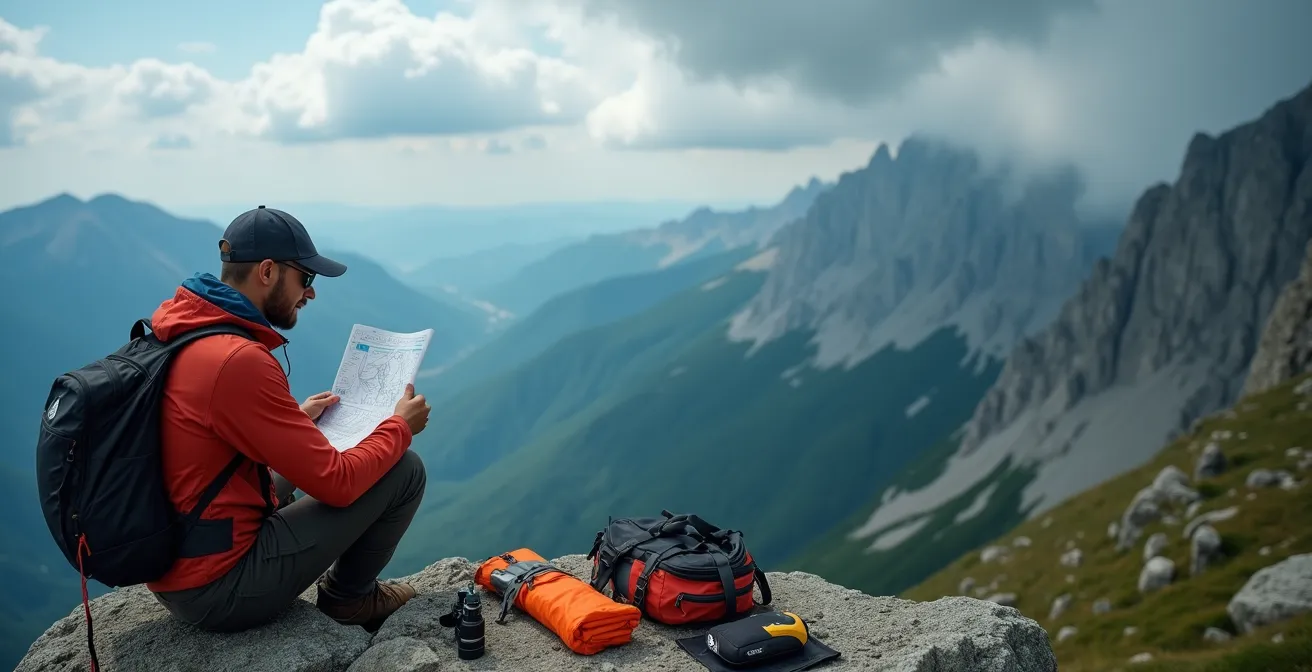
Your physical fitness from the gym is insufficient for the objective dangers of the wilderness; true survival depends on mental frameworks, not just gear.
- Most wilderness emergencies stem from a chain of poor decisions, not a single catastrophic event or gear failure.
- Panic is a greater killer than starvation or exposure because it shuts down rational thought. Structured protocols are the only antidote.
Recommendation: Shift your preparation focus from a simple gear checklist to mastering a dynamic risk calculus—constantly evaluating probability, consequence, and your own cognitive biases.
For the adventurer transitioning from the controlled safety of a climbing gym to the raw, unpredictable expanse of the outdoors, the change is profound. In the gym, risk is managed for you. Routes are set, pads are placed, and help is a shout away. The wilderness offers no such guarantees. It is an uncontrolled environment where the consequences of a mistake are absolute. Many believe that having the right equipment—the “ten essentials”—is the primary buffer against danger. They meticulously pack their compasses, headlamps, and first-aid kits, believing they have bought a ticket to safety.
This approach, while not wrong, is dangerously incomplete. It mistakes the tools for the skill. True wilderness risk management is not a static checklist but a dynamic mental process. It is a disciplined practice of observation, evaluation, and decision-making that begins long before you reach the trailhead and continues with every step you take. It’s about developing a profound respect for objective hazards and a deep understanding of your own subjective limitations. The most critical piece of survival gear you will ever carry is not in your pack; it is the structured, disciplined mind you bring with you.
But if the key is not just the gear, what is it? The real answer lies in shifting your mindset from that of a participant to that of an operator. It requires developing a rigorous risk calculus, embracing cognitive discipline to override emotional impulses, and cultivating a high degree of environmental literacy. This guide is built on that principle. We will deconstruct the anatomy of wilderness emergencies, from reading the environment to mastering your own psychology, to equip you with the mental frameworks necessary to navigate and survive in places where you are the ultimate authority on your own safety.
This comprehensive guide will walk you through the critical layers of risk management. By exploring each section, you will build the mental fortitude required to transform from a simple adventurer into a competent wilderness navigator.
Summary: A Strategic Guide for Uncontrolled Environments
- Objective Hazards: How to Read Weather Signs Before the Storm Hits?
- How to Survive an Unplanned Night Out with Only Day-Hike Gear?
- Solo Agility vs. Group Safety: Which Is Risker in Remote Areas?
- The Panic Spiral: Why Getting Lost Kills More People Than Starvation?
- PLB vs. Satellite Messenger: When to Push the SOS Button?
- Why Your Heart Rate Increases Faster When Exercising in Freezing Temps?
- Mountain Trekking vs. Coastal Kayaking: Which Trip Suits Beginners Best?
- Adventure Travel Insurance: Why Your Standard Policy Won’t Cover Helicopter Rescue?
Objective Hazards: How to Read Weather Signs Before the Storm Hits?
The first step in wilderness risk management is developing environmental literacy—the ability to read the world around you as accurately as you read a map. Technology has made us lazy; we glance at a weather app and assume we have the full picture. But in mountain environments, weather is intensely local and can change with terrifying speed. A forecast for “partly cloudy” is meaningless when you are in a valley system that generates its own weather. Your primary source of information must be the sky itself, and learning its language is a non-negotiable survival skill. The difference between a pleasant afternoon and a life-threatening emergency can be your failure to notice a shift in the wind or a change in cloud formation.
Understanding weather goes beyond simply “bad” or “good.” It’s about recognizing patterns and understanding the physics behind them. For example, a classic sign of an approaching frontal system is a specific sequence of clouds. It often begins with high, wispy cirrus clouds, which then thicken into a sheet-like layer of cirrostratus. As the front gets closer, these are replaced by a gray, featureless blanket of altostratus, signaling that precipitation is likely within 12 to 24 hours. Another critical tool is a barometer, often found on an altimeter watch. A steady, rapid drop in barometric pressure (4 or more millibars per hour) is a red-alert indicator of an imminent storm. You must learn to trust these natural signs more than the green icon on your phone’s screen.
The danger is not just the storm itself, but its insidious consequences. Many inexperienced adventurers underestimate the danger of being wet. They may think hypothermia is only a risk in freezing temperatures, but this is a fatal misconception. In fact, hypothermia can occur at 65°F (18°C) when a person is wet and exposed to wind. The cooling power of evaporation and convection can strip your body of its core heat with alarming efficiency. This is why developing the cognitive discipline to put on your rain gear *before* it rains, not when you start feeling drops, is a critical survival habit. It’s a simple action, but it reflects a proactive risk calculus rather than a reactive, and potentially tragic, response.
How to Survive an Unplanned Night Out with Only Day-Hike Gear?
An unplanned night in the wilderness is a common scenario that can escalate from an inconvenience to a life-or-death struggle. It is often the result of a chain of small errors: a late start, a wrong turn, underestimating the terrain. When dusk falls and you are not at your car, your body’s first response is a surge of adrenaline. This is a critical moment where cognitive discipline must override emotion. The single most important action is to halt all panicked movement. The STOP principle—Stop, Think, Observe, Plan—is not a suggestion; it is a lifeline. Case studies on wilderness survival show that individuals who force themselves to follow this protocol within the first 10 minutes of being lost have dramatically higher survival rates. It engages your prefrontal cortex, the seat of rational thought, and prevents the amygdala’s fear response from sending you into a blind, energy-wasting panic.
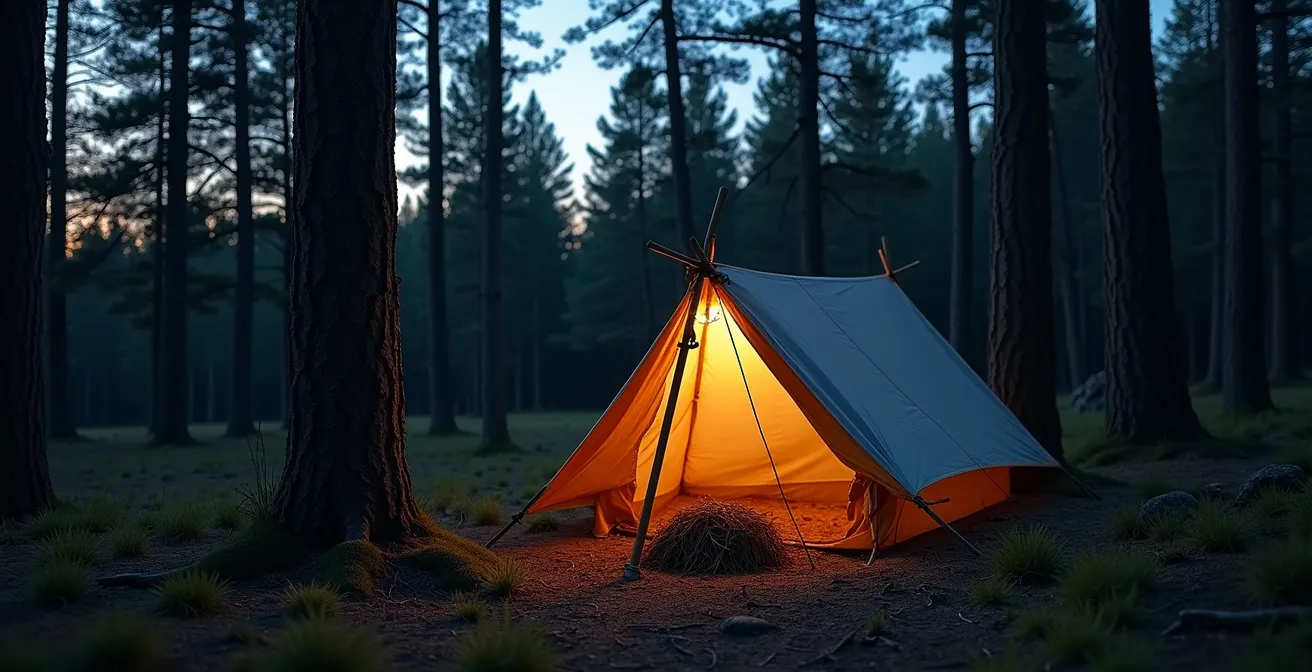
Once you have stopped, your priorities are dictated by the environment. In most situations, the primary threat is not starvation or predators; it is heat loss. Your risk calculus must now focus on one thing: conserving core body temperature. This means shelter is your number one priority, even before fire. An emergency space blanket, a staple of any day-pack, can be a lifesaver when configured as a simple lean-to shelter to block wind and trap radiant heat. Supplement this with natural insulation. Piling up a thick bed of dry leaves, pine needles, or other forest debris to create a barrier between you and the cold ground is more critical than building a large, fuel-hungry fire. A good debris bed can be the difference between a miserable night and the onset of hypothermia.
Every decision must be weighed in terms of energy expenditure versus survival benefit. Building a shelter costs calories, and you must decide if the effort is justified by the conditions. This is not a guess; it’s a calculation based on temperature and moisture.
The following table provides a clear decision matrix for prioritizing your actions. As data from survival experts demonstrates, the right action at the right time is crucial for energy conservation and preventing hypothermia.
| Temperature Range | Priority Action | Caloric Cost | Survival Benefit |
|---|---|---|---|
| Above 50°F (10°C) dry | Find wind protection | Low (200-300 cal) | Moderate comfort improvement |
| 32-50°F (0-10°C) or wet conditions | Build debris hut | High (800-1000 cal) | Critical – prevents hypothermia |
| Below 32°F (0°C) | Snow cave or quinzhee | Very High (1200+ cal) | Essential – life saving |
| Any temp with injury | Minimal ground insulation | Very Low (100 cal) | Critical – preserves core heat |
This matrix forces a logical, data-driven decision instead of an emotional one. By analyzing the conditions and making a calculated choice, you are actively managing your risk and energy reserves, which is the cornerstone of surviving an unexpected night out.
Solo Agility vs. Group Safety: Which Is Risker in Remote Areas?
The decision to travel solo or with a group is one of the most fundamental components of your pre-trip risk calculus. There are compelling arguments for both. A solo adventurer moves faster, makes decisions without committee, and can experience a profound sense of self-reliance and connection with nature. A group, on the other hand, provides redundancy in gear, skills, and decision-making. A twisted ankle that is a catastrophe for a solo hiker can be a manageable problem for a group of three.
However, the data on wilderness safety is sobering and points towards a clear answer. Despite solo hikers representing a minority of total trail users, search and rescue data reveals that 58% of all lost hikers requiring rescue are solo. This statistic is not an indictment of solo travel itself, but a stark warning that the margin for error is razor thin. When you are alone, there is no one to check your navigation, notice the early signs of hypothermia, or call for help if you are incapacitated. Every failure is a single point of failure for the entire system—you.
The risk of group travel is different, often stemming from social dynamics. “Summit fever,” poor communication, or a diffusion of responsibility can lead a group to make decisions that no single member would make alone. However, the inherent safety net of a group, provided it is functional, outweighs the agility of a solo traveler in most uncontrolled environments. The primary benefit is shared cognitive load. One person can focus on navigation while another monitors the weather and a third assesses the group’s physical condition. This distributed awareness is a powerful tool for breaking the chain of errors that so often leads to disaster.
For the adventurer moving from a gym to the mountains, the answer is unequivocal: start with a small, competent group. Your first forays into uncontrolled environments are not the time to test your ultimate self-reliance. They are the time to build experience, practice skills, and learn judgment with a safety buffer. The solitude of the wilderness will always be there, waiting for you once your skills and, more importantly, your judgment have been thoroughly proven.
The Panic Spiral: Why Getting Lost Kills More People Than Starvation?
In the theater of wilderness survival, the most lethal antagonist is not a bear, a blizzard, or a broken bone. It is an internal enemy: panic. The moment you realize you are lost, your physiology takes over. A flood of adrenaline and cortisol courses through your system, initiating the fight-or-flight response. Your heart rate skyrockets, your breathing becomes shallow, and your focus narrows. This is the beginning of the panic spiral, a psychological vortex that has killed more people in the backcountry than starvation and exposure combined. Panic is not an emotion; it is a neurological event that systematically dismantles your ability to think rationally.
The evidence for this is stark. Wilderness rescue statistics demonstrate that lost individuals are found on average only 58 meters from the nearest trail and 1.8 kilometers from their point of last seen. They do not die because they are hopelessly deep in the wilderness; they die because panic drives them to make irrational, self-destructive decisions within a stone’s throw of safety. They wander in circles, discard critical gear, and ignore obvious clues. The reason for this is physiological, as the Wilderness Medical Society explains in its research:
The prefrontal cortex, responsible for navigation and problem-solving, becomes suppressed by cortisol and adrenaline during panic, explaining why lost hikers often make irrational decisions that worsen their situation.
– Wilderness Medical Society, Epidemiology of Wilderness Search and Rescue Study
This suppression of higher-order brain function is why a seasoned mountaineer can become as disoriented as a child. It’s not a failure of character, but a failure of the brain’s executive functions. Recognizing this is the first step toward defeating it. You must train your response to the feeling of being lost. As discussed earlier, the STOP protocol (Stop, Think, Observe, Plan) is the primary tool of cognitive discipline. By forcing a pause, you give your body time to process the adrenaline and allow blood to return to your prefrontal cortex. Sit down. Drink water. Eat a snack. These simple actions are not a waste of time; they are a direct intervention against the panic spiral. Only when the physiological storm has passed can you begin to solve the problem of being lost.
PLB vs. Satellite Messenger: When to Push the SOS Button?
Carrying a personal locator beacon (PLB) or a satellite messenger is a critical layer of your safety system. It is your final link to the outside world when all other self-rescue options have failed. However, possessing the device is only half the battle; knowing when to activate it is a decision fraught with consequence. Pushing the SOS button initiates a massive and expensive response, deploying search and rescue (SAR) teams, and potentially helicopters. A premature activation for a manageable situation can divert resources from a true life-or-death emergency elsewhere. Conversely, waiting too long can be a fatal mistake. This decision is the ultimate test of your risk calculus.
There is no single, simple answer. The decision must be based on a clear-headed assessment of the situation, free from panic. The guiding principle is to activate the device only in the case of a “grave and imminent danger” that you cannot mitigate on your own. This typically involves a threat to life, limb, or eyesight. A twisted ankle may be painful and inconvenient, but if you are with a group, have shelter, and can splint it, it may not warrant an immediate SOS. A compound fracture with uncontrolled bleeding, on the other hand, is an unequivocal activation scenario. A satellite messenger with two-way communication offers more nuance, allowing you to text with emergency services to describe your situation, which can help them determine the appropriate level of response. A PLB, by contrast, is a one-way street: it sends a distress signal and your location, and that’s it.
To remove guesswork and emotion from this critical decision, you must rely on a structured mental framework. This forces you to systematically evaluate key variables before committing to an irreversible action. By working through a logical checklist, you ensure your decision is based on a comprehensive assessment of the situation, not on fear.
Your SOS Activation Decision Framework: Key Points to Verify
- Assess immediate threat level: Is there a clear and present danger to life, limb, or eyesight that is deteriorating? Activate immediately if yes.
- Evaluate self-evacuation capability: Can you or your group move to safety under your own power? Do you know your precise location and have a viable route out? Is the weather stable or worsening?
- Consider critical time factors: Is darkness approaching, which would make self-rescue impossible? Do you or a group member require time-sensitive medication that is unavailable? Is an injury worsening despite first aid?
- Check group resources: Have all first aid supplies been exhausted? Are water, food, and shelter resources critically low for the expected duration of self-rescue?
- Document decision rationale: Before activating, note your GPS coordinates, the exact nature of the emergency, the number of people affected, and their condition. This information will be vital for rescue teams.
Why Your Heart Rate Increases Faster When Exercising in Freezing Temps?
One of the most counter-intuitive dangers of wilderness travel is the hidden strain that cold weather places on your cardiovascular system. Many adventurers focus on the external threat of hypothermia, bundling up in layers to protect against the cold. They fail to recognize the intense *internal* battle their body is waging. When you exercise in freezing temperatures, your heart has to work significantly harder for two primary reasons. First, your body initiates vasoconstriction, narrowing the blood vessels in your extremities (hands, feet, skin) to reduce heat loss and redirect warm blood to your vital organs. This effectively increases your blood pressure, forcing your heart to pump against greater resistance.

Second, the cold, dry air you inhale must be warmed and humidified before it reaches your lungs. This process consumes a significant amount of heat and moisture from your body, further stressing your system. The combination of increased peripheral resistance and the energy demands of warming inhaled air means your heart rate will increase more rapidly and reach a higher peak for a given level of exertion than it would in temperate conditions. For a young, fit individual, this is usually manageable. But for anyone with underlying or undiagnosed heart conditions, this additional strain can be a trigger for a catastrophic cardiac event.
This is not a theoretical risk. It is a documented and often overlooked cause of death in the wilderness. While hypothermia and falls get more attention, the silent killer is often the heart itself. In fact, wilderness mortality research indicates that heart disease causes more wilderness fatalities than hypothermia, with the incidence of cardiac events increasing by 15-20% during strenuous exertion in cold weather. This highlights a crucial aspect of risk management: the most serious threats are not always the most obvious ones. A thorough risk assessment includes not just the external environment but also an honest and informed evaluation of your own physical health and limitations. Pushing your physical limits in a cold, uncontrolled environment is a gamble with far higher stakes than doing so in a gym.
Mountain Trekking vs. Coastal Kayaking: Which Trip Suits Beginners Best?
For a novice adventurer, choosing the right type of trip is a foundational element of their risk management. The question is not simply “which is easier?” but “which has a more forgiving failure mode?” Comparing mountain trekking and coastal kayaking offers a powerful lesson in the nature of risk itself. On the surface, a multi-day trek might seem more intimidating due to its duration and potential for getting lost. Coastal kayaking, by contrast, can feel more accessible—you launch from a beach and paddle along the shore. However, this perception belies the fundamental difference in how emergencies unfold in these two environments.
Mountain trekking accidents tend to have a slow onset. You get lost, the weather turns, or you develop a blister that gets infected. These problems typically develop over a period of hours, or even days. This extended timeline often provides opportunities for intervention and self-rescue. You have time to stop, think, build a shelter, or backtrack. Coastal kayaking emergencies, however, are characterized by a rapid onset. A capsize from an unexpected wave or a sudden, powerful offshore wind can create a life-threatening situation in mere minutes. The transition from placid paddling to cold water immersion is instantaneous, leaving almost no time for a measured, rational response.
Case Study: Beginner Incident Analysis
An analysis of over 500 beginner outdoor incidents reveals a critical distinction in risk profiles. In mountain trekking accidents, beginners often report feeling a sense of control even when they are objectively lost, as the situation degrades slowly. This allows time for problem-solving. Conversely, kayaking novices experiencing a capsize report immediate and overwhelming panic due to the shock of cold water and sudden instability. While a coastal rescue operation is often faster (1-2 hours) due to better accessibility for marine units, the window for survival post-incident is dramatically shorter than in a typical trekking scenario, where a lost hiker might have 12-24 hours before their situation becomes critical.
This analysis leads to a clear conclusion for the beginner. While both activities require specific skills, mountain trekking generally offers a more forgiving learning curve from a risk management perspective. The slower development of emergencies provides a wider margin for error, giving the novice time to apply problem-solving skills without the immediate, overwhelming stress of a rapid-onset crisis. Learning to manage risk is about building experience incrementally, and a land-based environment provides a more stable platform for that initial education.
Key Takeaways
- Effective risk management is a mental discipline focused on process, not a physical one focused on gear.
- Panic is a physiological event that cripples decision-making; structured protocols like STOP are the only reliable countermeasure.
- Your most important safety decisions are made before you leave home, through careful planning, self-assessment, and a conservative risk calculus.
Adventure Travel Insurance: Why Your Standard Policy Won’t Cover Helicopter Rescue?
The final, and often most overlooked, layer of wilderness risk management is financial. After you have planned your trip, assessed the risks, and packed your gear, you must consider the ultimate “what if”: what happens if you do everything right and still need to be rescued? Many adventurers assume their standard travel or health insurance will cover them. This is a dangerous and potentially bankrupting assumption. Most standard policies contain specific exclusions for activities they deem “high-risk,” and the definition of high-risk is broader than you might think.
Your policy may be void the moment you step off a marked trail, ascend above a certain altitude (often as low as 3,000 meters), or use ropes for any purpose. A helicopter rescue, which can easily cost tens of thousands of dollars, is almost never covered by a standard plan. The fine print is your enemy, and you must read it with the meticulousness of a lawyer. You are looking for specific coverage for “adventure sports” or “hazardous activities,” as well as explicit line items for “search and rescue” and “medical evacuation.” These are not the same thing. Rescue covers your extraction from a known point of injury, while search covers the cost of looking for you when your location is unknown—a cost many specialized policies still exclude.
For the serious adventurer, standard insurance is insufficient. The solution lies in specialized coverage. This can come in the form of dedicated adventure travel insurance policies from providers who understand the space, or through service agreements offered by organizations like Global Rescue or national alpine clubs. These are not technically insurance but memberships that guarantee and pay for rescue and evacuation services with far fewer activity exclusions. They are designed for the realities of uncontrolled environments. Ignoring this financial safety net is the final break in the chain of risk management. A successful adventure is one you return from—physically, mentally, and financially intact.
The first step in any adventure is not on the trail, but in the meticulous planning that precedes it. Your journey into the wilderness begins now, with the commitment to developing not just physical strength, but the cognitive discipline to be a safe and competent operator in uncontrolled environments. Begin applying this risk calculus to your next objective today.
Frequently Asked Questions about Wilderness Risk Management and Insurance
What activities void standard travel insurance?
Mountaineering above 3000-4000m, off-piste skiing, technical climbing, canyoning, and any activity using ropes or harnesses typically require specialized coverage.
What’s the difference between ‘search’ and ‘rescue’ coverage?
Rescue covers extraction from a known location (helicopter evacuation from an injury site). Search covers operations when your location is unknown—many policies exclude search costs, which can exceed $50,000.
Are alpine club memberships better than insurance?
Organizations like Global Rescue or national alpine clubs provide service agreements (not insurance) that guarantee and pay for rescue with fewer activity exclusions, often proving more comprehensive for serious adventurers.