In summary:
- Building a serious physique in a small space isn’t a compromise; it’s a discipline focused on mastering tension, not just lifting weights.
- Transform any corner into a high-performance gym in under two minutes by optimizing storage and choosing hyper-efficient equipment like resistance bands.
- The effectiveness of your workout is determined by focus and intensity (workout density), not duration. A focused 45 minutes is superior to a distracted 90.
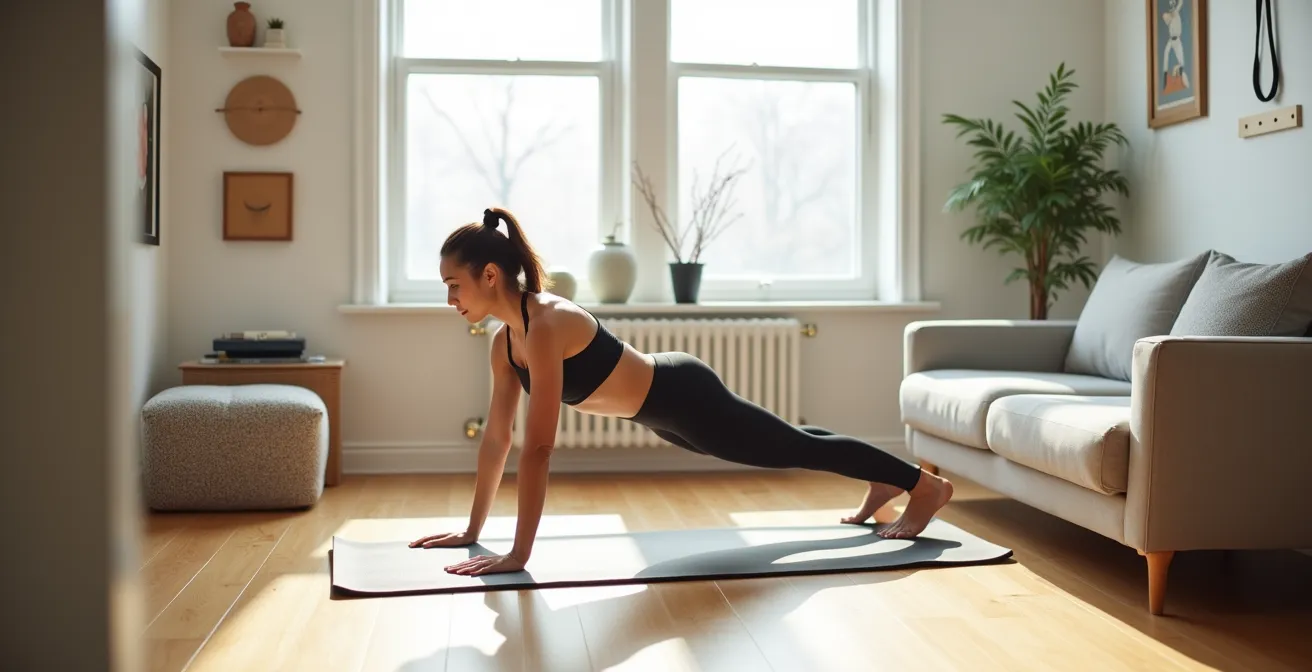
- Mastering spatial choreography with circular circuits allows for a full-body workout within the space of a single yoga mat.
The urban dweller’s paradox is a familiar one: you hold the ambition to build a defined, powerful physique, yet your living space is more shoebox than personal gym. The common advice often feels like a consolation prize: do a few push-ups, buy a resistance band, and try not to bother the downstairs neighbors. This approach treats apartment fitness as a watered-down version of “real” training, a necessary compromise that accepts limited results as a given.
But what if this perspective is fundamentally wrong? What if the constraints of a small apartment aren’t a barrier to overcome, but a set of parameters that define a unique and highly effective training discipline? The key to unlocking serious results without bulky equipment lies not in simply replicating gym exercises, but in mastering the underlying principles of muscle growth: bodyweight tension mechanics, spatial choreography, and intense workout density. This isn’t about “making do”; it’s about becoming a specialist in minimalist training.
This guide will deconstruct the science and strategy behind transforming your limited space into a potent environment for physical change. We will explore how to generate muscle-building tension without weights, turn a living room corner into a frictionless workout zone, and structure your sessions for maximum impact in minimum time. Get ready to stop compromising and start mastering the art of the apartment workout.
For those who prefer a visual summary, the following video offers a great overview of effective in-home workouts that are perfectly suited for apartment living, complementing the detailed strategies in this guide.
To help you navigate these transformative concepts, this article is structured to build your expertise from the ground up. The following summary outlines the key areas we will cover, from the foundational science of bodyweight training to the practical application of creating efficient, space-saving routines.
Summary: A Strategic Guide to Apartment Fitness Mastery
- Why Bodyweight Tension Can Build Definition as Well as Weights?
- How to Transform a Living Room Corner into a Gym in Under 2 Minutes?
- Resistance Bands vs. Dumbbells: Which Is Better for Small Spaces?
- The Carpet Hazard: Why Doing Plyometrics on Rugs Leads to Ankle Sprains?
- Circular Circuit Training: How to Arrange Exercises to Stay in One Spot?
- How to Integrate 5-Minute Activity Bursts Without Disrupting Your Workflow?
- Why 45 Minutes of Focus Trumps 90 Minutes of Distracted Training?
- Why Bodyweight Movements Are Safer Than Weights for Beginners Over 40?
Why Bodyweight Tension Can Build Definition as Well as Weights?
The most persistent myth in fitness is that muscle definition can only be forged with heavy iron. The reality is that your muscles don’t know if you’re lifting a dumbbell or your own body; they only respond to tension, time under tension, and mechanical stress. Achieving a defined physique is about mastering these tension mechanics, a skill that can be honed to perfection without a single weight plate. The goal is to make “easy” exercises progressively harder, forcing your muscles to adapt and grow.
This isn’t just about adding more repetitions. True bodyweight mastery involves manipulating leverage, tempo, and stability to increase the load on the target muscle. Think of the difference between a standard push-up and a pseudo-planche push-up, where shifting your hands closer to your hips dramatically increases the force required from your shoulders and chest. As fitness expert Adam Sinicki notes, this type of training is incredibly comprehensive.
It builds shocking strength, amazing resilience, movement endurance, and aesthetics all in one package.
– Adam Sinicki, The Bioneer YouTube channel
By applying principles of progressive overload, you can continuously challenge your body. This involves more than just doing more reps; it’s about increasing the difficulty of the movement itself. You can slow down each repetition to increase time under tension (TUT), move from two-legged squats to single-leg pistol squats, or work muscles to total failure. This ensures you’re always providing the necessary stimulus for hypertrophy (muscle growth).
How to Transform a Living Room Corner into a Gym in Under 2 Minutes?
The greatest obstacle to workout consistency isn’t a lack of time; it’s activation energy. The friction involved in getting ready—changing, gathering equipment, creating space—can be enough to derail your intentions. The solution is to design a “frictionless setup,” transforming a small corner of your living space into a dedicated gym that can be deployed in under two minutes. This isn’t about aesthetics; it’s about behavioral psychology.
The key is smart, consolidated storage. A stylish ottoman or a decorative chest can discreetly house all your essential gear. When it’s time to train, you simply open the lid, pull out your equipment, and you’re ready. This simple act removes the mental barrier of “getting set up” and makes starting your workout an almost automatic process.
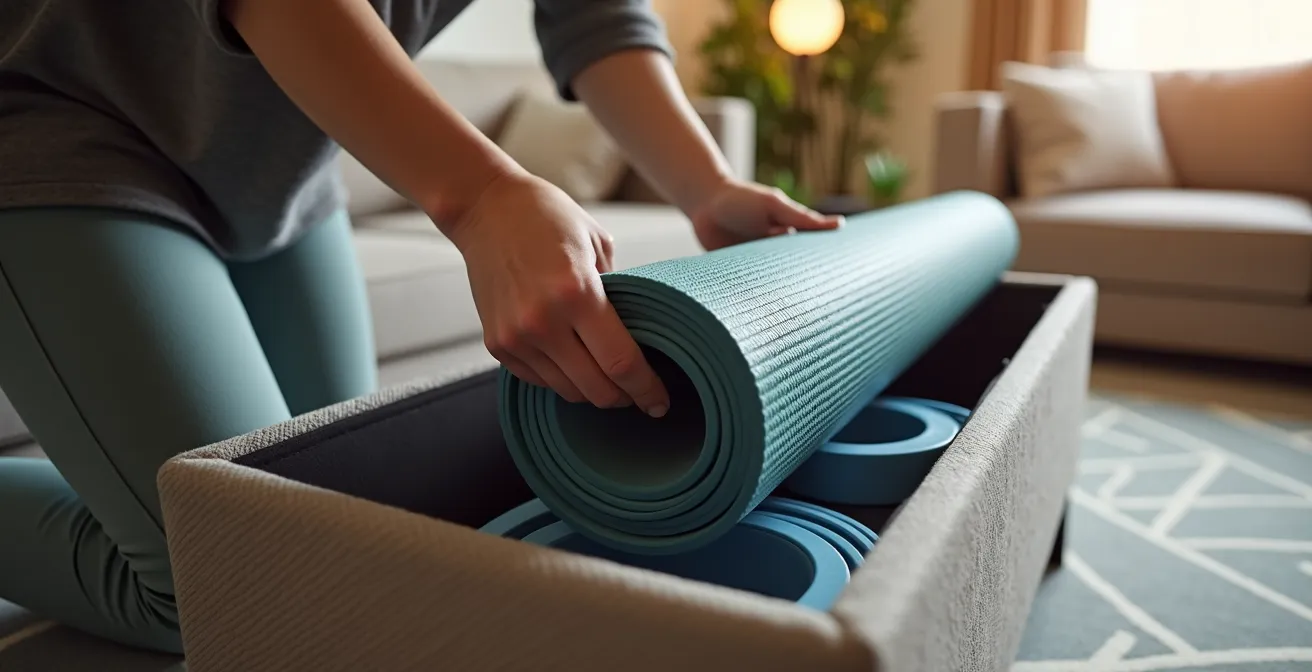
Your “fitness caddy” doesn’t need to be complex. A basic, highly effective setup for quiet apartment workouts can include a high-density yoga mat, a set of versatile resistance bands, and perhaps a pair of core sliders. This minimalist toolkit is compact, powerful, and easy to stash away, ensuring your living room returns to its primary function the moment your workout is over. This two-minute transformation is the cornerstone of building a sustainable home fitness habit.
Resistance Bands vs. Dumbbells: Which Is Better for Small Spaces?
For the space-conscious urbanite, the debate between resistance bands and dumbbells seems to have an obvious winner on storage alone. A full set of bands can fit in a shoebox, while a comparable range of dumbbells would require a dedicated rack. But the more important question for someone seeking serious results is: are bands an effective replacement for weights when it comes to building strength?
For years, bands were seen as a tool for rehabilitation or light “toning,” not serious strength training. However, modern research has dismantled this misconception. The principle of accommodating resistance, where the tension increases as you move through the range of motion, provides a unique and powerful stimulus for muscle growth. More importantly, when it comes to the bottom line of getting stronger, the science is clear.
In fact, a systematic review and meta-analysis of multiple studies directly comparing the two modalities found no superiority between elastic resistance and conventional devices for gains in muscular strength. This finding is a game-changer for apartment training. It confirms that a set of high-quality resistance bands is not a compromise; it’s an evidence-based, space-efficient tool fully capable of helping you achieve your strength and physique goals.
The Carpet Hazard: Why Doing Plyometrics on Rugs Leads to Ankle Sprains?
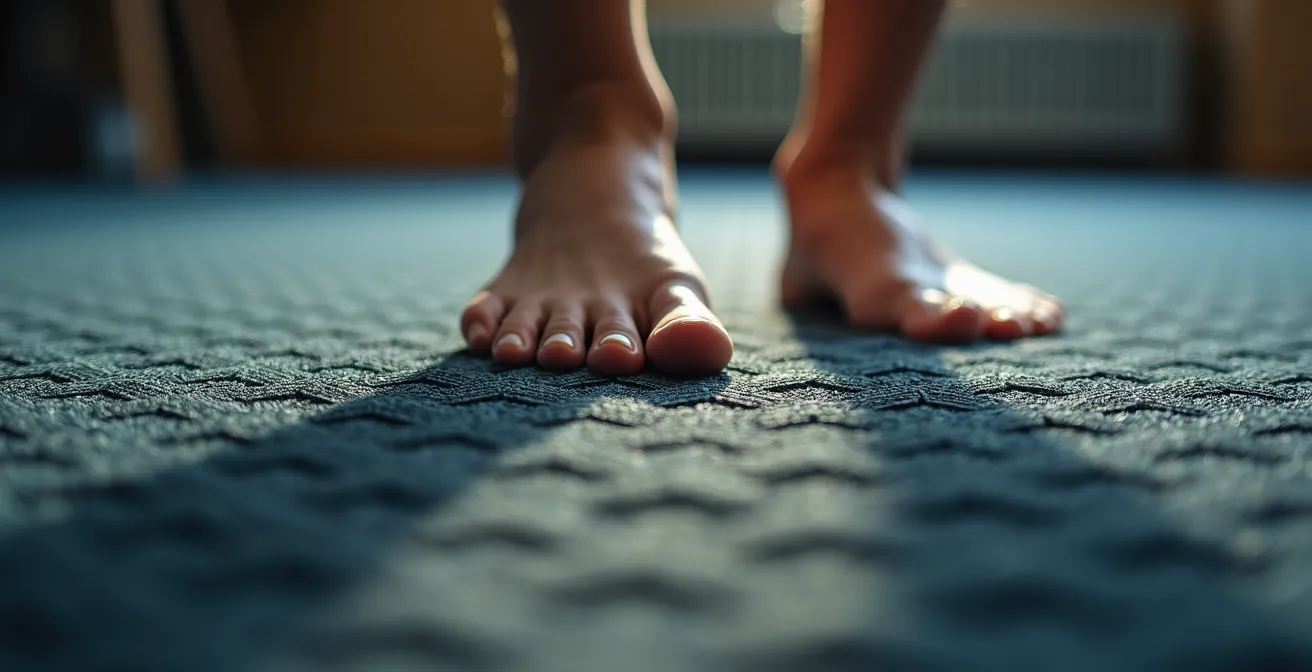
High-intensity interval training (HIIT) often relies on plyometrics—explosive jumping movements—to spike the heart rate. However, performing these exercises in a typical apartment living room presents a significant risk: the carpet. Landing a jump on a soft, plush, or uneven rug creates an unstable surface. Your ankle can easily roll, leading to sprains and sidelining your progress. The surface is simply not designed to absorb and distribute the force of dynamic movements.
The immediate solution is to create a safe landing zone. Placing a high-density exercise mat over the carpet provides a firm, stable surface that gives you the grip and support needed for controlled landings. This simple addition drastically reduces the risk of injury by ensuring your foot makes contact with a predictable, non-shifting surface.
An even better strategy, however, is to evolve beyond the need for jumping altogether. You can achieve the same metabolic and cardiovascular benefits with high-intensity, low-impact training (HILIT). These movements create explosive power and muscular endurance without the joint stress or the noise that bothers neighbors. Exercises like power knee-ups, burpee walk-outs, and mountain climbers with sliders challenge your body intensely while keeping your feet firmly in contact with the ground, eliminating the carpet hazard entirely.
Circular Circuit Training: How to Arrange Exercises to Stay in One Spot?
One of the biggest frustrations of apartment workouts is the constant need to rearrange your space to move from one exercise to another. This logistical shuffle breaks your focus, kills your momentum, and eats into valuable training time. The solution lies in “spatial choreography”—the art of designing workouts that flow seamlessly within the footprint of a single yoga mat. This is achieved through Circular Circuit Training.
The core principle is to sequence exercises based on your body’s position: standing, plank/floor, and supine/seated. By grouping movements this way, you can transition from one to the next with a simple, fluid motion, like rolling over or standing up, without ever needing to walk across the room. A well-designed circuit, often called the “Tripod Method” (standing, plank, supine), allows for a non-stop, full-body workout that requires minimal space and maximizes workout density.
This method transforms your training from a series of disjointed exercises into a continuous flow state. You maintain muscular tension and an elevated heart rate, leading to superior metabolic and muscle-building results. Below is a practical example of how to structure such a routine.
Your 1-Square-Meter Workout Plan
- Standing Position: Begin with your feet planted. Perform 10-15 bodyweight squats, focusing on full range of motion.
- Transition to Plank: From the bottom of your last squat, place your hands on the floor and walk out to a plank. Perform 10 push-ups.
- Roll to Supine: From the plank, lower your body and roll onto your back. Perform 15 glute bridges, squeezing at the top.
- Move to Seated: Sit up from the glute bridge position. Perform 20 Russian twists to target your obliques.
- Return to Standing: From the seated position, plant your feet and stand back up, ready to begin the next circuit. Complete 3-4 rounds.
How to Integrate 5-Minute Activity Bursts Without Disrupting Your Workflow?
The “all or nothing” mindset is the enemy of consistency. Many people believe that if they can’t dedicate a full hour to a workout, there’s no point in doing anything. A far more effective and sustainable approach is to practice “fitness micro-dosing”—integrating short, 2-to-5-minute bursts of activity throughout your workday. These aren’t meant to replace your main workouts; they are tools to manage energy, boost focus, and counteract the negative effects of a sedentary day.
The key to making this work is to link these activity bursts to your existing work habits, such as the Pomodoro Technique. At the end of a 25-minute work block, instead of scrolling through your phone, you perform a pre-planned 5-minute movement sequence. This could be a quick energy boost with jumping jacks, a posture reset with wall slides, or a desk yoga flow. As fitness personality Joe Wicks often demonstrates with his “hotel room workouts,” you don’t need any equipment or significant space to get your heart rate up and reset your mind.
By creating a “Movement Menu” of different short routines, you can choose what your body and mind need at any given moment. A plank hold during a phone call, a set of calf raises while reviewing an email—these small actions accumulate over the day, improving circulation, posture, and mental clarity without ever disrupting your professional flow.
Why 45 Minutes of Focus Trumps 90 Minutes of Distracted Training?
The most valuable currency in your workout is not time, but focus. A 45-minute session performed with high intensity and zero distractions will produce vastly superior results to a 90-minute workout peppered with phone checks, long rests, and a wandering mind. This principle is known as workout density: maximizing the amount of effective work performed per unit of time. In a small apartment, where distractions are abundant, mastering workout density is non-negotiable.
When you maintain focus and move with purpose, you create continuous pressure on the muscles. This intense, sustained effort can trigger a powerful physiological response similar to blood flow restriction (BFR) training. As expert Adam Sinicki explains, “Maintaining pressure on a muscle causes blood to pool, creating a hypoxic environment where slow-twitch fibres can’t function properly. Your body has to call in more fast-twitch fibres.” These fast-twitch fibers have the greatest potential for growth, meaning a focused, dense workout is a direct shortcut to building muscle.
Achieving this level of focus requires a deliberate ritual. You must consciously transition from your daily life into a protected “workout zone.” This involves eliminating all potential distractions and priming your brain and body for the intense effort to come. Setting a visible timer, curating a specific playlist, and reviewing your session goals are not trivial details; they are essential components of a high-density workout.
Key takeaways
- Muscle growth responds to tension and intensity, which can be generated effectively with bodyweight exercises by manipulating leverage and tempo.
- Spatial efficiency is paramount. A full-body workout is possible in a one-square-meter area by using circular circuits that flow between standing, plank, and supine positions.
- Workout density—the amount of work done per minute—is more important for results than total workout duration. Focus is a trainable skill.
Why Bodyweight Movements Are Safer Than Weights for Beginners Over 40?
For individuals starting or returning to fitness after 40, injury prevention is as important as building strength. While lifting weights is effective, it comes with a higher risk profile, especially for beginners who may lack the motor control or joint stability to handle external loads safely. Bodyweight movements offer a fundamentally safer pathway to a strong, resilient physique. They build strength by first teaching the body how to move correctly through its natural range of motion, creating a solid foundation before adding complexity.
This emphasis on mastering fundamental movement patterns is a powerful form of pre-habilitation. Indeed, research shows that proper strength training can have a profound impact on injury prevention, with some studies showing it reduced acute sports injuries by one third and overuse injuries by nearly half. Because bodyweight exercises inherently scale to your current strength level, the risk of overloading joints and connective tissues is significantly lower.
Beyond just safety, evidence suggests that bodyweight training may offer superior outcomes for healthy aging. A recent study directly compared mature athletes using free weights versus body mass-based training. While both groups gained muscle, the bodyweight group also saw a significantly decreased intramuscular fat content, indicating a better improvement in overall body composition. As expert Katey Davidson, MScFN, RD, CPT, highlights, “all exercise will decrease your risk of falls, but strength training is especially effective at this, with leg strength training being especially crucial.”
You now have the complete blueprint for building a serious physique within the confines of your apartment. The next step is to move from knowledge to action. Start by designing your own 1-square-meter circuit and commit to a 3-minute pre-workout focus ritual today.