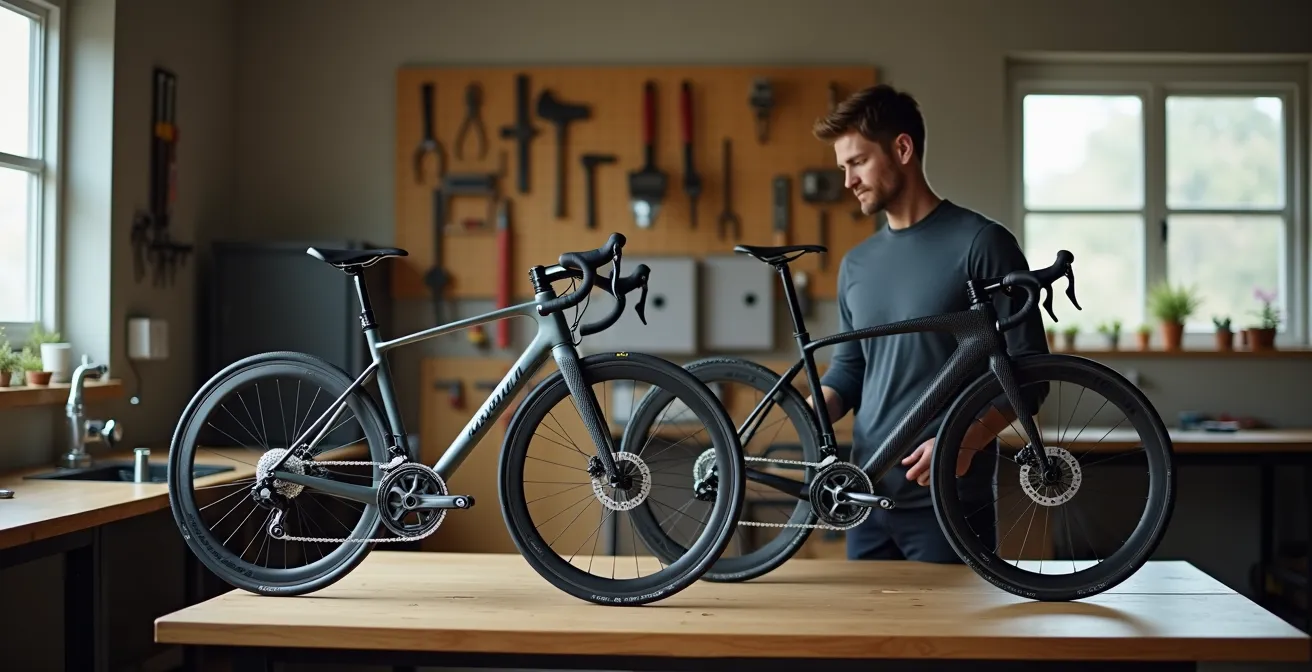
The common wisdom to “buy the best you can afford” is flawed financial advice for hobbyist athletes.
- The most expensive gear offers diminishing performance returns that are irrelevant for non-professionals.
- True value lies in maximizing your “Return on Experience” (comfort, safety, enjoyment) and minimizing Total Cost of Ownership (TCO).
Recommendation: Instead of focusing on the frame or headline features, allocate your budget first to high-quality contact points (boots, saddles, gloves) and durable technical apparel.
For any hobbyist athlete, the gear dilemma is a familiar crossroads. On one side, the siren song of glossy, professional-grade equipment promises to shave seconds off your time and elevate your game. On the other, the pragmatic voice of your bank account questions whether that carbon fiber frame or high-tech gadgetry is truly necessary. The internet is filled with advice that often boils down to “it depends on your goals” or the unhelpful “buy the best you can afford.” This leads to analysis paralysis, buyer’s remorse, and garages filled with overpriced equipment that fails to deliver on its promise.
But what if the entire question is framed incorrectly? The debate shouldn’t be about chasing the fractional performance gains of an elite athlete. For a hobbyist, the goal isn’t the podium; it’s maximizing enjoyment, ensuring safety, and staying motivated. It’s about achieving the highest possible Return on Experience (ROE) for every dollar spent. This requires a different mindset: you must stop thinking like a sponsored pro and start acting like the Chief Financial Officer (CFO) of your hobby.
This article provides a financial audit framework for your gear choices. We will dissect the myth of marginal gains for amateurs, analyze the long-term costs hidden behind a low sticker price, and identify the specific areas where a strategic investment pays the biggest dividends in comfort and durability. We’ll explore why the parts of your gear that touch your body are far more critical than the flashy components, why some brands hold their value like a blue-chip stock, and how to avoid the “feature trap” that drains your budget for technology you’ll never use. This is your guide to spending smarter, not just spending more.
To help you navigate these critical investment decisions, this guide breaks down the financial and practical implications of your gear choices, from big-ticket items to the fabrics you wear.
Summary: A CFO’s Guide to Buying Sports Gear
- Why the $500 Difference in Bikes Only Saves 2 Seconds?
- How to Choose Brands That Hold Value for Resale?
- Carbon Fiber vs. Aluminum: Is the Fragility Worth the Weight Savings?
- The Feature Trap: Paying for Technology You Will Never Use
- Boots First: Why Upgrading Contact Points Matters More Than the Frame?
- Why Generic Fabrics Cause Chafing and Overheating on Runs Over 10k?
- Why UV Exposure Degrades Helmet Plastic Even Without Crashes?
- Cheap vs. Technical Gear: Which One Actually Saves You Money Over 3 Years?
Why the $500 Difference in Bikes Only Saves 2 Seconds?
The concept of “marginal gains” was famously popularized by British Cycling, who meticulously sought 1% improvements in dozens of areas to achieve world dominance. For elite athletes, these gains are the difference between gold and silver. For a hobbyist, they represent a financial black hole. That $500—or $1,000—upgrade to a lighter bike or a more aerodynamic component might translate to a handful of seconds over an hour-long ride. You have hit the performance plateau, where the cost of improvement increases exponentially for imperceptible returns. The real-world impact is negligible, especially when factors like your personal fitness, nutrition, and rest have a dramatically larger effect on your performance.
Let’s audit the numbers. An expensive drivetrain might offer superior efficiency, but the actual power savings are minimal for an amateur’s output levels. For example, research demonstrates a 3% power output improvement from optimized drivetrain components under lab conditions—a difference most hobbyists would never feel. Furthermore, high-end gear often demands more frequent and complex maintenance, adding a hidden “time cost” to your investment. Instead of asking “How much faster will this make me?”, the savvy question is “Is this fractional gain worth the significant cost and added complexity?” For most amateurs, the answer is a resounding no.
To put this into perspective, consider the tangible differences between an entry-level and a pro-level bike. The primary gains are in weight and drivetrain efficiency, which have a very small effect outside of competitive racing.
| Factor | Entry-Level ($1000) | Pro-Level ($1500) | Real-World Impact |
|---|---|---|---|
| Weight Difference | 22 lbs | 19 lbs | 2-3% speed gain on climbs |
| Drivetrain Efficiency | 95% | 97% | 2% power savings |
| Maintenance Time | 2 hrs/month | 4 hrs/month | More complex systems |
| Resale Value (2 years) | 40% retention | 55% retention | Better long-term value |
How to Choose Brands That Hold Value for Resale?
A smart gear CFO thinks about an asset’s entire lifecycle, not just its purchase price. The ability to resell your equipment for a decent price in two or three years drastically lowers its Total Cost of Ownership (TCO). This is where brand choice becomes a strategic financial decision. “Hype brands” that are popular today may have poor long-term reliability or use proprietary parts that make them undesirable on the second-hand market. In contrast, value-holding brands often have a long history of durability, widespread dealer support, and use industry-standard components that are easy to service or upgrade.
Think of it like buying a car. A reliable, well-known brand with a strong parts network will always have a better resale value than an obscure or notoriously unreliable one. In sports gear, brands like Shimano in cycling or Patagonia in outdoor apparel are known for their longevity and, consequently, their strong second-hand market value. Investing in these brands means your money isn’t just spent; it’s parked in an asset that retains a significant portion of its worth. This is a core principle for managing your hobby’s budget effectively.
As the experts at BTO Sports note in their equipment analysis, a higher initial investment often leads to better financial outcomes. This perspective is crucial for any amateur athlete looking to make a sound purchase.
Paying more up front translates to fewer replacements and better resale value if well maintained.
– BTO Sports Equipment Guide, Entry-Level vs Pro Motocross Gear Analysis
Action Plan: Auditing a Brand’s Resale Potential
- Check market data: Use eBay’s “Sold Items” filter to see what gear actually sells for, not the asking price. This is your most reliable source for real-world market value.
- Prioritize standard components: Favor brands that use widely adopted, non-proprietary parts (e.g., Shimano/SRAM groupsets). This makes repairs and upgrades easier for future buyers.
- Investigate warranty transferability: Research if a brand’s warranty is tied to the original owner or if it follows the product. A transferable warranty is a major selling point.
- Gauge community sentiment: Join sport-specific online forums and communities to see what real users say about a brand’s long-term reliability and customer service.
- Compare depreciation rates: Use resale platforms to compare the 3-year depreciation of “hype brands” versus established “legacy brands.” The numbers will reveal the true value holders.
Carbon Fiber vs. Aluminum: Is the Fragility Worth the Weight Savings?
The carbon-versus-aluminum debate is a classic example of a pro-level concern trickling down to the amateur market. Carbon fiber offers a superior stiffness-to-weight ratio, which is why it’s the standard for professional racing. However, for a hobbyist, it introduces a significant risk factor: fragility. While modern carbon frames are incredibly strong, they are vulnerable to catastrophic failure from sharp impacts or improper clamping—a dropped tool or a bike falling against a sharp corner can compromise the frame’s integrity in ways that aren’t always visible. Aluminum, on the other hand, tends to dent or bend, providing a visible warning of damage.
From a financial auditor’s perspective, this is a risk-reward calculation. Is the minor weight advantage worth the risk of a multi-thousand-dollar frame being rendered worthless by a single accident? A detailed 500-gram weight saving equates to roughly a 1.5% improvement in climbing speed for the average rider. For someone not competing for a prize, this gain is trivial. The peace of mind and durability of a high-quality aluminum frame often represent a much smarter investment, delivering 98% of the performance with a fraction of the financial risk. The Return on Experience is higher with a bike you’re not afraid to lean against a wall.
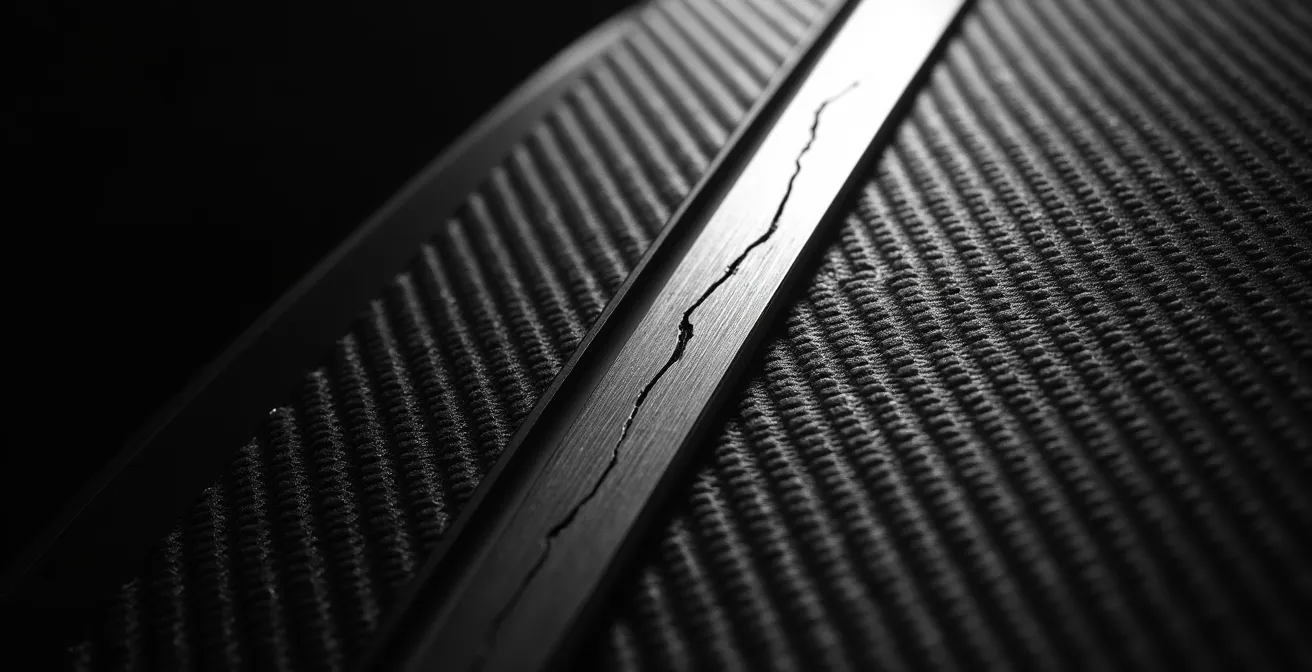
This macro view highlights the fundamental material differences. The woven structure of carbon fiber is optimized for specific load paths but can be vulnerable to off-axis impacts, whereas brushed aluminum offers more uniform impact resistance. This visual contrast underscores the trade-off between specialized performance and all-around durability, a key consideration for the amateur’s budget and use case.
The Feature Trap: Paying for Technology You Will Never Use
Modern sports equipment is a marvel of engineering, often packed with advanced features like electronic shifting, automated suspension adjustments, and countless data sensors. Marketers excel at presenting these features as game-changers, essential for unlocking your “full potential.” This is the feature trap: paying a premium for technology whose benefits you are not skilled enough to perceive or dedicated enough to use. For a pro, electronic shifting provides flawless gear changes under extreme load. For a hobbyist riding on weekends, a well-maintained mechanical groupset performs its function perfectly at a fraction of the cost and complexity.
Every added feature introduces a “cognitive cost.” It’s one more thing to set up, charge, troubleshoot, and potentially break. This is time and mental energy not spent enjoying your sport. An honest audit of your own habits and skill level is crucial. Before you pay for the “pro” model, ask yourself: Will I genuinely use this feature on every ride? Do I have the time and desire to learn its intricacies? Often, the simpler, more robust entry-level or mid-tier model provides a better Return on Experience because it just works, allowing you to focus on the activity itself.
The smarter investment is often in well-made, durable fundamentals rather than complex electronic add-ons. The best gear for a hobbyist is the gear that disappears, letting you immerse yourself in the experience without distraction. Paying extra for features that add complexity without a tangible benefit to your enjoyment is a poor allocation of your limited budget.
Boots First: Why Upgrading Contact Points Matters More Than the Frame?
Here is the single most important investment principle for a hobbyist athlete: allocate your budget to the contact points first. These are the parts of the gear that directly touch your body: your shoes or boots, your saddle, your gloves, the grips on your handlebars, and the insoles in your footwear. No matter how light or aerodynamic your bike frame is, your experience will be miserable if your saddle causes pain or your shoes create hotspots. Discomfort is the number one killer of motivation and enjoyment. Therefore, investing in high-quality contact points yields the highest possible Return on Experience (ROE).
A $1,000 frame upgrade might save you 30 seconds, but a $150 professional bike fit or a pair of perfectly molded ski boot liners can extend your comfortable time in the sport by hours. These investments directly address the sources of pain, chafing, and numbness that force people to cut their sessions short. This is the “Contact Point Principle” in action: comfort and injury prevention are far more valuable to a hobbyist’s long-term participation than raw performance metrics. Before you even look at a carbon frame or electronic components, ensure your shoes fit perfectly, your shorts have a high-quality chamois, and your saddle is right for your anatomy.
Case Study: The ROI of a Professional Bike Fit
An amateur cyclist spent years chasing speed by upgrading wheels and components with limited success. Frustrated with neck pain and numbness after 90 minutes of riding, they invested in a professional bike fit. The fitter adjusted the saddle height, stem length, and cleat position. The result was not just the elimination of pain but an immediate increase in power output and endurance. The cyclist noted, “My bike is now very optimized to take advantage of every marginal gain.” As this analysis of marginal gains shows, the investment in the human-machine interface delivered a far greater return than thousands spent on hardware alone.
Why Generic Fabrics Cause Chafing and Overheating on Runs Over 10k?
The “Contact Point Principle” extends beyond hard goods like saddles and boots; it is just as critical for apparel. For a short jog, a simple cotton t-shirt might seem adequate. But as your duration and intensity increase, the limitations of generic fabrics become painfully obvious. Cotton is hydrophilic, meaning it loves water. This is a disastrous quality for athletic wear. As you sweat, a cotton shirt becomes a heavy, wet, and abrasive blanket. It clings to your skin, causing chafing, and its evaporative cooling effect is nullified, leading to overheating in warm conditions or a dangerous chill in the cold.
This is where technical fabrics demonstrate their immense value. Materials like polyester, nylon, and merino wool are hydrophobic. They don’t absorb moisture; they pull it away from your skin and push it to the outer surface of the fabric where it can evaporate. This process, known as wicking, keeps you drier, lighter, and dramatically reduces the risk of chafing. The numbers are stark: a key insight from material science research reveals that cotton absorbs up to 27 times its own weight in moisture, while many technical polyesters absorb less than 0.4%.

Investing in a few high-quality, technical base layers, shorts, and socks is not a luxury; it’s a fundamental requirement for anyone serious about an endurance hobby. This investment directly translates to a higher Return on Experience by eliminating the distraction and pain of poor moisture management, allowing you to focus on your performance and enjoy the activity for longer.
Why UV Exposure Degrades Helmet Plastic Even Without Crashes?
Safety gear is the one area where skimping on cost has the most severe potential consequences. A helmet is a non-negotiable investment, but many athletes make a critical financial error: they judge its lifespan by the absence of crashes. However, the primary enemy of your helmet’s integrity isn’t impact; it’s the sun. The outer shell of most helmets is made from polycarbonate plastic, and the inner protective layer is Expanded Polystyrene (EPS) foam. Both of these materials are degraded by long-term exposure to ultraviolet (UV) radiation.
Over time, UV rays make the plastic shell brittle and the EPS foam less able to absorb and distribute impact forces. Your helmet may look perfectly fine on the outside, but its protective capabilities could be severely compromised. This is why virtually all helmet manufacturers recommend replacement every 3 to 5 years, regardless of use or impact history. Thinking you are “saving money” by using a seven-year-old helmet is a dangerous illusion. You are wearing a piece of equipment that will likely fail to protect you when you need it most. The true cost of a cheap or old helmet isn’t its purchase price but the potential cost of a head injury.
A mid-range helmet from a reputable brand (often in the $150-$250 range) offers the same certified level of protection as a top-of-the-line model. The extra cost for premium helmets typically goes towards better ventilation, aerodynamics, and lighter weight—marginal gains that, once again, are less critical for a hobbyist. Your audit should focus on the manufacturing date and a regular replacement schedule. To assess your current helmet, perform this simple inspection:
- Check for a chalky texture: Run your hand over the outer shell. A dusty or chalky feel indicates UV degradation of the plastic.
- Look for discoloration: Yellowing or fading, especially on lighter-colored areas, is a clear sign of sun damage.
- Test strap flexibility: The nylon or plastic straps can also become brittle. Bend them to check for cracking.
- Inspect the foam: Gently press on the internal EPS foam. If it feels crumbly or doesn’t rebound, its integrity is gone.
Key Takeaways
- Focus on “Return on Experience”: Prioritize gear that enhances comfort, safety, and enjoyment over gear that offers marginal performance gains.
- Think in Total Cost of Ownership (TCO): Factor in maintenance, replacement frequency, and resale value, not just the initial sticker price.
- The Contact Point Principle is Key: Your first and best investment should always be in the gear that touches your body—shoes, saddles, and high-quality apparel.
Cheap vs. Technical Gear: Which One Actually Saves You Money Over 3 Years?
The final step in our financial audit is to zoom out and look at the long-term picture. The most compelling argument for investing in quality technical gear is found in its Total Cost of Ownership (TCO) over a multi-year period. A cheap, $30 cycling jersey might seem like a bargain, but if its fabric stretches, its seams chafe, and its zipper breaks after one season, you’ll be buying another one next year, and the year after. A well-made $80 jersey from a reputable brand, however, is built to withstand hundreds of wash cycles and will likely serve you well for three years or more. As Rizer Sports points out, durability is a form of savings.
While pro sports gear may cost more upfront, it lasts much longer than cheap alternatives. Professional equipment is built with reinforced materials. Instead of replacing shoes or equipment frequently, you make a one-time investment that supports your performance for months or years.
– Rizer Sports, Pro Sports Gear Buying Guide
This principle holds true across most gear categories. Cheap running shoes with low-grade foam break down faster, increasing injury risk and forcing replacement more often. In contrast, a technical shoe with a durable midsole compound maintains its cushioning and support for many more miles. When you factor in the high resale value of quality gear, the financial case becomes undeniable. That “expensive” piece of equipment might actually be the cheapest option when viewed through a three-year lens.
This table illustrates a simplified TCO analysis for a typical amateur athlete, comparing budget vs. technical options over a three-year span. It clearly shows how initial savings can be erased by higher replacement costs and zero resale value.
| Equipment Type | Budget Option | Technical Option | 3-Year TCO Difference |
|---|---|---|---|
| Running Shoes | $60 x 6 pairs = $360 | $150 x 2 pairs = $300 | Save $60 with technical |
| Cycling Jersey | $30 x 4 = $120 | $80 x 1 = $80 | Save $40 with technical |
| Sports Helmet | $50 x 2 = $100 | $150 x 1 = $150 | Budget saves $50 initially |
| Resale Value | $0 (worn out) | 40% retention | Technical retains value |
By adopting this CFO mindset, you can build a collection of gear that not only supports your hobby but also represents a sound and sustainable investment in your long-term enjoyment and well-being. Audit your needs, prioritize your contact points, and always consider the total cost of ownership.
Frequently Asked Questions About Sports Equipment Budgeting
What percentage of advanced features do amateur athletes actually use?
While exact percentages vary, anecdotal evidence and industry observation suggest a very low utilization rate. For many beginners and hobbyists, the perceived benefits of pro-level features are often outweighed by their complexity. The key is that high-quality gear fundamentally changes the training experience through durability and comfort, not necessarily through advanced electronic features that go unused.
How can I test if I need electronic shifting or flight attendant suspension?
The best way is to rent or demo the equipment before buying. Most reputable bike shops offer demo programs. Use the gear for at least two or three of your typical sessions on familiar terrain. This is the only way to determine if your current skill level can actually perceive and benefit from the technology’s advantages. If you can’t tell the difference, you don’t need it yet.
What’s the cognitive cost of complex features?
The cognitive cost is the mental energy you expend on tasks other than the sport itself. This includes initial setup, learning the user interface, charging batteries, and troubleshooting when things go wrong. More features invariably demand more mental overhead, which is time and focus taken away from the pure enjoyment of the activity.