
If you stretch relentlessly but remain chronically stiff, you’re likely targeting the wrong problem. The common belief is that stiffness comes from “tight” muscles needing to be lengthened. The reality is that stiffness is often your nervous system applying “brakes” to prevent movement into ranges you can’t actively control. The solution isn’t more passive stretching; it’s building active, usable mobility to convince your brain to release those brakes and grant you true freedom of movement.
For anyone who diligently performs their daily stretches yet still feels trapped in a stiff, uncooperative body, the frustration is palpable. You follow the conventional wisdom: hold a stretch, breathe, and try to lengthen those “tight” muscles. Yet, the feeling of restriction persists, whether it’s in your hips after sitting, your shoulders after a workout, or your neck from hours at a desk. This cycle leads many to believe they are simply “not flexible” or that their stiffness is a permanent state.
The conventional approach frames stiffness as a simple hardware problem—muscles that are too short. But what if this is a fundamental misdiagnosis? What if the root cause isn’t the length of your tissues, but your brain’s ability to control them? This is the crucial distinction between passive flexibility and active mobility. While flexibility is your ability to be moved into a range of motion, mobility is your ability to get there and control it yourself. The feeling of “tightness” is often a protective mechanism from your nervous system, preventing you from entering ranges where it senses instability and a risk of injury.
This article will deconstruct this common misunderstanding. We will move beyond the superficial advice to “just stretch more” and delve into the neurological underpinnings of chronic stiffness. You will learn why having flexibility without control is a recipe for continued restriction, how to reclaim your body’s innate movement potential with targeted joint-centric training, and how to finally address the root cause of why you still feel stiff.
To navigate this crucial topic, this guide breaks down the core concepts, from identifying your own mobility deficits to implementing practical, daily routines. Explore the sections below to build a comprehensive understanding and an actionable plan.
Summary: A Movement Specialist’s Guide to Unlocking Stiffness
- Why Being Flexible Doesn’t Mean You Have Usable Mobility?
- How to Perform Controlled Articular Rotations (CARs) for Joint Health?
- Static Stretching vs. PNF: Which Unlocks Range of Motion Faster?
- The False Flexibility Trap: Is Your Spine Moving Instead of Your Hips?
- Pre-Workout vs. Before Bed: When Is Mobility Training Most Effective?
- Why Running Might Worsen Hip Tightness for Desk Workers?
- Why Increasing Tissue Temperature Improves Muscle Elasticity?
- Correcting ‘Tech Neck’ Posture: The 10-Minute Daily Fix for Remote Workers
Why Being Flexible Doesn’t Mean You Have Usable Mobility?
The most significant misunderstanding in the quest for pain-free movement lies in equating flexibility with mobility. Flexibility is a passive quality; it’s the range of motion a joint can be moved through with external help. Think of a yoga instructor pushing you deeper into a hamstring stretch. Your leg goes far, but you didn’t put it there—an external force did. This is your passive range of motion (PROM). While useful, it doesn’t guarantee you can use that range in daily life or athletic pursuits.
Mobility, on the other hand, is active and controllable. It is your usable range of motion (AROM)—the degree to which you can actively move a joint without assistance. This is the range your nervous system “owns.” The gap between your passive flexibility and your active mobility is the “mobility deficit.” This deficit is where the danger lies. When you have a large passive range but very little active control over it, your nervous system perceives this uncontrolled territory as unsafe. In response, it creates protective tension—what you feel as “stiffness”—to act as neurological brakes, preventing you from accidentally entering a range where you could get injured.
This is why you can stretch your hamstrings for 20 minutes, achieve a new passive range, but feel just as “tight” an hour later. You haven’t taught your nervous system how to control that new range, so it simply reverts to the familiar, safe zone. While research indicates that flexibility naturally decreases as we age, maintaining and improving active mobility is the key to functional longevity and resolving chronic stiffness. Your goal shouldn’t be to become more flexible, but to close the gap between your passive and active ranges, proving to your brain that you own every degree of your movement.
How to Perform Controlled Articular Rotations (CARs) for Joint Health?
If chronic stiffness is a problem of control, then the solution must be a practice that teaches control. This is the precise function of Controlled Articular Rotations (CARs). They are the most fundamental practice for improving joint health, enhancing mobility, and providing your brain with the clear feedback it needs to release protective tension.
As the experts at Physioinq Penrith define it, CARs are a systematic way to explore and expand your usable range of motion:
CARs are active rotational movements of joints at the outer limits of articular motion… The goal is to use the whole ROM of a single joint in a controlled and mindful manner.
– Physioinq Penrith, Controlled Articular Rotations – What are they and why should you do them?
To perform a CAR, you must isolate a single joint and move it through its greatest, pain-free rotational path. The key principles are tension and isolation. You create full-body tension to “lock down” surrounding joints, preventing compensation. For a shoulder CAR, you might brace your core and squeeze your other fist to ensure only the shoulder joint is moving. The movement must be slow and deliberate, exploring the very edge of your active range. This slow, controlled exploration sends a powerful signal to the brain: “I am in control here. This range is safe.”

By performing CARs daily, you are not just stretching; you are conducting a daily diagnostic on your joints. As movement specialist Petra Fisher found, implementing CARs daily for over six years transformed the exercise into a tool for identifying restrictions before they become injuries. This consistent practice nourishes the joint capsule with synovial fluid, maintains existing ranges, and gradually expands the boundaries of your active control. This is how you systematically dismantle the neurological brakes causing your stiffness.
Static Stretching vs. PNF: Which Unlocks Range of Motion Faster?
While the long-term solution to stiffness lies in building active control, stretching techniques still have their place—primarily for creating a temporary “window” of increased range that can then be trained for control. The two most common methods are static stretching and Proprioceptive Neuromuscular Facilitation (PNF). But which is more effective?
Static stretching is the classic “hold-and-breathe” method. By holding a muscle in a lengthened position for 30-60 seconds, you are primarily targeting the passive elastic properties of the muscle and fascia, encouraging them to lengthen over time. It is a slow, gradual process best suited for cool-downs to help restore muscles to their resting length after a workout.
PNF stretching, on the other hand, is a more active process that “tricks” the nervous system. The most common technique, “contract-relax,” involves pushing against an immovable object for a few seconds (contracting the target muscle) and then relaxing into a deeper stretch. This contraction triggers the Golgi Tendon Organ (GTO), a sensory receptor that tells the muscle to relax, allowing for a greater immediate increase in range of motion. While the immediate effects can feel profound, research comparing PNF and static stretching shows that for long-term flexibility gains, the difference is often negligible in many cases.
The choice between them depends on your goal, as a direct comparison shows their distinct mechanisms and ideal applications.
| Aspect | PNF Stretching | Static Stretching |
|---|---|---|
| Mechanism | Contract-relax triggers Golgi Tendon Organ | Passive muscle lengthening |
| Immediate Effect | Rapid, temporary ROM increase | Gradual tissue length changes |
| Best Use | Pre-workout for quick mobility | Cool-down for lasting flexibility |
| Peak Effect Time | Progressive over 15 minutes | Peaks at 10 minutes |
Ultimately, both methods primarily increase passive range. PNF is superior for creating a quick, temporary expansion of movement to be used immediately, while static stretching is better for long-term tissue adaptation. However, neither will solve chronic stiffness unless you follow it up with active exercises, like CARs, to teach your brain how to control that newly acquired range.
The False Flexibility Trap: Is Your Spine Moving Instead of Your Hips?
One of the most insidious reasons you might feel perpetually stiff, despite stretching, is the “false flexibility” trap. This occurs when you attempt to move one joint, like the hip, but your body—in its quest for the path of least resistance—creates the movement somewhere else, often in the lumbar spine. You think you’re increasing hip mobility, but you’re actually just reinforcing a dysfunctional compensation pattern.
For example, when trying to stretch your hip flexor in a lunge, many people will arch their lower back excessively to feel a “deeper” stretch. The sensation is real, but the movement is coming from spinal extension, not true hip extension. This not only fails to improve hip mobility but can also lead to lower back pain and instability. Your brain learns that “hip extension” means “arch the back,” further cementing the poor motor control that causes stiffness in the first place.
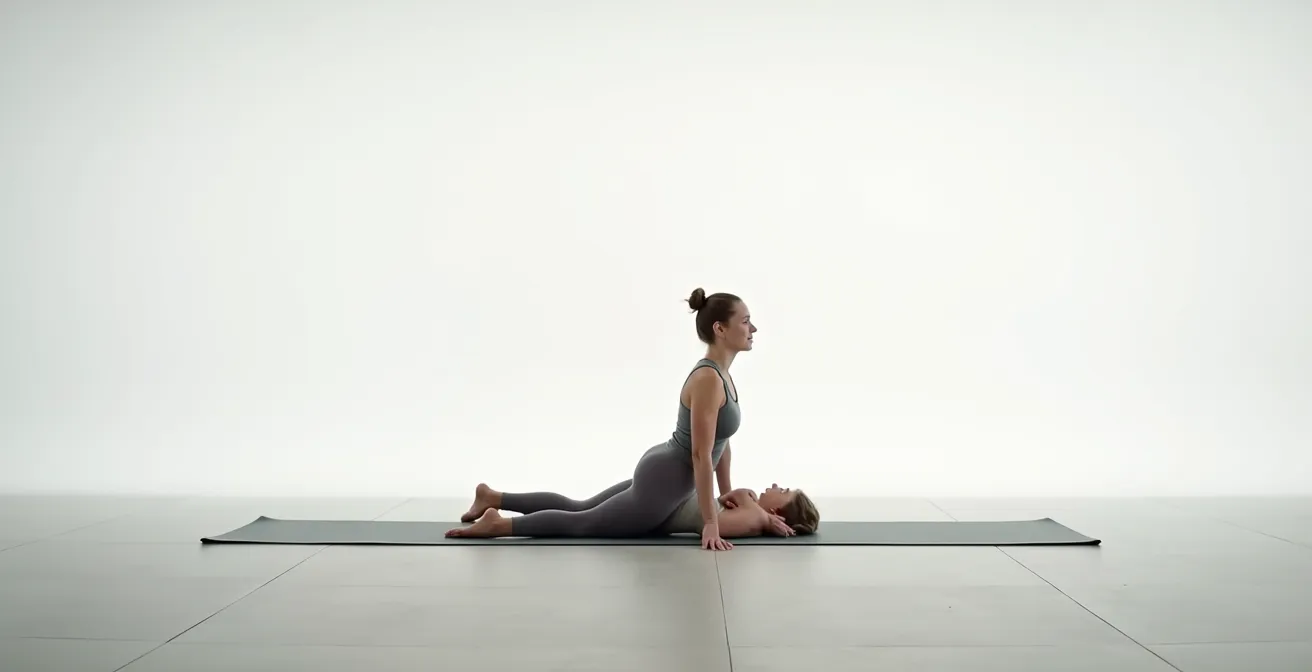
To truly improve mobility, you must learn to isolate the target joint and prevent compensation. This requires awareness and specific strategies to lock down adjacent areas. For the hips, getting into a quadruped (all-fours) position is an excellent way to provide feedback on spinal movement. By forcing yourself to maintain a neutral spine, you can begin to feel what true, isolated hip rotation feels like. Escaping this trap is not about pushing harder; it’s about moving smarter and with more control.
Action Plan: Lock-Down for True Hip Mobility
- Get on all fours (quadruped position) to lock the spine in a neutral, flat position.
- Place a small object, like a massage ball or yoga block, on the flat part of your lower back.
- Perform a slow, controlled hip circle or a “fire hydrant” movement with one leg.
- If the object on your back wobbles or falls, your spine is compensating for a lack of hip mobility.
- Practice the movement with the goal of keeping the object perfectly still, forcing true hip isolation.
Pre-Workout vs. Before Bed: When Is Mobility Training Most Effective?
The question of when to perform mobility work is crucial, as the timing can dramatically influence the outcome. The answer isn’t a simple “morning or night” but depends entirely on your goal and the state you want to induce in your nervous system. As movement specialist Matthew Bezuidenhout explains, the intent dictates the timing.
For a pre-workout routine, the goal is to prepare the body for performance. This means “up-regulating” the nervous system into a sympathetic (fight-or-flight) state. Here, you should focus on dynamic mobility and CARs. These active movements increase heart rate, lubricate the joints with synovial fluid, and prime the neuromuscular pathways for the specific demands of the upcoming activity. Static stretching should be avoided, as it can temporarily decrease power output and neural drive.
Conversely, mobility work before bed should be designed to “down-regulate” the nervous system, shifting it into a parasympathetic (rest-and-digest) state. This is the ideal time for slower, more mindful mobility flows, diaphragmatic breathing exercises, and potentially some gentle static stretching. The focus is on calming the system, reducing residual muscle tone from the day, and promoting recovery. A study mentioned by Tom’s Guide suggests that a full body express mobility workout can ease tension, which is ideal for a pre-sleep routine.
However, perhaps the most effective strategy for combating chronic stiffness, especially for desk workers, is to abandon the “one and done” session mindset. A case study highlighted by Taylor emphasizes that consistency trumps duration. Implementing 2-3 minute “mobility snacks” every hour—such as a few shoulder CARs or hip circles—was more effective at preventing stiffness than a single, longer session. Participants using this distributed approach reported feeling significantly more mobile and less restricted, demonstrating that frequent, small inputs are key to keeping the nervous system happy and the joints mobile throughout the day.
Why Running Might Worsen Hip Tightness for Desk Workers?
For many desk workers, going for a run seems like the perfect antidote to a day spent sitting. It gets the body moving and the heart pumping. However, for those already dealing with “tight” hips, running can paradoxically make the problem worse. This happens because of a combination of pre-existing dysfunction from sitting and the specific demands of the running gait.
Prolonged sitting places the hip flexors in a shortened position and encourages the glutes to become neurologically inhibited or “dormant.” When you go straight from your desk to a run, your body carries this pattern with it. Your hip flexors are already primed to be overactive, and your glutes—the primary drivers of hip extension—are not firing optimally. As a result, your body recruits other muscles to do the job. The hamstrings and lumbar erectors work overtime to create propulsion, while the overactive hip flexors struggle to control the leg’s forward swing, leading to a feeling of anterior hip impingement or increased tightness.
Running on this dysfunctional foundation essentially becomes high-repetition practice of a poor movement pattern. Instead of opening up the hips, you are reinforcing the very imbalances that cause the stiffness. To make running a beneficial activity, desk workers must first counteract the effects of sitting with a dedicated pre-run protocol designed to “wake up” the system and restore proper mechanics. This involves releasing overactive tissues and activating dormant ones before asking them to perform.
A simple but effective protocol can make all the difference:
- Release: Spend 2 minutes using a foam roller or lacrosse ball on your hip flexors (TFL and rectus femoris) to reduce over-activity and break up adhesions.
- Activate: Perform 20 glute bridges, focusing on squeezing the glutes at the top to wake them up and remind them of their role in hip extension.
- Mobilize: Complete 10-15 leg swings (forward-and-back and side-to-side) for each leg to dynamically prepare the hip joint for movement.
- Test: Perform a few slow, controlled hip CARs to ensure the joint feels free and ready before you begin your run.
Why Increasing Tissue Temperature Improves Muscle Elasticity?
A proper warm-up is a non-negotiable component of any effective mobility practice. Its primary purpose is to increase tissue temperature, which fundamentally changes the physical properties of your muscles and connective tissues (fascia), making them more pliable and resilient. Without adequate warmth, attempting to force a range of motion is not only less effective but also significantly increases the risk of injury.
Dr. Aaron Horschig of Squat University provides a perfect analogy: muscles and fascia behave like taffy or silly putty. When cold, they are stiff, brittle, and can snap easily if stretched too quickly or too far. When warm, however, they become more viscous and pliable. This change in viscosity allows the tissue fibers to slide past one another more freely, enabling them to stretch further without sustaining the micro-trauma that leads to pulls and tears. This is a purely mechanical property, but it’s essential for creating a safe environment for mobility work.
This principle is especially important for individuals dealing with chronic stiffness or conditions like osteoarthritis. The global burden of this condition is immense; a recent study in Frontiers in Medicine indicates that the global prevalence of osteoarthritis affects 606.9 million people worldwide, a major cause of the very joint stiffness we aim to alleviate. For these individuals, cold, stiff tissues are even more susceptible to damage. A warm-up—consisting of 5-10 minutes of light cardio (like cycling or jogging) or performing a series of dynamic movements—raises the core body temperature and sends blood flow to the muscles, preparing them for the demands of stretching and mobility exercises. This simple step ensures that your efforts to improve range of motion are building resilience, not causing harm.
Key Takeaways
- Chronic stiffness is often a nervous system issue of poor motor control, not just short muscles.
- The goal is to increase usable mobility (active control) to close the gap with your passive flexibility.
- Daily Controlled Articular Rotations (CARs) are the most effective tool for teaching the brain to own your range of motion.
- Avoid the “false flexibility” trap by isolating joints and preventing compensation from your spine or other areas.
- Consistency trumps duration; short, frequent “mobility snacks” are more effective than infrequent long sessions.
Correcting ‘Tech Neck’ Posture: The 10-Minute Daily Fix for Remote Workers
One of the most common modern-day ailments is “tech neck,” the forward head posture that results from hours spent looking down at screens. This posture overloads the muscles in the back of the neck, weakens the deep neck flexors in the front, and often leads to a stiff, immobile thoracic (mid-upper) spine. Simply stretching the “tight” neck muscles provides only temporary relief because it fails to address the underlying structural imbalance.
A complete fix requires a three-part system that restores mobility where it’s lost and builds strength where it’s needed. The foundation of forward head posture is often a rigid thoracic spine. When your mid-back can’t extend, your head juts forward to compensate. Therefore, the first step is to restore movement to this area.
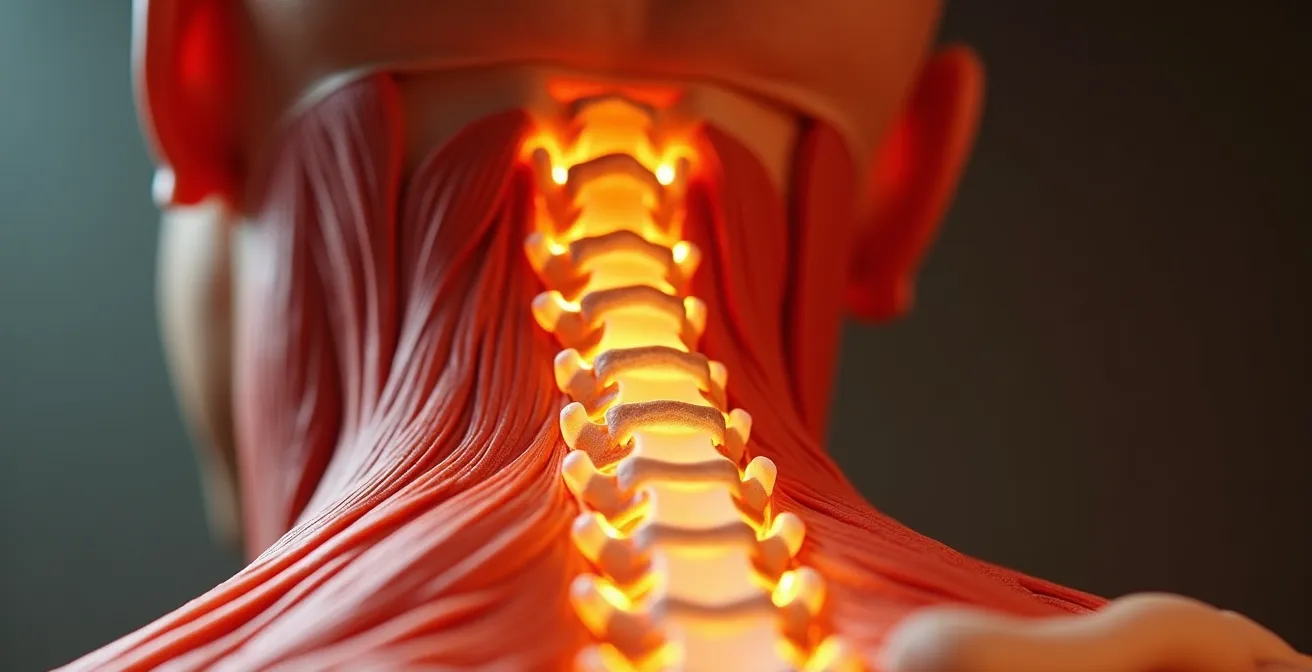
Once mobility is improved, the next step is to activate the weakened muscles of the upper back (like the rhomboids and lower trapezius) that are responsible for pulling your shoulder blades back and down. Finally, you must strengthen the deep neck flexors at the front of your neck, which are crucial for holding your head in a neutral, stacked position over your shoulders. A consistent, 10-minute daily routine incorporating these three elements can effectively reverse tech neck and alleviate the associated stiffness and pain.
Here is a balanced 10-minute routine:
- Part 1: Mobilize the Thoracic Spine (3 minutes): Perform cat-cow stretches on all fours to gently flex and extend the spine. Follow this with thoracic extensions over a foam roller, supporting your head with your hands as you arch your mid-back over the roller.
- Part 2: Activate the Upper Back (3 minutes): Perform wall slides. Stand with your back against a wall, with your arms in a “goalpost” position. Slowly slide your arms up the wall while keeping your elbows and wrists in contact, focusing on squeezing your shoulder blades together.
- Part 3: Strengthen Deep Neck Flexors (4 minutes): Perform chin tucks. Lie on your back without a pillow and gently nod your head as if saying “yes,” creating a “double chin.” Hold for 5-10 seconds and repeat, feeling the muscles at the front of your neck working.
By consistently applying these principles—from daily CARs to targeted postural correctives—you are no longer just fighting symptoms. You are actively reprogramming your nervous system, building robust joint health, and earning true freedom of movement. Start today by incorporating a simple five-minute CARs routine for your stiffest joints and begin the journey toward resolving chronic stiffness for good.