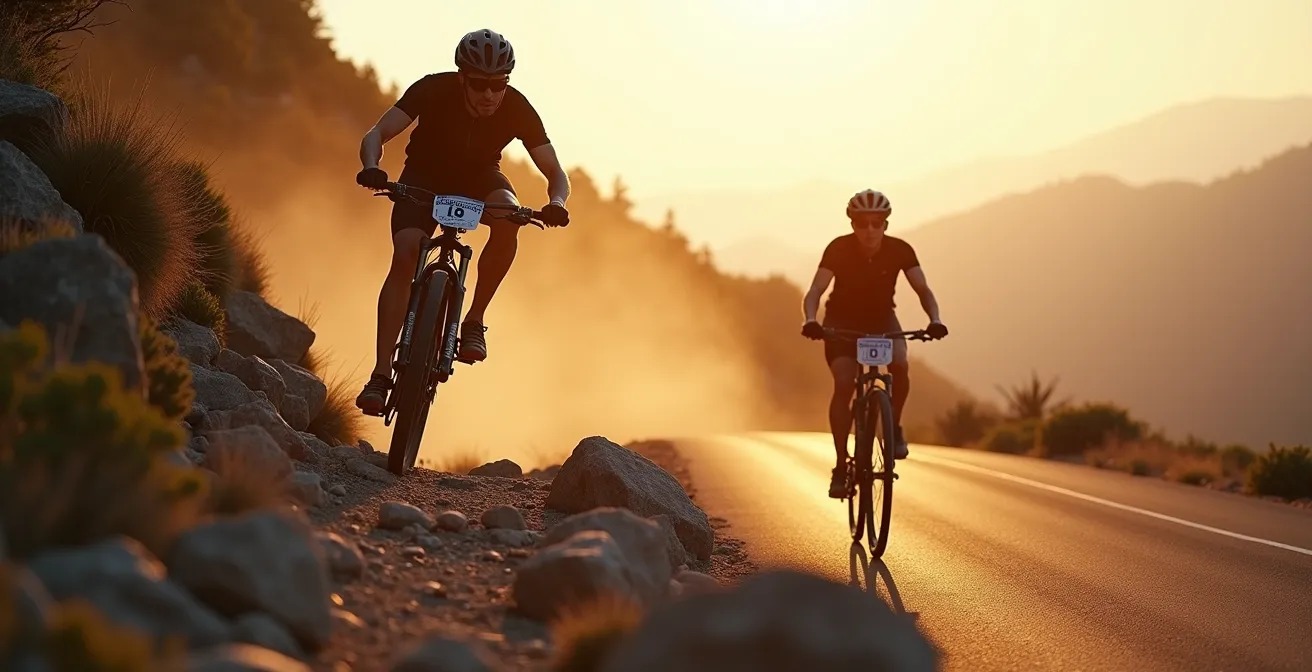
Contrary to the road cyclist’s instinct for rigid control, true on-road safety comes from embracing the dynamic, adaptive skills learned on unpredictable dirt trails. This article deconstructs how MTB techniques for vision, braking, and body position are not just ‘off-road skills’ but a fundamental reprogramming of your brain and body, transforming panic reactions into controlled, confident maneuvers on any surface, wet or dry.
Every road cyclist knows the feeling. The sudden tightening in your shoulders as the tarmac darkens with rain on a descent, or the instinct to grab a fistful of brake when a car pulls out unexpectedly. The common advice is to be more cautious, to ride rigidly, to rely on hope. But this approach is fundamentally flawed. It treats the bike and rider as a passive object to be protected, rather than a dynamic system capable of reacting with confidence.
The truth is, superior safety on the road isn’t born from an abundance of caution, but from a surplus of skill. This is where the world of mountain biking offers a transformative solution. It’s not just about getting muddy in the off-season; it’s about a complete neuromuscular reprogramming. The skills required to navigate roots, rocks, and loose dirt are the very same skills that turn a nervous road cyclist into a composed and reactive one.
This guide moves beyond simply listing techniques. We will deconstruct the core principles of MTB handling—vision, braking, and body language—to explain precisely why they are so effective at preventing crashes on the road. We will also establish why none of these skills can be truly mastered without a proper, ergonomic bike fit, which serves as the essential foundation for all dynamic movement. This is your blueprint for becoming a safer, faster, and more confident rider on any surface.
To navigate this deep dive into advanced bike handling, the following sections will break down each critical skill and its underlying principles. This structure is designed to build your understanding from foundational visual techniques to the physical ergonomics that enable them.
Summary: Road vs. MTB: How Mountain Biking Handling Skills Save Road Cyclists from Crashes?
- Why Look-Ahead Skills on Trails Prevent Panic Braking on Roads?
- How to Modulate Brakes When Traction Is Unpredictable?
- Static Road Posture vs. Dynamic MTB Body Language: When to Move?
- The Lean Angle: How Dirt Cornering Teachings Apply to Wet Tarmac?
- Off-Season Dirt: Why Winter is the Best Time to Switch Bikes?
- Why a Saddle That Is Too High Causes Hip Rocking and Knee Pain?
- Indoor Cycling vs. Winter Riding: Which Maintains Better Bike Handling Skills?
- Bike Fit Ergonomics: Why Your Lower Back Hurts After 20 Miles?
Why look-ahead skills on trails prevent panic braking on roads?
Panic braking is a symptom, not the problem itself. It’s the result of your brain being overwhelmed by sudden, unexpected information. On a mountain bike trail, your brain is forced to process a constant stream of complex data: roots, rocks, drops, and changing cambers. This environment naturally trains you to look far ahead, not at your front wheel. This isn’t just a good habit; it’s a cognitive survival mechanism. By scanning 10-20 meters down the trail, you give your brain the time it needs to assess threats, plan lines, and prepare motor responses.
This process is about managing your cognitive bandwidth. When you fixate on the obstacle directly in front of you, you use 100% of your mental processing power on a single, immediate threat, leaving no room for strategic planning. Looking ahead expands your awareness, allowing you to identify escape routes and alternative lines before you even reach a hazard. As studies examining perceptual-motor skills in cycling show, riders trained on varied terrain develop superior hazard recognition in traffic. You’re no longer just reacting; you’re proactively navigating.
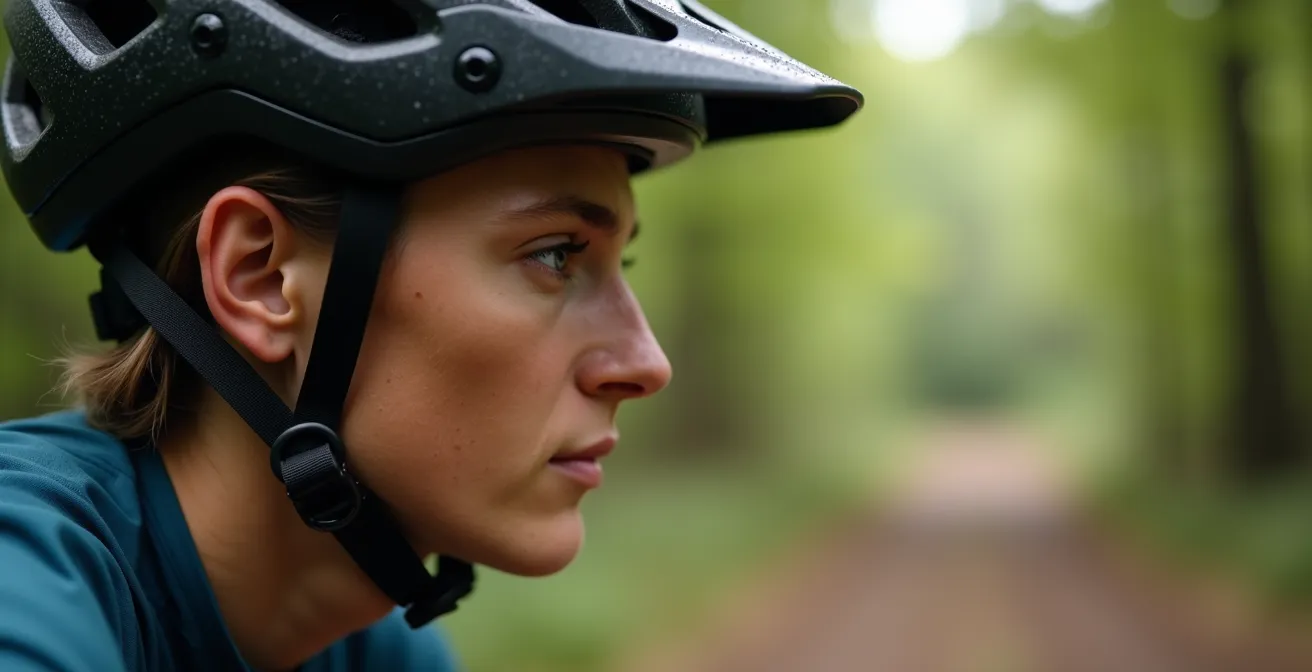
When you transfer this skill to the road, the benefits are immediate. Instead of being startled by a pothole, you’ve already seen it and adjusted your line. Instead of panicking when a car door opens, you’ve already registered it as a potential threat and moved to the far side of your lane. Your “panic” situations are downgraded to “planned” maneuvers. To build this skill, focus on these key techniques:
- The 3-Second Rule: Consciously keep your gaze focused on the point you will reach in three seconds. This forces you to look further ahead as your speed increases.
- Peripheral Processing: While your focus is distant, train your brain to notice and process information from your peripheral vision. This is crucial for detecting cross-traffic or pedestrians.
- Break Target Fixation: If you see a hazard, consciously look where you want to go—the escape route—not at the hazard itself. Your bike will follow your eyes.
How to modulate brakes when traction is unpredictable?
Many road cyclists treat their brakes as an on/off switch and live in fear of the front brake. This habit comes from a misunderstanding of physics and a lack of practice on low-traction surfaces. Mountain biking forces you to unlearn this. On a loose, gravelly descent, grabbing a fistful of brake—front or rear—guarantees a skid. You learn to see braking not as a way to stop, but as a way to manage speed and maintain traction.
The key is progressive modulation, or “feathering.” It’s a delicate conversation with your tires about the available grip. This starts with overcoming the fear of the front brake. Due to weight transfer under deceleration, a significant amount of your stopping power is at the front. In fact, braking physics research shows that approximately 70% of stopping power comes from the front brake. An MTB rider learns to trust and use this power by shifting their weight back simultaneously to counteract the forward pitch, keeping the rear wheel on the ground.
This creates a dynamic braking system where you actively manage a “traction budget.” Leaning, pedaling, and braking all spend from this budget. On wet tarmac, a road cyclist’s instinct is to brake timidly, using only the rear, which can easily lock up. The MTB-trained rider will use both brakes progressively, feeling for the edge of traction and adjusting pressure in micro-seconds, while shifting their weight to maximize the grip available.
The following table illustrates the fundamental differences in approach, which directly translate to safety on the road.
| Aspect | Road Cyclist Habit | MTB-Trained Technique | Safety Benefit |
|---|---|---|---|
| Brake Application | On/off binary | Progressive feathering | Better traction control |
| Front Brake Use | Minimal (fear-based) | 70% reliance | Shorter stopping distance |
| Body Position | Static | Dynamic weight shift | Prevents endo/skidding |
| Sensory Feedback | Visual only | Visual + auditory + tactile | Earlier traction loss detection |
Static road posture vs. dynamic MTB body language: when to move?
The classic road cycling posture is one of static efficiency: locked-in, aero, and rigid, designed to hold a position for hours. While effective for power output on smooth roads, this posture becomes a liability when stability is challenged. A mountain biker, by contrast, is never static. Their body is in constant motion, acting as “human suspension” to absorb impacts and maintain traction. The default MTB “attack position”—hinged at the hips, elbows bent, chest low, and weight centered—is not a single posture but a ready state from which to move.
This dynamic body language is about separating your body’s mass from the bike’s. When you hit a pothole or a patch of rough pavement, a rigid roadie is jolted along with the bike, potentially losing control. An MTB-trained rider absorbs the impact by allowing the bike to move underneath them, using their arms and legs as shock absorbers. They can “unweight” the bike to float over obstacles or push it into the ground to find more grip. This active control is what keeps the tires connected to the ground when things get rough.
The benefits of this cross-training are evident at the highest levels of the sport. Professional road cyclists renowned for their incredible bike handling, like Peter Sagan and Cadel Evans, have strong off-road backgrounds. Their ability to navigate chaotic pelotons and treacherous descents stems from this ingrained dynamic body language. Even track-trained riders like Bradley Wiggins and Geraint Thomas benefit from the heightened bike control learned in a different discipline, demonstrating that skills are transferable.
For a road cyclist, the key is knowing when to switch from your efficient, static posture to this active, dynamic one. The moments to “get into attack position” are clear: entering a corner with an uncertain surface, descending on wet or broken pavement, navigating dense traffic, or hopping a curb. It means consciously breaking your roadie habits and adopting a more fluid, responsive stance, ready to absorb and react.
The lean angle: how dirt cornering teachings apply to wet tarmac?
Cornering on a road bike is often taught as a simple lean: bike and body tilt together into the turn. This works perfectly when traction is high. On wet tarmac, loose gravel, or an off-camber road, this technique dramatically increases the risk of the tires sliding out from under you. Mountain biking teaches a more sophisticated technique: bike-body separation. This principle is arguably the most critical skill for preventing low-side crashes on slippery surfaces.
The technique involves keeping your torso and center of mass more upright while pushing the bike down and leaning it into the turn. By doing this, you keep the majority of your weight directed vertically down onto the tire’s contact patch, maximizing grip. At the same time, you drop your outside foot to its lowest point and apply pressure, which further drives the tires into the road. This allows the bike to achieve a significant lean angle for cornering, while your body remains in a more stable and balanced position, ready to correct a slide.
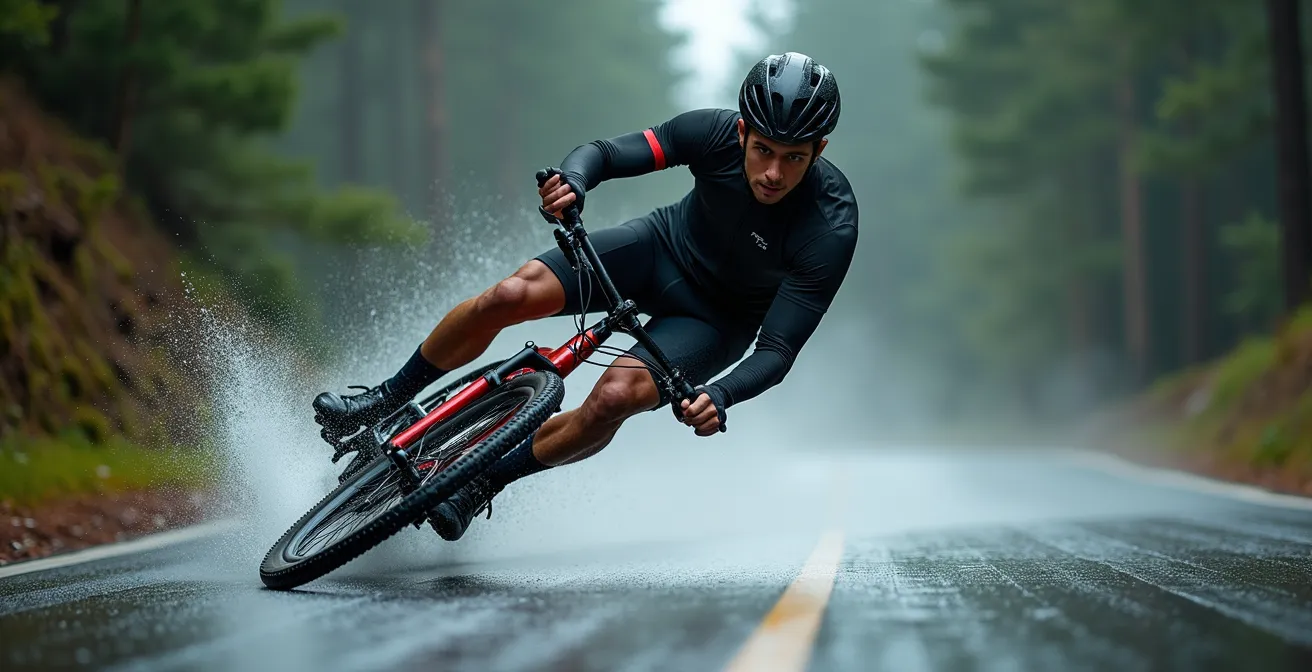
This is the opposite of a road cyclist’s instinct to lean with the bike and keep their inside pedal up to avoid pedal strike. The MTB approach prioritizes grip and balance over all else. The sequence is critical:
- Brake Before the Turn: Get all your braking done while the bike is upright and traction is maximal. Never brake mid-corner.
- Look Through the Exit: Fixate your eyes on where you want to go, not at the ground or the apex of the turn.
- Initiate the Lean: Push the bike down into the turn, keeping your upper body relatively upright. Consciously push on the inside handlebar (counter-steering) to initiate the lean quickly.
- Drop the Outside Foot: As you lean the bike, drop your outside pedal and apply firm pressure to it. This action plants your tires securely.
This method feels counter-intuitive at first, but it is the physical embodiment of traction management. It gives you a larger margin for error on unpredictable surfaces, turning a treacherous wet corner into a controlled, confident arc.
Off-season dirt: why winter is the best time to switch bikes?
For many road cyclists, winter means one of two things: miserable, cold road miles or the monotonous hum of an indoor trainer. There is a third, far more productive option: switching to a mountain or gravel bike. The off-season is the perfect time to not just maintain fitness, but to actively overhaul your bike handling skills. Riding on dirt, mud, and gravel through the winter provides a low-consequence environment to practice the dynamic skills discussed in this article.
The slower speeds of off-road riding give you more time to process feedback from the bike. You can feel the precise moment a tire begins to lose traction and learn to correct it without the high-speed panic of a road descent. Every ride becomes a lesson in traction control, line choice, and dynamic body positioning. You are constantly making micro-corrections, engaging stabilizer muscles that have been dormant during a season on smooth tarmac, and rewiring your brain to read terrain instead of just a power meter.
Furthermore, winter dirt riding breaks the mental monotony of structured training. It re-engages the playful aspect of cycling, which is a powerful motivator when the weather is bleak. This psychological refresh is as important as the physical training. When you return to your road bike in the spring, you won’t just be fit; you’ll be a fundamentally different rider. Potholes will seem less intimidating, wet corners less treacherous, and your overall confidence in controlling the bike will be an order of magnitude higher. The investment in off-season dirt time pays its biggest dividends in on-road safety.
This period should be viewed as deliberate skill acquisition, not just “junk miles.” Focus on sessions dedicated to cornering, braking on loose surfaces, and navigating technical sections. Each ride builds a deeper, more intuitive connection between you and your bike, a connection that is the bedrock of true handling mastery.
Why a saddle that is too high causes hip rocking and knee pain?
Before you can effectively apply dynamic MTB skills, we must address the static foundation: your bike fit. An incorrect setup can actively fight against the very movements you’re trying to learn. One of the most common and detrimental fit issues is a saddle set too high. A roadie’s quest for maximum leg extension often pushes the saddle upward, but this creates a cascade of negative effects that destabilize the entire system.
When the saddle is too high, your leg must over-extend at the bottom of the pedal stroke. To reach the pedal, your pelvis is forced to rock from side-to-side on the saddle with each revolution. This hip rocking is a major red flag. It indicates instability, wastes energy, and is a primary cause of saddle sores and chafing. More critically, this instability at the core prevents you from maintaining a strong, balanced platform from which to perform dynamic movements like bike-body separation or absorbing bumps.
This over-extension also places enormous strain on the ligaments and tendons around the knee, often leading to pain in the back of the knee (biceps femoris tendonitis) or IT band syndrome on the outside. While the nervous system can adapt to small changes, as moderate evidence suggests that adjustments of less than 4% of leg length may not affect metabolic cost, larger errors in height force harmful compensations. A saddle that is too high effectively locks your body into a rigid, inefficient, and unstable posture, making advanced bike handling impossible and increasing the risk of injury.
Action Plan: Your Dynamic Saddle Height Audit
- Reject static measures: Ignore simplistic methods like ‘heel on pedal’. Assess your position on a trainer under load at your typical 80-90 rpm cadence.
- Focus on hip stability: Have someone film you from behind. If your hips are rocking side-to-side, your saddle is too high. Lower it in 2-3mm increments until the rocking stops.
- Check ankle flexion: At the bottom of the stroke, you should have a slight, natural ankle flexion (heel slightly lower than the ball of the foot). If your toe is pointed down (plantarflexion), the saddle is too high.
- Monitor muscle engagement: Pay attention to your glutes and hamstrings. If you feel your lower back compensating or straining to complete the pedal stroke, your saddle is likely too high.
- Test descending control: On a safe descent, can you easily drop your heels and shift your weight back behind the saddle? If not, a too-high saddle may be physically blocking this crucial safety move.
Indoor cycling vs. winter riding: which maintains better bike handling skills?
The debate between riding indoors on a trainer versus bundling up for a winter ride is often framed around fitness metrics and convenience. From a bike handling perspective, however, the answer is unequivocally clear: real-world riding is non-negotiable for skill maintenance. An indoor trainer, while excellent for structured physiological training, is a sensory deprivation chamber for your nervous system.
Riding a bike is a constant stream of feedback. Your brain processes billions of signals related to balance, traction, and body position—a phenomenon known as proprioception. As master bike fitter Steve Hogg explains, this feedback loop is vital for maintaining the brain’s “map” of your body in space. In his analysis for Cyclingnews, on the anatomy of bike position, he notes:
Our nervous system sends 4 billion signals per second to the brain, but the brain can only process 2 thousand signals per second. Every time you stretch or stimulate a muscle, it sends a proprioceptive charge saying ‘Remember me?’ and the brain devotes more space to that body part.
– Steve Hogg, Cyclingnews
On an indoor trainer, the bike is locked in place. There is no need to balance, no micro-corrections for wind, no feedback from changing road surfaces. Your stabilizer muscles become inactive, and the neural pathways responsible for bike handling are starved of input. This leads to a “wooden” feeling when you return to the road, as your reaction times are dulled and your intuitive feel for the bike is diminished.
The following table starkly compares the impact of each training method on the skills that actually keep you safe.
| Training Aspect | Indoor Trainer | Winter MTB/Gravel | Skill Transfer to Road |
|---|---|---|---|
| Proprioception | Minimal – static position | Maximum – constant micro-corrections | Essential for bike control |
| Stabilizer Muscles | Inactive | Highly engaged | Prevents ‘wooden’ feeling |
| Cognitive Load | Underload – no risk assessment | Positive stress – constant decisions | Sharper reactions |
| Neural Pathways | Sensory input drastically reduced | Full sensory engagement | Better hazard response |
| Balance Skills | Zero development | Continuous refinement | Crucial for safety |
Key Takeaways
- Vision is Proactive, Not Reactive: Train your eyes to scan far ahead to manage cognitive bandwidth and turn panic moments into planned maneuvers.
- Braking is a Dynamic Dialogue: Master progressive modulation with both brakes and use dynamic weight shifts to manage a finite “traction budget,” especially on wet surfaces.
- Your Body is the Suspension: Abandon a rigid road posture in challenging situations. Adopt a dynamic MTB “attack position” to absorb impacts and maintain control.
Bike fit ergonomics: why your lower back hurts after 20 miles?
If advanced skills are the software of safe cycling, then bike fit is the hardware. You cannot run sophisticated programs on a machine that is fundamentally misaligned. Lower back pain after a relatively short ride is a classic sign that your bike fit is not just uncomfortable, but is actively undermining your ability to ride safely and effectively. It’s an alarm bell indicating a systemic failure, not just a localized ache.
Lower back pain often arises from a position that forces your lumbar spine to flex excessively to reach the handlebars, a problem commonly caused by a saddle that’s too high or a reach that’s too long. This puts your hamstrings on excessive stretch and forces your pelvis to tilt posteriorly (tuck under), rounding your lower back. In this compromised position, your deep core stabilizing muscles cannot engage properly. Your back is no longer a strong, supportive platform but a strained, vulnerable link in the chain.
From this unstable position, it is impossible to generate efficient power, let alone perform the dynamic movements required for advanced handling. You cannot hinge at the hips for an “attack position” if your pelvis is already locked in a dysfunctional tilt. You cannot absorb bumps through your arms and legs if your core cannot stabilize your torso. As a systematic review of bike positional variables highlights, the relationship between fit and pain is complex, involving an interplay between the rider’s personal flexibility, core strength, and the bike’s geometry. Pain is the final outcome of a system that is out of balance.
Therefore, resolving pain is the first step toward unlocking higher performance and safety. It requires a holistic view that treats the rider and bike as a single ergonomic system. Chasing a “pro” look with a slammed stem or an excessively high saddle is counterproductive if it creates a painful, unstable position that prevents you from controlling your bike when it matters most.
Ultimately, becoming a safer, more capable cyclist is a dual-path journey. It involves both installing new software—the advanced handling skills from mountain biking—and ensuring your hardware—your bike fit—is perfectly optimized to run it. By addressing your position to eliminate pain and then layering on dynamic skills practice, you transform yourself from a passive passenger to an active pilot, in full control of your machine on any road, in any condition. The next logical step is to seek a professional bike fit that considers both your anatomy and your performance goals.