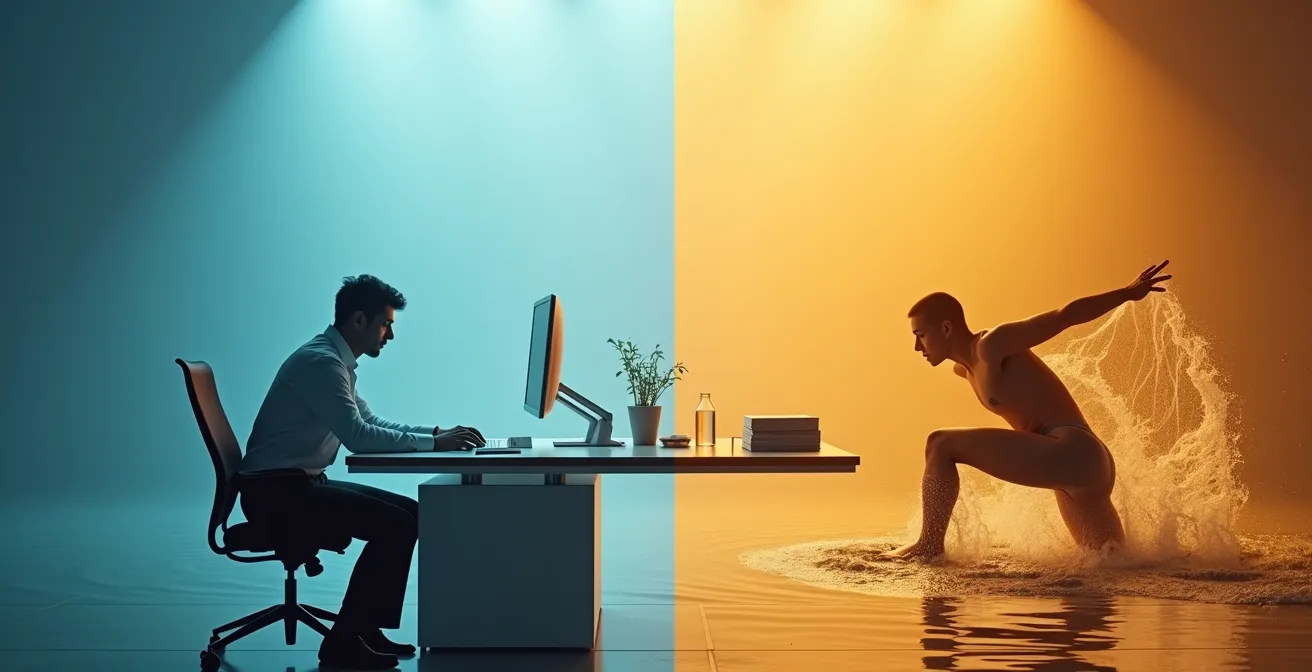
The best sport for a desk job isn’t the one that burns the most calories, but the one that strategically reverses your specific ‘postural debt’ from sitting.
- Most desk workers suffer from tight hips and a weak posterior chain; some sports, like running, can worsen these imbalances if not approached correctly.
- Activities promoting spinal extension and bilateral (symmetrical) movement, like rowing, are generally superior for postural correction than unilateral sports like tennis.
- Frequent, short bursts of movement throughout the day are more effective at offsetting the harms of sitting than one long weekly session.
Recommendation: Start with a self-assessment of your hip and back health before committing to any new high-impact activity.
The dull ache in your lower back, the tightness in your hips, the creeping slump in your shoulders—this is the familiar language of a body confined to a desk. In response, the conventional wisdom is a simple, urgent command: “move more.” You’re told to join a gym, start running, or take up a sport, with the assumption that any activity is the perfect antidote to a sedentary life. But what if this well-intentioned advice is not just incomplete, but potentially counterproductive?
The reality is that not all exercise is created equal, especially for a body that has adapted to eight hours of sitting. The chronic hip flexion, forward head posture, and dormant gluteal muscles create a specific imbalance—a “postural debt.” Simply layering any intense activity on top of this compromised foundation can reinforce negative patterns or, worse, lead to injury. A weekend warrior approach to tennis or an impromptu decision to start CrossFit can introduce new asymmetries and stresses that your body is unprepared to handle.
This guide offers a more strategic perspective. The key is not just to move, but to engage in strategic counter-movement. We will explore a diagnostic approach to understanding your body’s unique needs as a desk worker. Instead of providing a simple list of “good” sports, we will equip you with a framework to evaluate which discipline will actively rebalance your kinetic chain, correct your posture, and build resilient strength. We will analyze why some popular choices might be poor fits, compare the true postural benefits of different sports, and determine the optimal frequency of exercise to truly undo the damage of sitting. This is your blueprint for choosing an athletic pursuit that truly complements, rather than complicates, your professional life.
This article provides a complete framework for making an informed choice. It will guide you through self-assessment, compare specific sports based on their biomechanical benefits, and offer practical strategies for integration and consistency. Explore the summary below to navigate the key areas of your decision-making process.
Summary: Finding the Right Sport to Counteract a Desk Job
- Why Running Might Worsen Hip Tightness for Desk Workers?
- How to Test a New Sport for 4 Weeks Before Committing Financially?
- Tennis vs. Rowing: Which Is Better for Postural Correction?
- The High-Impact Mistake: Starting CrossFit with a Weak Lower Back
- Frequency vs. Duration: Is It Better to Play 1 Hour Daily or 4 Hours Sunday?
- Standing Desk vs. Swiss Ball Chair: Which Is Better for Core Engagement?
- Why Sitting for 8 Hours Costs You More in Productivity Than a 1-Hour Workout
- Adapting Your Outdoor Sport for Winter Conditions Without Losing Motivation
Why Running Might Worsen Hip Tightness for Desk Workers?
For many office workers seeking an accessible and effective form of cardio, running seems like the obvious choice. However, for a body conditioned by prolonged sitting, running can be a double-edged sword. The primary issue lies in the biomechanics of the running stride, which heavily involves the hip flexors—the very muscles that become chronically shortened and tight from sitting all day. When you sit, your hips are in a constant state of flexion. Going for a run without proper preparation can reinforce this pattern, further tightening the hip flexors and inhibiting the opposing muscles, the glutes.
This muscular imbalance, known as “lower crossed syndrome,” is a hallmark of postural debt. The tight hip flexors pull the pelvis forward, creating an anterior pelvic tilt, which increases the arch in the lower back and places compressive stress on the lumbar spine. Meanwhile, the underactive glutes fail to provide adequate hip extension and stability, forcing smaller, less suitable muscles like the hamstrings and lower back to overcompensate. This can lead to a cascade of issues, from hamstring strains and runner’s knee to persistent lower back pain. Instead of counteracting the effects of sitting, an improper running routine can effectively cement them in place.
Before committing to running, a self-assessment is critical. The Thomas Test is a simple, effective way to gauge your hip flexor length. By performing this diagnostic test, you can identify if you have pre-existing tightness that needs to be addressed before you start logging miles. Understanding your baseline is the first step in a strategic approach.
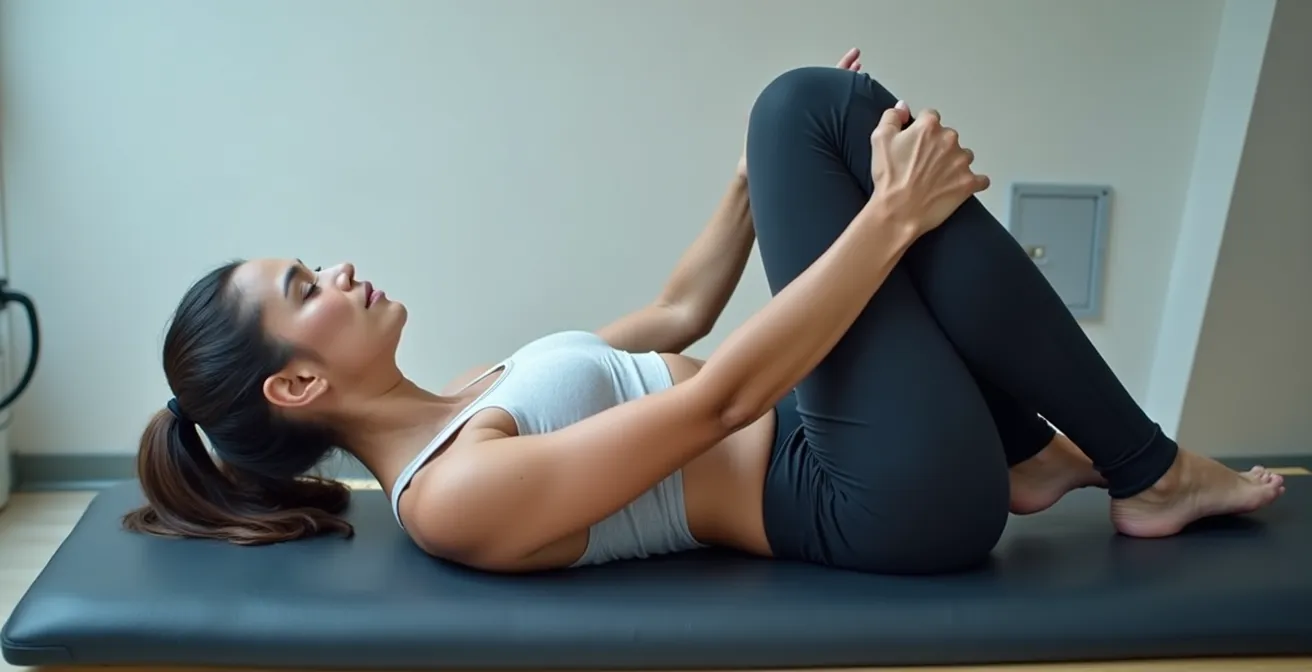
As this demonstration of the Thomas Test shows, assessing your body’s specific limitations is a non-negotiable starting point. If your hanging leg cannot rest parallel to the surface or lifts when you pull the other knee to your chest, you likely have significant hip flexor tightness. In this case, starting a running program should be preceded by a dedicated routine of hip flexor stretches and glute activation exercises to restore balance and prevent injury. Without this foundational work, you risk running yourself into more pain, not away from it.
How to Test a New Sport for 4 Weeks Before Committing Financially?
Once you’ve identified a potential sport that offers strategic counter-movement, the next hurdle is often commitment—both in time and money. The prospect of investing in expensive equipment or a year-long membership for an activity you might not enjoy can be a significant deterrent. A smarter approach is to design a low-cost, four-week trial period to test the waters. This “beta test” for your new athletic life allows you to assess not only your enjoyment but also how your body responds to the new demands before making a substantial financial outlay.
The key is to seek out introductory offers, pay-as-you-go options, and low-cost entry points. Many specialized facilities, such as climbing gyms, yoga studios, and CrossFit boxes, offer free trial classes or discounted introductory packages for newcomers. Publicly funded resources are another excellent avenue; community pools and municipal tennis courts often provide affordable hourly rates that are perfect for a trial run. Don’t underestimate the power of borrowing or renting equipment. A friend’s spare tennis racket or a gym’s rental climbing shoes are all you need to get a feel for the sport.
This trial period is also an opportunity to build the habit of exercise with minimal friction. Studies show that workers who start with accessible, low-cost activities are more likely to transition successfully to a regular fitness routine. The goal of these four weeks is not to achieve mastery, but to gauge compatibility. Do you look forward to the sessions? Do you feel better afterward? Does it fit realistically into your schedule? Answering these questions with minimal financial risk is the most effective way to ensure your new sport becomes a sustainable part of your life.
The following table breaks down potential trial costs for several popular sports, demonstrating that a test run is often far more affordable than perceived.
| Sport | Trial Option | Trial Cost | Full Cost (Monthly) | Equipment Needed |
|---|---|---|---|---|
| Rowing | Gym day pass with rowing machine | $15-25/session | $150-200 club membership | None for trial |
| Rock Climbing | Bouldering gym intro class | $30-40 total | $80-120 membership + $200 gear | Rental shoes ($5) |
| Tennis | Public court + borrowed racket | $0-10/hour | $100-150 lessons + $150 equipment | Borrowed/cheap racket |
| Swimming | Public pool sessions | $5-10/visit | $50-80 pool membership | Swimsuit + goggles ($40) |
Tennis vs. Rowing: Which Is Better for Postural Correction?
When choosing a sport to counteract a sedentary job, the distinction between bilateral and unilateral movement is paramount. Rowing and tennis offer a perfect case study in this contrast. While both are excellent forms of exercise, one is inherently better suited to correcting the postural debt of a desk worker. Considering that 43.6% of the average American workday is spent sitting according to the U.S. Bureau of Labor Statistics, the need for a targeted corrective activity is clear.
Tennis is a unilateral sport, meaning it predominantly uses one side of the body. The powerful serves, forehands, and backhands all involve forceful, asymmetrical rotation. For a body already dealing with imbalances from sitting, this can be problematic. A dominant arm and shoulder can become overdeveloped, while the non-dominant side remains comparatively weak, potentially exacerbating existing muscular discrepancies and spinal rotation. While tennis is fantastic for agility and cardiovascular health, it requires a separate, dedicated program of corrective exercises to ensure that it doesn’t create new imbalances on top of old ones.
Rowing, on the other hand, is a bilateral and symmetrical activity. The movement of the rowing stroke is a powerful, fluid sequence that engages the entire posterior chain—the network of muscles on the back of your body, including the glutes, hamstrings, and back extensors. The “catch” position encourages thoracic extension, and the “drive” phase is a powerful glute-driven leg press. In essence, every stroke is a direct counter-movement to the hunched-over, hip-flexed posture of sitting.
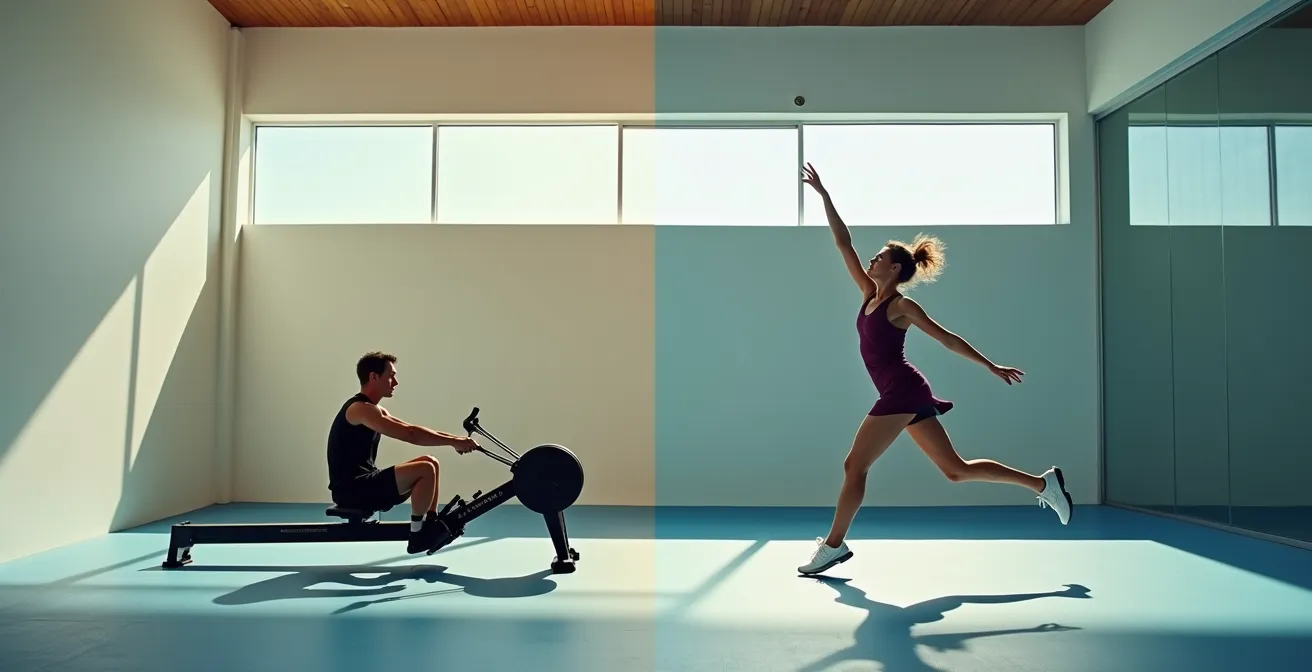
As an expert in the field explains, the choice is clear from a postural perspective. Kate Meier, a certified personal trainer, notes the fundamental difference:
Rowing is a bilateral, symmetrical movement that directly counteracts the forward slouch by strengthening the entire posterior chain, while tennis as a unilateral sport can introduce new imbalances if not properly complemented with corrective exercises
– Kate Meier, NASM-CPT, USAW-L1, Garage Gym Reviews Office Workout Guide
For a desk worker seeking a single sport to provide a corrective benefit, rowing is the more efficient and targeted choice. It builds the very muscles that sitting weakens and stretches the ones that sitting tightens, all within a single, balanced movement.
The High-Impact Mistake: Starting CrossFit with a Weak Lower Back
CrossFit and other high-intensity interval training (HIIT) programs are incredibly popular for their efficiency and community atmosphere. They promise rapid results by combining weightlifting, gymnastics, and metabolic conditioning. However, for a desk worker, jumping directly into this high-impact world without a proper foundation is a significant mistake. The complex, powerful movements at the heart of CrossFit—like Olympic lifts, box jumps, and kipping pull-ups—demand a level of core stability and mobility that the average sedentary body simply does not possess.
The primary risk lies in the weakened posterior chain and poor neuromuscular control common in office workers. A weak lower back, inhibited glutes, and tight hips create a fragile foundation. Subjecting this unprepared structure to explosive, high-load movements is a recipe for injury, particularly to the lumbar spine and shoulders. Your body will naturally find the path of least resistance, compensating for a weak core by over-relying on the lower back, or for poor shoulder mobility by compromising form. It’s not that CrossFit is inherently dangerous; it’s that starting it with a significant “postural debt” is like building a skyscraper on a foundation of sand.
The solution is not to avoid high-intensity training altogether but to earn the right to participate. A 2021 study on workplace exercise found that building foundational strength through simple bodyweight and resistance band exercises for 4-6 weeks dramatically reduced injury risk when transitioning to more intense programs. This “Phase 0” is a non-negotiable prerequisite for any desk worker considering CrossFit. It involves re-activating dormant muscles, improving mobility, and teaching the body to move correctly under low load before adding intensity and complexity.
Before you even consider stepping into a CrossFit box, you must be able to pass a basic readiness assessment. This isn’t about performance; it’s about injury prevention. The following checklist outlines the absolute minimum physical competency required.
Your CrossFit Readiness Plan for Desk Workers
- Foundation Test 1: Hold a plank position for 60 seconds without your lower back sagging.
- Foundation Test 2: Perform 10 bodyweight squats with proper depth and without your knees caving inward (knee valgus).
- Foundation Test 3: Complete 10 push-ups with a full range of motion and a stable core.
- Foundation Test 4: Demonstrate overhead mobility by trying to touch your hands behind your back (one from above, one from below).
- Foundation Test 5: Execute 20 glute bridges, holding for 2 seconds at the top of each repetition.
If you cannot comfortably complete these tasks, you are not ready for CrossFit. Focus on a “Phase 0” protocol of resistance band training and bodyweight exercises to build your foundation first. This patient, strategic approach will ensure your high-intensity journey is a successful and sustainable one.
Frequency vs. Duration: Is It Better to Play 1 Hour Daily or 4 Hours Sunday?
In the quest to combat a sedentary work life, a common dilemma arises: is it better to cram all your physical activity into a long weekend session or to spread it out in smaller daily doses? For the desk worker, the answer is unequivocally clear: frequency trumps duration. The “weekend warrior” approach—sitting for 40 hours during the week and then attempting a four-hour marathon of activity on Sunday—is a flawed strategy that fails to address the core problem.
The negative effects of prolonged sitting are cumulative and occur in real-time. Your metabolism slows, your posture degrades, and your muscles begin to “forget” how to function correctly with each passing hour of inactivity. A single, intense session on the weekend, while better than nothing, is not enough to reverse the damage accumulated over five consecutive days. It’s like trying to undo a week of poor eating with one giant salad. Furthermore, this boom-and-bust cycle of activity significantly increases the risk of overuse injuries, as a deconditioned body is suddenly asked to perform at a high level.
The science supports a more consistent approach. Recent research published in the British Journal of Sports Medicine shows that just 22-40 minutes of daily moderate to vigorous physical activity is enough to offset the health risks of sitting for 10 hours. The focus should be on breaking the long periods of stillness. Even more compellingly, a 2023 study found that walking for just 5 minutes every 30 minutes can offset the most harmful metabolic effects of prolonged sitting. Workers who integrated these “activity snacks” showed better blood pressure and heart rate regulation than those who did a single longer session.
This doesn’t mean you must hit the gym every day. It means you should reframe your concept of exercise. A brisk 20-minute walk at lunch, a 15-minute bodyweight circuit before work, and taking the stairs are all valuable deposits into your “movement bank.” For your chosen sport, aiming for three 45-minute sessions during the week is far more beneficial for postural correction and overall health than a single, grueling 2-hour session on the weekend. Consistency is the key to re-patterning your body and truly counteracting your sedentary job.
Standing Desk vs. Swiss Ball Chair: Which Is Better for Core Engagement?
The battle against sedentary work has moved from the gym into the office itself, with “active workstations” becoming increasingly popular. The two most common contenders are the standing desk and the Swiss ball chair, both promising to improve posture and engage the core. While both are superior to a traditional static chair, they serve different purposes and come with their own set of pros and cons. The best choice depends on your goal, your current core strength, and your ability to use the tool correctly.
A standing desk primarily combats the negative effects of hip flexion. By allowing you to work in an upright position, it helps to lengthen the hip flexors, encourages better circulation, and burns slightly more calories than sitting. However, its effect on core engagement is mostly passive. It’s entirely possible to slouch while standing, locking your knees and shifting your weight onto one hip, which simply trades one poor posture for another. Its main benefit is breaking the seated position, but it requires conscious effort to maintain good posture and is best used when you can alternate between sitting and standing every 30-45 minutes to prevent leg fatigue.
A Swiss ball chair, by contrast, demands active core engagement. Its unstable surface forces your body to make constant micro-adjustments to maintain balance, which activates the deep stabilizing muscles of your core and improves proprioception (your sense of body position). However, this constant work can lead to fatigue, especially if you have a weak core to begin with. Using a Swiss ball all day can cause the lower back muscles to become overworked and tight as they struggle to maintain stability. It is an excellent tool for active sitting in shorter bursts (1-2 hours), but not a full-day replacement for a good ergonomic chair.
To help you decide, this comparative analysis from Hinge Health’s physical therapy guidelines breaks down the options.
| Option | Core Activation Level | Pros | Cons | Best For |
|---|---|---|---|---|
| Standing Desk | Moderate (passive) | Burns more calories, reduces hip flexor tightness, improves circulation | Can cause hip locking, weight shifting, leg fatigue | Workers who can alternate positions every 30-45 min |
| Swiss Ball | High (active) | Constant micro-adjustments, improved proprioception, active sitting | Lower back fatigue if core weak, difficult for all-day use | Short periods (1-2 hours) with strong core endurance |
| Balance Board | Very High | Maximum core engagement, ankle stability, constant movement | Distracting for detailed work, fatigue quickly | Phone calls, reading, short tasks |
| Regular Chair + Timer | Variable | Comfortable, allows focus, no special equipment | Easy to forget movement, passive posture | Combined with hourly movement breaks |
The key isn’t the object, but the usage. One can slouch while standing and sit rigidly on a Swiss ball. True core engagement is a conscious action, not an automatic benefit of the equipment.
– Dr. Caitlin Shaw, PT, DPT, Hinge Health Physical Therapy Guidelines
Ultimately, the most effective strategy is variety. The ideal “active workstation” is not a single piece of equipment but a system that encourages frequent changes in position throughout the day.
Why Sitting for 8 Hours Costs You More in Productivity Than a 1-Hour Workout
The time spent on a one-hour workout is often viewed as a “cost” to the workday—an hour that could have been spent answering emails or finishing a report. This is a fundamental misunderstanding of how the body and brain function. In reality, the eight hours of uninterrupted sitting are the real productivity killer, and the one-hour workout is a high-return investment. The cost of sedentarism isn’t just measured in back pain; it’s measured in lost focus, diminished creativity, and reduced cognitive output.
The physiological mechanism is straightforward. When you sit for extended periods, your posture tends to degrade into a slump. This forward head and rounded shoulder position isn’t just an aesthetic issue; research has demonstrated that poor posture from excessive sitting reduces cognitive function by limiting blood flow and oxygen supply to the brain. Your metabolic rate plummets, leading to feelings of lethargy and brain fog. You become physically and mentally sluggish, making it harder to solve complex problems, maintain concentration during meetings, or generate innovative ideas.
Conversely, physical activity acts as a powerful neurological and psychological reset. A workout increases blood flow to the brain, delivering a fresh supply of oxygen and nutrients that enhance cognitive function. It triggers the release of neurotransmitters like dopamine and serotonin, which improve mood and motivation, as well as brain-derived neurotrophic factor (BDNF), a protein that supports the growth of new neurons and is crucial for learning and memory. A 2020 study confirmed this powerful link, finding that employees who took short exercise breaks during the day reported not only better job satisfaction but also improved productivity and time management. The time “lost” to the workout was more than regained through heightened efficiency and reduced errors in the hours that followed.
Viewing exercise as an essential component of your professional toolkit, rather than a detraction from it, is a critical mindset shift. The most productive employees are not those who are chained to their desks the longest, but those who strategically integrate movement to keep their minds sharp and their bodies resilient. That one-hour workout isn’t costing you productivity; it’s buying it back from the eight hours of sitting that are actively draining it away.
Key takeaways
- Diagnose Before You Prescribe: The most critical first step is to assess your own “postural debt,” particularly hip flexor tightness and core weakness, before choosing a sport.
- Prioritize Strategic Counter-Movement: Select activities that actively reverse the patterns of sitting, favoring bilateral, symmetrical sports like rowing or swimming over unilateral ones like tennis.
- Frequency Over Duration: Consistent, shorter bursts of activity throughout the week are far more effective at combating the negative effects of sitting than a single, long “weekend warrior” session.
Adapting Your Outdoor Sport for Winter Conditions Without Losing Motivation
For those who find their athletic passion outdoors—whether it’s trail running, cycling, or tennis—the arrival of winter can feel like a major roadblock. Shorter days, freezing temperatures, and inclement weather can quickly sap motivation and derail a hard-won fitness routine. However, the winter months should not be a period of hibernation. Instead, they offer a perfect opportunity to adapt your training, focus on different physical attributes, and maintain your fitness base so you can return to your primary sport stronger in the spring.
The key to a successful winter adaptation is skill transfer. Instead of trying to replicate your outdoor sport in miserable conditions, identify its core physical demands and find an indoor alternative that hones those same skills. This strategic substitution not only maintains your fitness but can also address weaknesses and improve your overall athleticism. For example:
- An outdoor cyclist can switch to cross-country skiing (indoor or outdoor) to maintain cardiovascular endurance while dramatically improving balance and core strength.
- A trail runner can take up indoor rock climbing or bouldering, which builds immense core stability, grip strength, and upper body power—attributes that directly translate to better running form.
- An open-water swimmer can transition to an indoor rowing machine (ergometer) to get a similar full-body cardiovascular workout that emphasizes posterior chain strength.
This is also the time to shift your focus from performance metrics (like speed or distance) to consistency goals. The simple aim of moving three times a week, regardless of the activity, can be far more motivating than trying to hit a personal best in a snowstorm. High-Intensity Interval Training (HIIT) becomes a particularly powerful tool during winter.
Remote workers report that HIIT workouts are particularly effective during winter months because they require minimal equipment, can be done indoors in small spaces, generate heat quickly to combat cold, and show results fast which maintains motivation. Workers confirm HIIT sessions of just 15-30 minutes keep them engaged and prevent the winter fitness slump, with free YouTube videos providing endless variety without leaving home.
By viewing winter not as an obstacle but as a distinct training season for cross-training and building foundational strength, you can maintain your motivation and emerge in the spring as a more resilient, well-rounded athlete.
The first step toward counteracting your sedentary job is to create a personalized and sustainable plan. By assessing your body’s needs, choosing a sport that offers strategic counter-movement, and committing to consistency, you can transform your physical well-being and professional performance. Start today by evaluating your options and designing a low-risk trial period for your new athletic life.