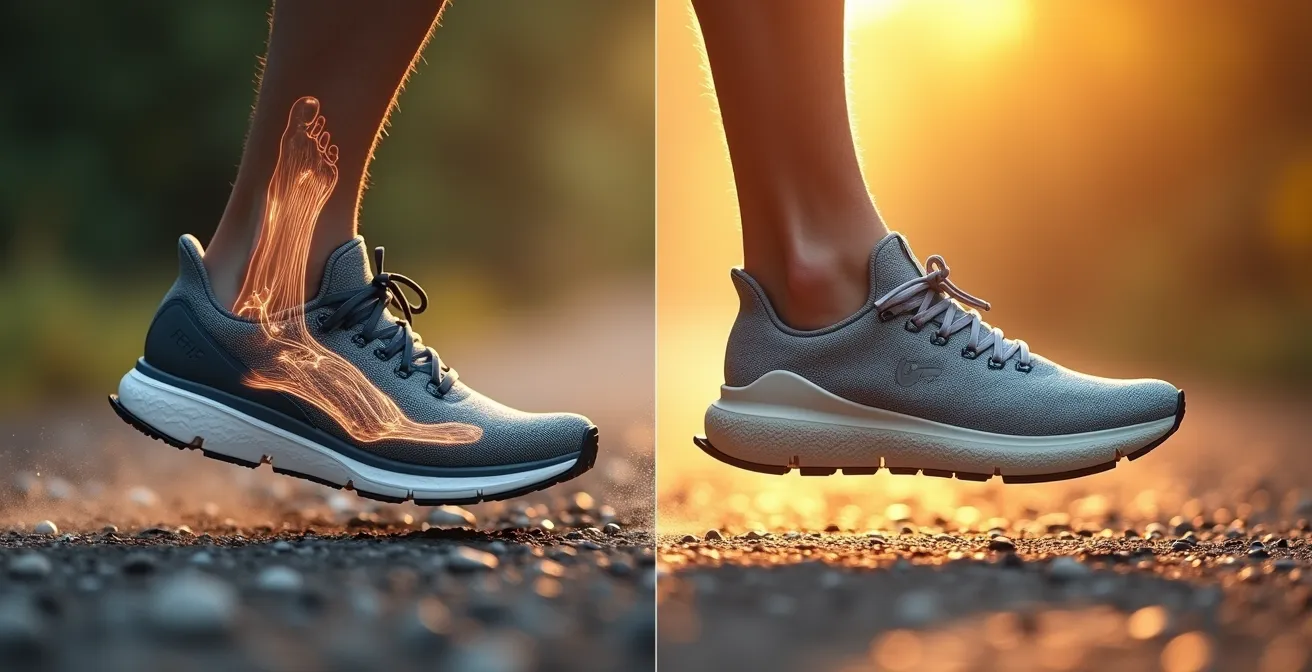
The debate between zero-drop and maximalist shoes misses the point: knee pain is primarily a load management issue, not a cushioning one.
- Maximalist foam can inadvertently increase impact forces and destabilize your gait by dulling proprioceptive feedback.
- Zero-drop shoes demand more from your Achilles and calves, risking new injuries if the transition is not managed correctly.
Recommendation: Analyze your gait (e.g., through outsole wear) to identify your specific biomechanical inefficiency, then select a shoe architecture that helps correct that specific loading pattern.
The dull ache in your knee after a run is a frustratingly common story for many runners. In the search for a solution, you’re faced with a barrage of conflicting marketing messages. One camp champions maximalist shoes, promising a cloud-like ride that absorbs every shock. The other advocates for zero-drop footwear, arguing that a “natural” foot position is the key to an injury-free stride. This leaves the runner with chronic pain caught in the middle, confused and uncertain which path leads to relief.
But what if both arguments are fundamentally flawed? As a sports podiatrist, I see that knee pain is rarely a “shoe problem.” It’s a biomechanical load problem. The shoe is simply a tool that can either correct or exacerbate an underlying gait inefficiency. The question isn’t “which shoe is better,” but rather “which shoe architecture best addresses my specific movement pattern?” High-stack cushioning might feel good initially, but it can mask poor form. Conversely, a minimalist design can promote better mechanics but brutally expose any weaknesses in your kinetic chain.
This article will dissect the architectural trade-offs of each shoe type, not to declare a winner, but to empower you with the clinical knowledge to select the right tool for your body. We will move beyond marketing claims to explore the biomechanical principles of load distribution, stability, and proprioception. By understanding how shoe design interacts with your unique gait, you can finally make an informed decision that targets the cause of your knee pain, not just the symptoms.
To navigate this complex topic, this guide breaks down the critical factors you must consider, from the risks of a sudden transition to understanding the subtle signals your own body and gear are giving you.
Summary: Zero Drop vs. Maximalist Cushioning: Which Shoe Architecture Prevents Knee Pain?
- Why Low Drop Shoes Can Cause Achilles Tendonitis in Beginners?
- How to Measure Toe Splay Room to Prevent Black Toenails?
- Road Shoes on Trail: Why Soft Foam Becomes Unstable on Rocks?
- The Valgus Collapse: Why Your Knees Caving In Leads to ACL Risks?
- Lug Depth: Deep Cleats vs. Hybrid Tread for Mixed Terrain?
- The Outsole Signal: What Uneven Wear Says About Your Gait?
- Shoe Rotation: How Alternating Models Extends Life and Reduces Injury?
- Smart Watch Metrics: Which Data Points Actually Improve Performance?
Why Low Drop Shoes Can Cause Achilles Tendonitis in Beginners?
The transition to low or zero-drop shoes is often promoted as a path to a more “natural” and efficient midfoot or forefoot strike, which can potentially reduce stress on the knees. However, this shift comes with a significant biomechanical trade-off. For a runner accustomed to traditional shoes with a higher heel-to-toe drop (e.g., 8-12mm), the heel is artificially elevated, which keeps the calf muscle complex (gastrocnemius and soleus) and the Achilles tendon in a slightly shortened position. Removing that elevation forces these tissues to work through a greater range of motion with every step.
This sudden increase in demand is a classic recipe for an overuse injury. The Achilles tendon, which connects the calf muscles to the heel bone, is subjected to a much higher tensile load. In fact, research from 2014 demonstrated that even during walking, a standard 10mm heel offset significantly alters Achilles tendon load compared to a flatter shoe. When you add the high-impact forces of running, the risk of micro-trauma, inflammation, and eventually Achilles tendonitis, becomes substantial for an unconditioned lower leg.
The body is an incredible machine of adaptation, but it requires time. A “cold turkey” switch from a high-drop cushioned trainer to a zero-drop minimalist shoe is a shock to the system. It’s not the low-drop architecture itself that is inherently dangerous, but the failure to respect the necessary adaptation period for the posterior chain muscles and tendons. Without a gradual transition, you are simply trading one potential problem (knee pain) for another, very real one (Achilles injury).
Action Plan: Gradual Transition Protocol to Low-Drop Shoes
- Incremental Drop Reduction: Do not swap your maximalist shoes for a zero-drop model overnight. Start with a pair that has a drop 2-4 mm lower than what you’re used to, and limit your first runs in them to very short distances.
- Non-Running Adaptation: Before running in your new shoes, simply walk around in them or wear them for your strength training sessions. This allows your feet and lower legs to adjust to the different feel and posture without adding high-impact stress.
- Progressive Frequency: Slowly increase how often you wear the new, lower-drop shoes. Alternate them with your current, higher-drop runners, gradually making them a more frequent part of your rotation over several weeks or months.
- Targeted Mobility and Strengthening: Regularly stretch your calves and Achilles tendon. Additionally, incorporate barefoot movements during your strength or mobility work to help re-engage and strengthen the intrinsic muscles of your feet, preparing them for a more natural foot position.
How to Measure Toe Splay Room to Prevent Black Toenails?
Subungual hematoma, or “runner’s toe,” is the painful blackening of a toenail caused by repetitive trauma. While often blamed on shoes being too short, the more frequent culprit is an inadequately shaped toe box that restricts natural toe splay. During the push-off phase of your gait, your toes need to spread out to provide a stable base and assist in propulsion. A tapered, narrow toe box squeezes the toes together, causing them to slam into the front or top of the shoe with every stride. This repetitive impact leads to bleeding under the nail.
A proper fit is not just about length; it’s about shape. The shoe’s toe box should mirror the natural, splayed shape of your foot, not force your foot into the shoe’s shape. Some brands have built their entire design philosophy around this concept; for instance, certain footwear design research shows that anatomically shaped toe boxes allow toes to move naturally, which can improve stability and reduce friction-related issues like blisters and black toenails. The goal is to have about a thumb’s width of space between your longest toe and the end of the shoe, but also ample width for your toes to spread without touching the sides.
A simple, effective way to test this is the insole trace test. Remove the insole from the shoe and stand on it with your full body weight. Your foot should be contained entirely within the boundaries of the insole, especially at the forefoot. If your toes or the ball of your foot spill over the edges, the toe box is too narrow for your foot’s natural shape, regardless of its length. This is a clear indicator that the shoe will restrict toe splay and put you at risk for black toenails and other forefoot issues.
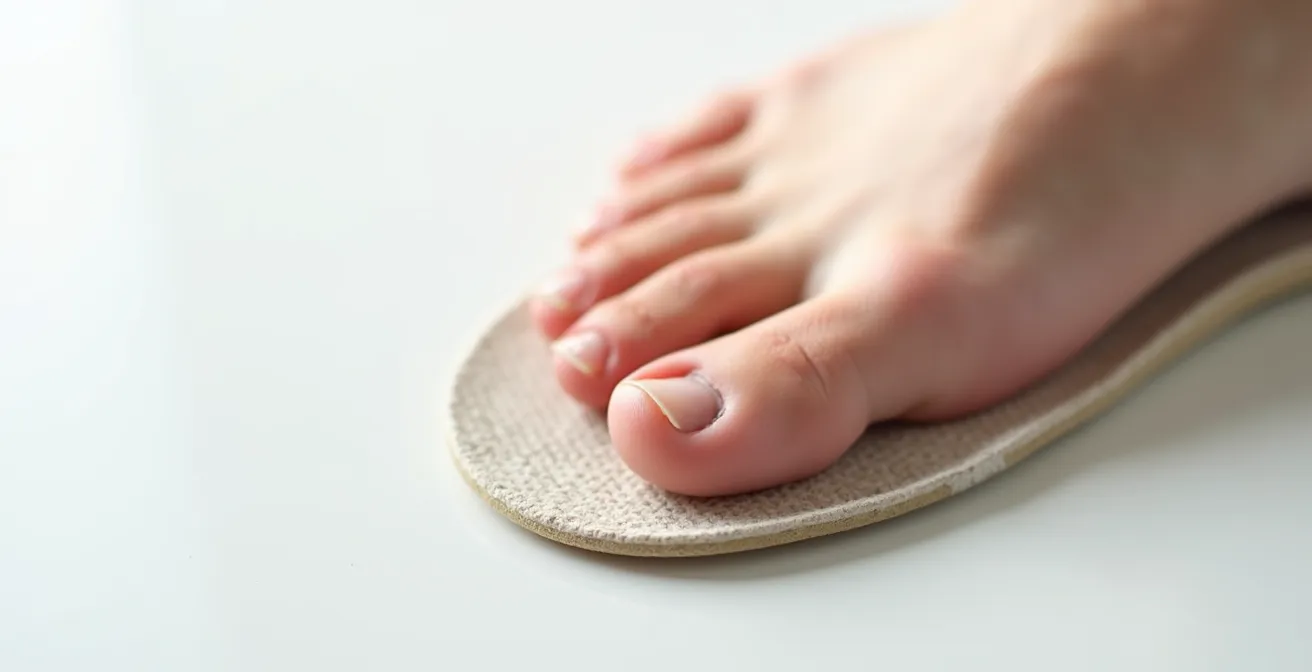
As the image demonstrates, observing how your foot sits on the insole provides an immediate, visual confirmation of fit. This simple diagnostic is far more reliable than just wiggling your toes inside a laced-up shoe. It directly assesses the relationship between your foot’s functional shape and the shoe’s internal platform, which is the true foundation of a proper fit.
Road Shoes on Trail: Why Soft Foam Becomes Unstable on Rocks?
Maximalist road running shoes are engineered for a single purpose: to cushion impact on hard, predictable surfaces like asphalt and concrete. They achieve this with thick stacks of soft, highly responsive foam. While this feels comfortable on the road, that same architecture becomes a significant liability on the trail. Trails are uneven, unpredictable, and littered with obstacles like rocks, roots, and ruts. On this type of terrain, stability and proprioceptive feedback are far more important than maximal cushioning.
Proprioception is your body’s ability to sense its position in space. Your feet are packed with nerves that send constant information to your brain about the ground underneath you, allowing for micro-adjustments that prevent a rolled ankle or a fall. A thick, soft midsole acts like an insulator, dampening this crucial ground-feel. As biomechanical research indicates, shoes with excessive cushion can block this feedback, which may lead to harder, less controlled foot strikes as the body overcompensates for the lack of sensation. This reduces your ability to react quickly to changes in terrain.
Furthermore, the high stack height of a maximalist road shoe creates a longer lever arm, making you more susceptible to ankle rolls. When your foot lands on the edge of a rock or an angled root, the soft foam compresses unevenly, creating an unstable platform that can easily tip over. Trail-specific shoes, in contrast, often have a lower stack height, firmer foam, and sometimes a rock plate. These features provide a more stable, predictable base and allow you to feel the ground, giving you the control needed to navigate technical terrain safely. Using a soft road shoe on a rocky trail is like trying to balance on a mattress—the softness that provides comfort on a flat floor becomes a source of dangerous instability on an uneven surface.
The Valgus Collapse: Why Your Knees Caving In Leads to ACL Risks?
Knee valgus, often described as “knock-knees,” is a critical biomechanical flaw where the knee collapses inward during weight-bearing activities like running, jumping, or squatting. This movement pattern is frequently linked to weakness or poor neuromuscular control of the hip abductor and external rotator muscles, particularly the gluteus medius. When these muscles fail to stabilize the pelvis and femur, the upper leg bone (femur) rotates inward, placing immense rotational and shearing stress on the knee joint. This inward deviation dramatically increases the strain on the ligaments that stabilize the knee, most notably the Anterior Cruciate Ligament (ACL) and the Medial Collateral Ligament (MCL).
The choice of footwear can inadvertently contribute to this dangerous pattern. While maximalist shoes are marketed for their cushioning, some research suggests this feature can have unintended consequences. For example, some studies in recreational runners suggest that ground reaction forces can actually increase in maximalist shoes, potentially as a result of the runner feeling overly confident and altering their form for the worse. The thick foam can disconnect the runner from the ground, impairing proprioception.
This sensory confusion can be a significant problem, as it prevents the neuromuscular system from making the precise, rapid adjustments needed for proper joint alignment. As one leading researcher on the topic explains, this disconnect between perception and reality is a key risk factor.
Shoes with thicker heels confused runners about their gait — confusion that was strongly linked to injury. Runners with thicker heels could not accurately identify how their foot landed with each step.
– Heather Vincent, Ph.D., University of Florida study 2024
If a runner already has a tendency toward valgus collapse, a shoe that masks ground feel can prevent them from consciously or subconsciously correcting their form. The knee continues to cave inward on an unstable platform, stride after stride, accumulating micro-trauma that can eventually lead to a significant ligamentous injury. Therefore, a shoe that promotes stability and proprioceptive awareness might be more beneficial for such an individual than one that simply offers maximal cushioning.
Lug Depth: Deep Cleats vs. Hybrid Tread for Mixed Terrain?
When running on trails, the outsole of your shoe becomes your primary interface with the ground, and lug depth is the most critical variable determining traction. The choice between deep, aggressive lugs and a more moderate, hybrid tread depends entirely on the terrain you frequent. There is no single “best” lug depth; it’s a trade-off between grip on soft ground and stability on hard surfaces.
Deep Lugs (5mm+): These are designed for soft, loose, or muddy conditions. The long, widely spaced cleats act like teeth, digging into the earth to provide a secure foothold. On terrain like thick mud, loose dirt, or wet grass, they are indispensable for preventing slips. However, on hard-packed trails or sections of rock, these deep lugs can become a liability. The tall, narrow rubber studs can squirm or fold under pressure, creating a feeling of instability and accelerating wear.
Hybrid Treads (3-4mm): These shorter, more numerous lugs are the all-rounders of the trail world. They provide adequate grip for most conditions, from hard-packed dirt to light mud and gravel. Their lower profile offers a more stable and comfortable ride on firm surfaces, making them ideal for runs that cover a mix of trail types and even short road sections. For many runners, a hybrid tread offers the most versatile and practical solution.
A shoe’s stack height and firmness also influence the ideal lug depth, as a higher, softer shoe may feel more unstable with aggressive lugs. As compiled from data in biomechanical footwear studies, the relationship can be summarized as follows:
| Shoe Type | Stack Height | Recommended Lug Depth | Rationale |
|---|---|---|---|
| Soft Maximalist Trail | 30mm+ | 3-4mm (shorter/hybrid) | Prevents lug squirm on hard surfaces |
| Firm Low-Profile | 15-25mm | 5mm+ (deeper) | Better ground control with closer foot position |
| Zero-Drop Trail | 10-20mm | 4-6mm (medium) | Balance between grip and stability |
The Outsole Signal: What Uneven Wear Says About Your Gait?
Long before you feel pain, your running shoes are providing clear, objective data about your biomechanics. The wear patterns on the outsole are a diagnostic map of how you distribute force throughout your stride. Learning to read this map is the first step toward understanding your unique gait and selecting footwear that addresses your needs, rather than just following trends. The three most common patterns are overpronation, underpronation (supination), and neutral.
Pronation is the natural inward roll of the foot as it transitions from heel-strike to toe-off. It’s a necessary shock-absorbing mechanism. However, too much or too little can lead to problems. Overpronation is an excessive inward roll, often linked to flat feet, which can place stress on the inner ankle, shin (shin splints), and knee. This is revealed by heavy wear on the inner edge of the shoe’s outsole. Conversely, underpronation (or supination) is an insufficient inward roll, often associated with high arches. This reduces the body’s natural shock absorption and places stress on the outer structures of the foot and leg. It is identified by excessive wear on the outer edge of the shoe.
A neutral gait pattern is characterized by a balanced, S-shaped wear path from the outer heel to the center of the forefoot, indicating efficient shock distribution. Understanding your pattern is the key to selecting the right category of shoe.
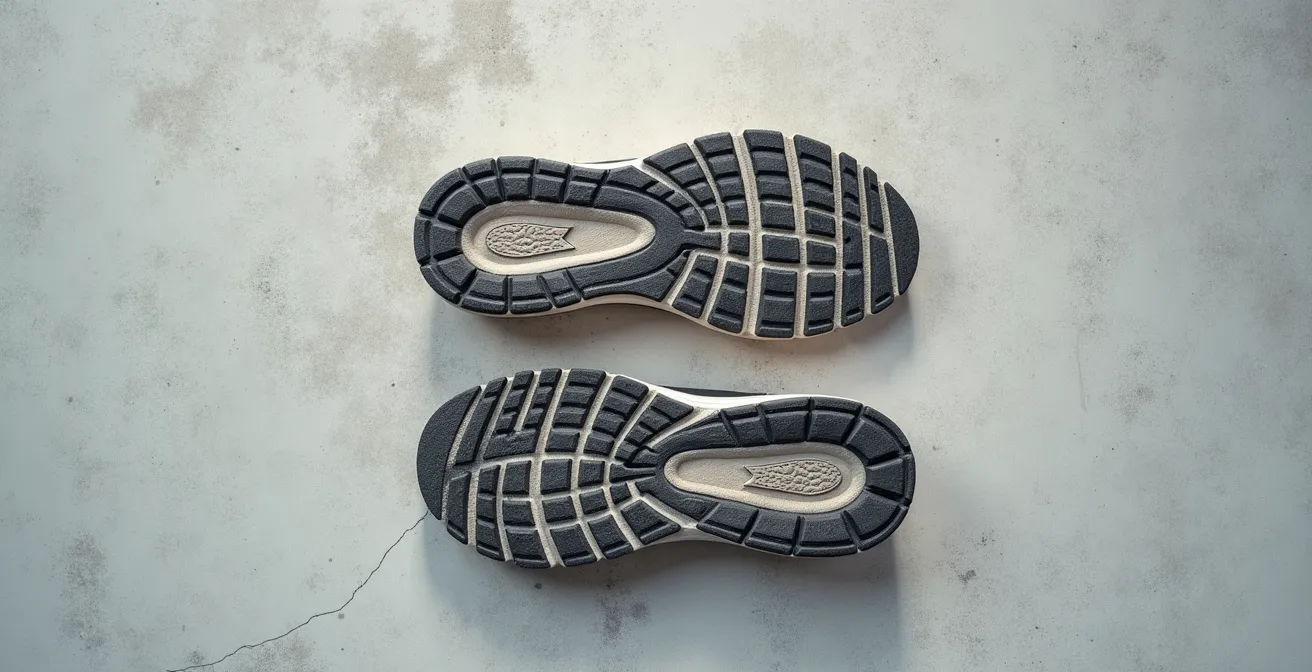
It is critical, however, to interpret this data correctly. As a core principle in sports biomechanics states, the wear pattern is a symptom of your movement, not a problem the shoe can magically fix on its own. A motion-control shoe may help limit overpronation, but it doesn’t address the weak hips or poor neuromuscular control that may be causing it.
Wear patterns are symptoms, not problems the shoe can solve.
– Biomechanics principle, Running injury prevention research
This table, based on gait analysis data from sports clinics, provides a guide to interpreting these signals:
| Wear Pattern Location | Gait Type | Biomechanical Impact | Recommended Shoe Type |
|---|---|---|---|
| Inner side/edge of shoe | Overpronation | Feet roll inward excessively, increased stress on ankles and knees | Motion control with medial support |
| Outer edge of shoe | Underpronation/Supination | Limited natural pronation, reduced shock absorption | Neutral cushioned shoes |
| Central heel and forefoot | Neutral | Balanced weight distribution | Neutral or light stability shoes |
Key takeaways
- Shoe choice should be driven by correcting specific gait inefficiencies (like overpronation or valgus collapse), not just by cushioning levels.
- Transitioning to low-drop shoes requires a gradual, structured protocol to avoid overloading the Achilles tendon and calf muscles.
- Outsole wear patterns are a direct diagnostic signal of your gait mechanics and should be the primary guide for your next shoe purchase.
Shoe Rotation: How Alternating Models Extends Life and Reduces Injury?
The concept of a shoe rotation—alternating between two or more different pairs of running shoes—is one of the most effective and evidence-supported strategies for both injury prevention and extending the life of your footwear. From a biomechanical perspective, running is a highly repetitive motion. Using the exact same shoe for every run means you are loading your body’s tissues in the exact same way, day after day. This can concentrate stress on specific muscles, tendons, and joints, increasing the risk of an overuse injury.
By rotating between different models (e.g., a maximalist cushioned shoe for long, slow days and a lighter, lower-drop shoe for speed work), you introduce variability into the loads placed on your body. Each shoe, with its unique geometry, foam density, and drop, will slightly alter your gait and muscle activation patterns. This variation spreads the stress more evenly across your musculoskeletal system, allowing certain tissues to recover while others are engaged. It’s akin to cross-training for your feet and lower legs.
From a materials science standpoint, rotation also extends the functional life of your shoes. The EVA or TPU foam that makes up a shoe’s midsole requires time to decompress and regain its structural integrity after being pounded during a run. It’s generally accepted that running shoes should be replaced every 300-500 miles. By alternating pairs, you give the foam in each shoe at least 24-48 hours to fully recover its cushioning and responsive properties. This not only ensures you get the protective benefits you paid for with every run but also means the foam degrades more slowly, allowing you to get more quality miles out of each pair. A strategic rotation should include different tools for different jobs: a cushioned model for impact reduction on recovery days, and a more responsive, lower-profile shoe to encourage better form and foot strength on shorter, faster days.
Smart Watch Metrics: Which Data Points Actually Improve Performance?
Modern GPS watches provide a deluge of data, from heart rate to VO2 max to sleep scores. For a runner concerned with knee pain and biomechanics, however, a few key metrics stand out as genuinely useful diagnostic tools: cadence, vertical oscillation, and ground contact time. These data points provide direct insight into your running form and how it’s being influenced by your footwear choices. Instead of being vanity metrics, they can serve as an objective feedback loop to guide your training and shoe selection.
Cadence, or steps per minute, is perhaps the most critical. A low cadence (typically below 170 spm) is often associated with overstriding—landing with your foot too far in front of your body’s center of mass. This acts as a braking force and sends significant shock up the leg to the knee. Increasing your cadence, even by 5-10%, encourages a shorter, quicker stride, promoting a foot strike that is closer to your center of mass and reducing impact forces. When you switch to a lower-drop shoe, for example, you can monitor your cadence to ensure you are adapting your form correctly.
Vertical Oscillation measures how much your torso “bounces” up and down with each stride. While some vertical movement is necessary, excessive bounce is wasted energy and indicates higher impact forces on landing. Ground Contact Time (GCT) measures how long your foot stays on the ground with each step. A long GCT can be a sign of inefficient, “heavy” running. Both of these metrics are influenced by shoe architecture. Recent 2024 biomechanical research found that certain technologically advanced shoes could alter joint forces and encourage a more efficient foot strike pattern without increasing load. By monitoring these metrics on your watch, you can get objective feedback on whether a new pair of shoes is genuinely improving your efficiency or just masking poor mechanics.
To apply these principles effectively, the next logical step is to perform a self-assessment of your gait and current footwear. Begin by analyzing your outsole wear patterns to identify your primary biomechanical signature and use that data to inform your next footwear decision.